10 Myths About Real Estate Tokenization That Still Fool Smart People
Many execs dismiss real estate tokenization with old assumptions. But major institutions are moving in, and governments are building the rules. Here are 10 persistent myths, plus the facts behind each.

Real estate moves slowly, and always has: deals take months and paperwork fills rooms. So when something new like tokenization comes along, people raise an eyebrow, which is fair enough.
But here is what usually happens next. Someone hears "tokenization," connects it to "crypto," remembers a headline about a crashed meme coin, and decides the whole thing is nonsense. That one mental shortcut costs them a real opportunity.
We wrote this article because we keep hearing the same ten wrong ideas, from developers, fund managers, and executives who run serious portfolios. These are not stupid people. They are busy people working with bad information. So let's fix that: ten myths, real data, no hype. If you manage property, run developments, or make decisions about high-value assets, this is for you.
Myth 1: It's Just Another Crypto Trend — It Will Pass
This is myth number one for a reason: it sounds smart. Crypto had booms and crashes, NFTs came and went, so tokenization must be another fad that fades once the hype dies down.
The problem with that logic is who's actually building. Passing trends don't attract the most conservative institutions in finance, but tokenization has. Some of the world's largest asset managers and banks have launched tokenized funds, one of which grew into the billions of dollars within its first year, and are building tokenization systems right now. These are not firms known for chasing memes.
Look further out and the picture is the same. Deloitte's Center for Financial Services has forecast that tokenized real estate could grow from around $300 billion to roughly $4 trillion by 2035, and it isn't the only major forecast pointing that way. We compare the big institutional projections side by side in our RWA tokenization forecast, and they consistently point in one direction. A ten-year, multi-trillion-dollar build-out is not what a passing fad looks like.
Myth 2: Tokens Are the Same as Cryptocurrency
This is one of the most common mix-ups, and it's easy to see why. The word "token" does a lot of work in this industry, and most people first met it through cryptocurrency. So when an executive hears that their building will be "tokenized," their mind jumps straight to Bitcoin, or worse, to some meme coin, and they stop listening. But the difference is simple. Bitcoin has no building behind it; a real estate token does. Bitcoin's price changes with market mood; a real estate token's value is tied to actual rent and property prices. Bitcoin is unregulated in most places; real estate tokens are treated as securities, with all the rules that come with that.
Think of it this way. A share in a real estate company and a share in a tech startup are both "shares," but nobody confuses them. Same idea here: a real estate token and a cryptocurrency are both "tokens," but they work in completely different ways. The blockchain is just the engine under the hood, and you don't need to understand it, just as you don't need to understand the banking network behind a wire transfer to send one.
Myth 3: There Are No Real Regulations — It's the Wild West
Five years ago this was partly true. Today it is outdated, and it's worth walking through what has actually happened recently.
In Europe, the MiCA regulation is now fully live, and authorities have issued licenses across EU member states, with real estate tokens typically falling under the same investment-product rules that cover traditional securities. In the UAE, Dubai's regulators have introduced a specific category for asset-backed tokens, and Dubai's own government land authority has launched a tokenized property platform. When the government runs it, the "Wild West" argument is dead. In the US, new federal legislation for digital assets has passed and the securities regulator is actively updating its rules, while in Asia, Singapore and Hong Kong are running government-backed frameworks for tokenized settlement and digital assets.
Is regulation the same everywhere? No. Every country has its own rules, and that creates real complexity. But anyone who says tokenization has no regulation simply has not checked recently.
Myth 4: If You Buy a Token, You Own the Property
There's some truth here, and that's the problem: the part people get wrong is the part that actually matters.
In most cases you do not get your name on a property deed. Instead, tokens represent shares in a Special Purpose Vehicle, an SPV, usually an LLC or a trust, that owns the property. As a token holder you get economic rights: your share of rent, your share of profit when the property sells, and sometimes voting rights on key decisions.
But is that really unusual? If you own shares in a REIT, you don't own the buildings. If you invest in a private real estate fund, you own units in that fund, not bricks and walls. The structure is the same; the technology is different. What matters is not whether your name is on a deed, but what rights your token actually gives you, whether those rights are clearly defined, and whether they are legally enforceable. In well-structured projects, the answer to all three is yes. The lesson is simple: read the offering documents, always, just as you would with any serious investment.
Myth 5: It Guarantees Liquidity — You Can Sell Anytime
Here we need to be honest, because this myth is sometimes spread by tokenization companies themselves, and that hurts everyone.
Tokenization creates the technical infrastructure for easier trading: a blockchain transaction can settle in minutes, not months. That part is real. But having the technology for liquidity and actually having a liquid market are two different things. For a market to be liquid you need buyers, sellers, a regulated trading venue, and real volume, and all of these are growing but not yet fully mature.
Industry research shows a large share of investors still see limited liquidity as a real barrier. We agree, and we think any honest platform should say this upfront. Progress is happening fast: government-backed regulated marketplaces for trading tokenized property shares have started to open, beginning in the UAE, with more coming in Europe and Asia. The infrastructure that makes secondary trading possible is being built now. The honest answer is that liquidity is improving rapidly but is not instant or guaranteed today, and anyone who promises otherwise is not being straight with you.
Myth 6: It's Too Complicated — Only Tech People Understand This
This myth is usually a few years out of date. It describes the early platforms of 2017 and 2018, which really were confusing: you needed a crypto wallet, you had to understand gas fees, and the interface was built by engineers for engineers. Anyone who tried tokenization back then and walked away has a fair reason to expect the worst. But those days are over.
Today's platforms work like any investment portal: you register, verify your identity, browse properties, choose one, and invest. Everything happening on the blockchain, the smart contracts, the token creation, the ownership record, is invisible to the user, running in the background like the server behind your email.
And it shows in who actually uses these platforms. Early government-backed tokenized offerings have drawn large numbers of ordinary investors from many countries, most of them first-time buyers in that market rather than crypto developers, using a clean and simple interface. If you can use online banking, you can use a tokenization platform.
Myth 7: Tokenization Eliminates All Middlemen
This myth sounds great in theory: blockchain removes intermediaries, peer-to-peer everything, no more lawyers or agents or fees. In practice, anyone who has actually tried to tokenize a property alone runs into the opposite lesson fast: the deal needs more legal and professional support, not less. In the real world of property, people still matter.
What tokenization actually does is automate specific tasks. Smart contracts can distribute rental income automatically, with no accountant doing manual transfers every month; KYC checks can be built into the platform; ownership records update in real time. These are genuine improvements that save time and money.
But someone still needs to manage the property, find and screen tenants, and handle legal disputes, and the legal structuring behind every tokenized project, the SPV, the contracts, the jurisdiction, still requires experienced professionals. Think of it like upgrading from paper accounting to software: your accountant doesn't disappear, their work just gets faster and more accurate. Same thing here.
Myth 8: It's Only for Small Retail Investors
This might be the most backwards myth on the list. People see "buy property from $50" and conclude it's a tool for small-time investors, and they miss the bigger picture completely.
The data tells a different story. Industry research indicates that the majority of capital in tokenized assets comes from institutional investors, not retail. Major banks have launched tokenized private-equity and institutional-grade funds aimed at their high-net-worth and institutional clients, not at small buyers. That is where the serious capital is going.
For property owners and developers, this is where the real opportunity sits. Tokenization gives you a structured, compliant way to sell your existing portfolio to a global investor base, at a premium, because you are offering something the market wants: accessible, transparent, fractional access to quality real estate. Developers have tokenized higher-value residential and commercial assets and reached investors from dozens of countries who would never have gone through a traditional off-plan sales process. That is not micro-investing; it is a new distribution channel for serious property.
Myth 9: It's Basically a REIT — Nothing New
If you know REITs, this comparison feels natural. Both pool real estate investment, and both give you property exposure without buying the whole building. So what is actually different? We break the two down in detail in our tokenized real estate versus REITs comparison, but here are the points that matter most.
With a REIT, you buy a share in a management company that owns many properties, and you have no say in which buildings are in the portfolio. With tokenized real estate, you can choose the exact property you want. REITs trade only during stock-exchange hours; tokenized assets can settle outside those hours where a compliant venue exists. REITs carry management layers and fund-level fees, while tokenized projects can offer more direct access and lower overhead.
But here is the deepest difference, and it matters most for asset owners. If you put your properties into a REIT, you hand control to a fund manager who decides the strategy, the pricing, and the timeline. With tokenization, the asset owner stays in control: you decide what to sell, at what price, and on what terms, and you keep the relationship with your investors. Neither model is "better," they serve different needs, but calling them the same thing is like calling a taxi and owning a car the same thing. Both get you somewhere; the control and the economics are completely different.
Myth 10: Tokenized Real Estate Is Risk-Free
We saved the most dangerous myth for last, because this one can cost people real money.
No investment is risk-free, not stocks, not bonds, not gold, and not tokenized real estate. All the normal risks of property still apply: markets fall, tenants leave, maintenance costs rise, downturns hit values, and disasters happen. These risks exist whether ownership is recorded on paper or on a blockchain.
Tokenization also adds risks of its own, and they're broader than most people expect. Liquidity can dry up, so selling quickly is not always possible, as we said earlier. Regulation can shift and change what's allowed. The platform running the offering can fail if it's poorly built or managed, and custody of the tokens has to be handled properly or access can be lost. Smart contract bugs are on the list too, which is why serious projects get their code audited. The point is that the risks are spread across the whole structure, legal, operational, market, and technical, not concentrated in any one place.
But here is the important part: these risks are manageable. Quality projects use audited smart contracts, work inside clear legal frameworks, partner with regulated custodians, and tell investors what the risks are, because trust matters more than a sale. If someone tells you tokenized real estate is a guaranteed way to make money with zero risk, walk away. That is not tokenization talking, that is a bad salesperson.
Real estate tokenization is not magic, it is infrastructure. Good infrastructure makes transactions safer, faster, and cheaper, but it does not change what real estate fundamentally is: an asset with real rewards and real risks.
The Bottom Line
Tokenization is not perfect. It has real challenges: liquidity is still growing, regulation differs between countries, and the technology is still maturing. We said that honestly in this article, and we meant it. But the myths we covered today belong in 2020, not today.
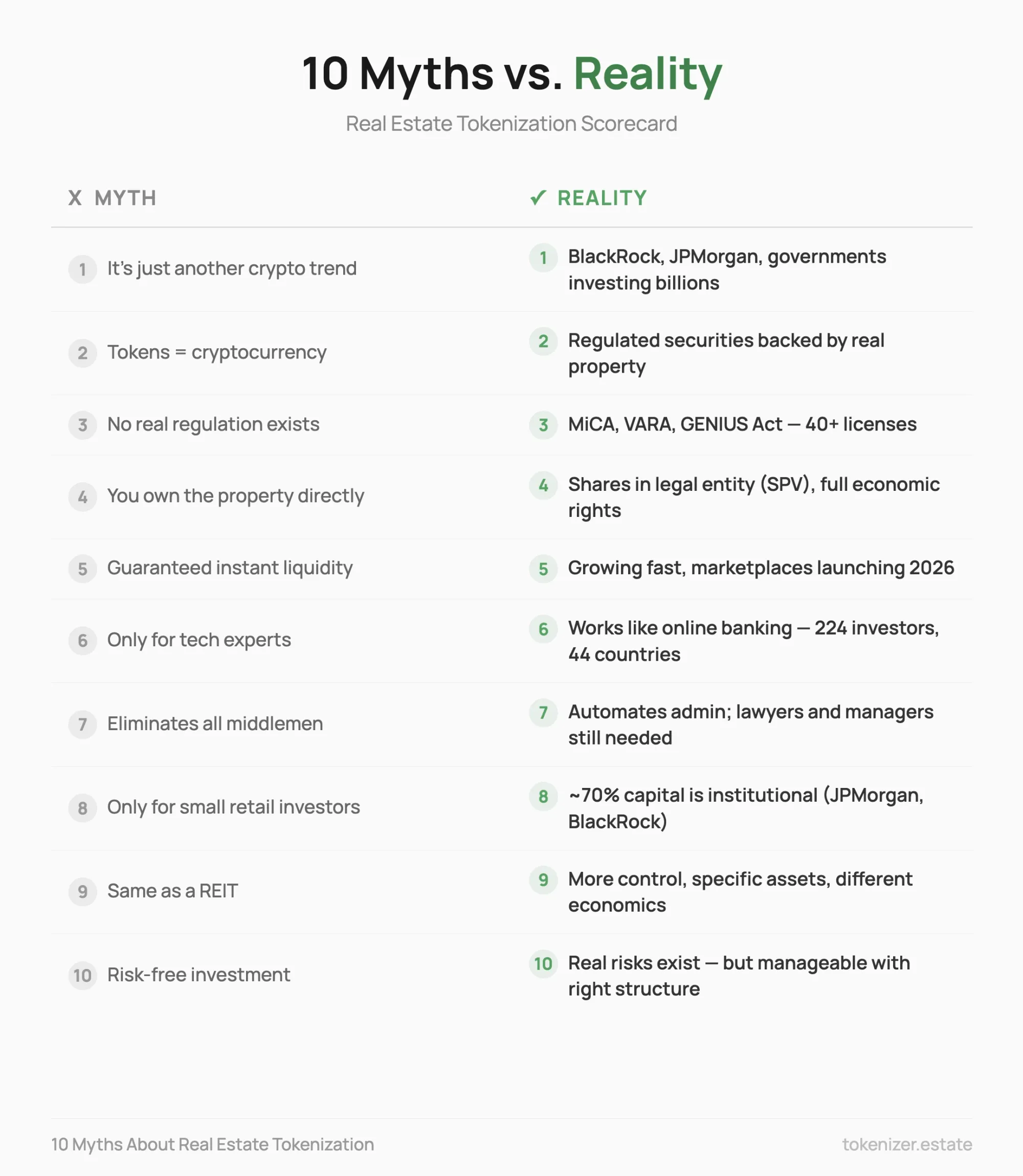
The facts are clear. The largest institutions in finance are investing serious money, governments in the UAE, Europe, and Asia are building regulatory frameworks, independent forecasts project trillions of dollars in tokenized real estate over the next decade, and every month more real deals close with real buildings and real investors.
For people who work with high-value assets, whether that's a portfolio of residential buildings, a hotel chain, a marina, or an industrial complex, the window for early movers is closing, not because tokenization will disappear, but because your competitors are starting to figure it out. You don't need to understand blockchain or love crypto. You just need to look at the data and ask yourself one question: is this something you want to lead, or something you want to react to later?
This article is for informational purposes only and does not constitute investment, legal, or financial advice. Tokenized real estate is a security in most jurisdictions and carries market, liquidity, regulatory, and technology risk. Do your own due diligence and consult qualified professionals before issuing or investing.
Share this post
Build your own tokenization business with Tokenizer.Estate
Tokenizer.Estate provides a full end-to-end solution — from legal setup to blockchain infrastructure — to help you launch your project with confidence
Book a Free Consultation