White Label Real Estate Tokenization Platform: How It Works, What It Costs, and Who It Is For
You own the asset — but the capital is locked. A white label tokenization platform lets you convert real estate equity into digital tokens, reach global investors, and automate distributions without hiring a blockchain team. Here's how the infrastructure works and who it's built for.


You own a commercial building in a growing city. A family office in Singapore asks if they can invest. A fund manager in the Gulf is interested in a share. Right now, there is no clean way to make either of those deals happen — not without selling the whole asset, restructuring ownership manually, or spending months on legal paperwork.
A white label tokenization platform changes that. It converts ownership rights in your asset into digital tokens on a blockchain, so qualified investors anywhere in the world can buy a share, hold it securely, and receive distributions automatically. No intermediaries doing paperwork by hand. No geography limit.
This article explains how the Tokenizer.Estate white label platform works, what modules it includes, who it is built for, and what it costs to get started.
What the Problem Actually Is
Traditional capital raises have a geography problem and a friction problem.
Geography: your investors are mostly local, or in your existing network. You are not reaching pension funds in Southeast Asia, family offices in the Gulf, or high-net-worth individuals in Europe — because there is no practical mechanism to include them in a deal structured for a local market.
Friction: even when you find the right investor, the process is slow. Legal documents, wire transfers, manual cap table management, quarterly distribution calculations. Every step has a cost and a delay.
Tokenization solves both at once. And a white label platform is the infrastructure that makes it work under your own brand, without you needing to build anything from scratch.
If you are new to the concept, our guide on how to tokenize real estate covers the fundamentals.
Four Modules That Do the Heavy Lifting
Tokenizer.Estate is built specifically for real estate tokenization — not a generic blockchain tool adapted after the fact. The platform has four core modules, each solving a specific operational problem.
Back Office Asset Management
The command center. Real-time data and transaction monitoring across all your assets. Investor request handling, portfolio analytics, and role-based access — different people on your team see only what they need. All actions are logged in an auditable trail, and private keys are stored on separate secure infrastructure.
Smart Contract Generator
The part that removes the biggest technical barrier. Normally, deploying smart contracts requires a Solidity developer — expensive, hard to find, slow to onboard. This module lets you manage token sale stages with a few clicks. The contracts are audited, handle dividend distribution and token redemption automatically, and run as permissioned tokens on widely supported, EVM-compatible blockchains, so they carry compliance rules inside the token while staying compatible with mainstream wallets and infrastructure.
Investor Dashboard
What your investors see. Fully branded for your company — your logo, your colors, your domain. Investors get a clean, secure interface where they purchase tokens, track holdings, and access redemption or buyback options. The dashboard integrates both traditional payment providers and crypto payments.
Custom Landing Page
Every tokenization project needs a public face. The platform includes a website builder with 30+ ready-to-use blocks, light and dark mode, and SEO optimization. No separate web agency needed.
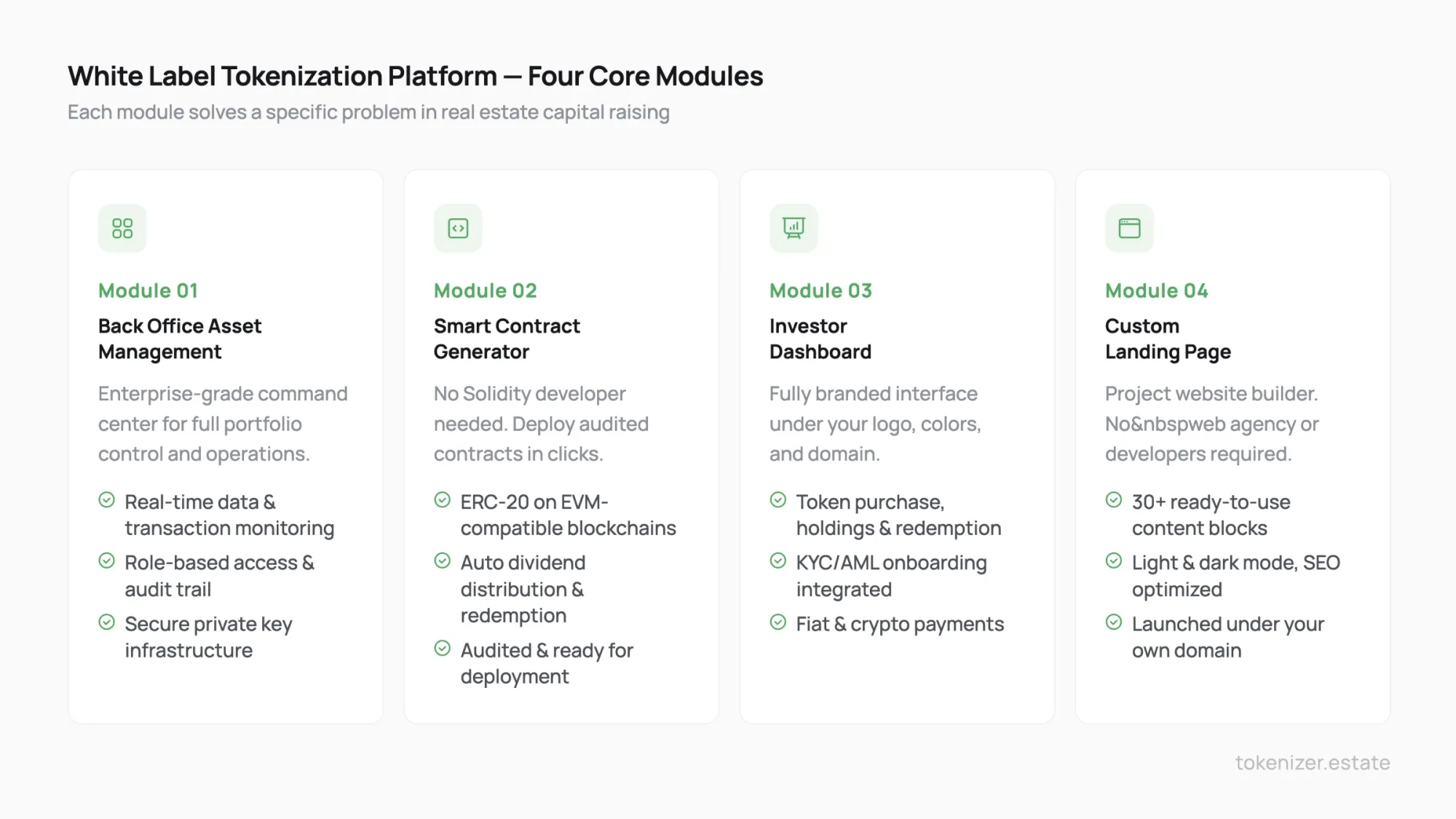
Each module solves a specific problem in real estate capital raising
Who Is This Platform Actually For?
The platform covers five use cases. The value proposition differs depending on your situation.
Property Developers. You need to pre-sell or raise capital before construction completes. Tokenization gives you access to a global pool of investors instead of depending on one anchor buyer or a single construction loan. You shorten your sales cycle and reduce concentration risk.
Real Estate Firms. You manage a portfolio and want to offer fractional ownership. The platform automates KYC/AML onboarding, cap table management, and distribution payments. You offer innovative investment products without building the infrastructure.
High-Net-Worth Individuals. You own a high-value asset — a building, a portfolio, a marina. Tokenization lets you unlock partial liquidity without a full sale. Tokenize 20–30% of the equity, raise capital from global investors, and keep full operational control.
Real Estate Investment Funds. You manage a fund and want to broaden your investor base beyond existing institutional relationships. A tokenized fund structure gives you retail access with automated dividends and transparent blockchain reporting.
Financial Institutions. Banks, family office platforms, or financial intermediaries that want to offer real estate tokenization as a service to clients. You present it as your own product. The underlying infrastructure is Tokenizer.Estate's — the brand and the client relationships are yours.
For a deeper look at how tokenization can work as a standalone business model, see our article on real estate tokenization as a business.

The Compliance Infrastructure You Actually Need
This is what separates a serious platform from a proof of concept.
Tokenized real estate equity is a security in most jurisdictions. You cannot issue tokens to investors in the EU, the Gulf, or Southeast Asia without complying with the rules of those markets. Getting this wrong means legal exposure for you and risk for your investors.
Tokenizer.Estate builds compliance into the platform market by market, rather than relying on a single generic KYC form. The platform is designed to support structured tokenization wherever it is legally permitted, adapting to local requirements rather than forcing every deal through one template, and new jurisdictions are added as demand appears.
Each jurisdiction has different rules about what a token can represent, who can buy it, how transfers work, and what documentation is required. The platform is built to handle that variation, so when you launch, you are not starting from zero on compliance.
How Big Is the Real Estate Tokenization Market?
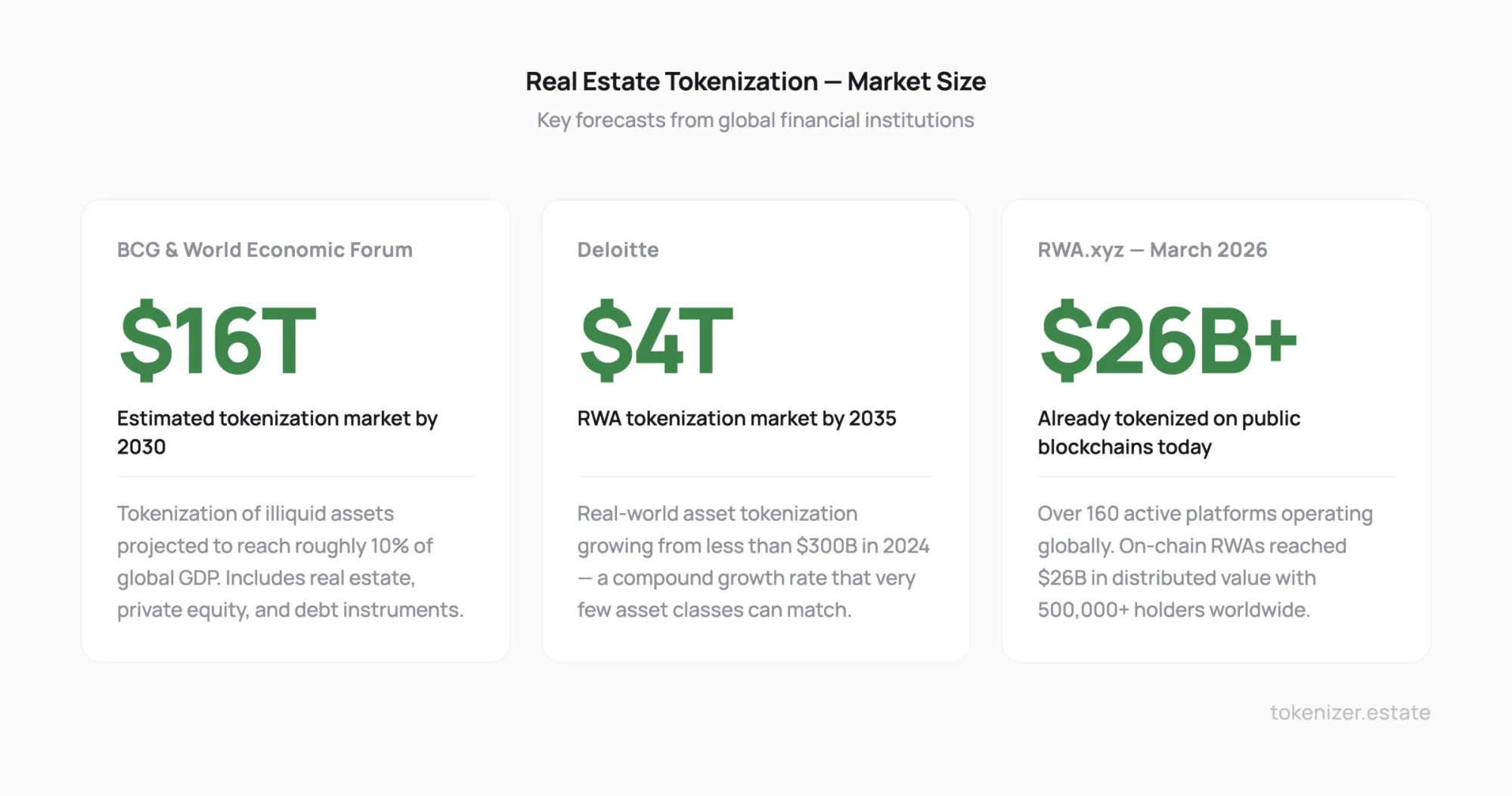
$16 trillion — projected tokenization market by 2030 (BCG / World Economic Forum), roughly 10% of global GDP.
$4 trillion — real-world asset tokenization market by 2035 (Deloitte).
Billions — already tokenized on public blockchains today, across a growing number of active platforms and holders worldwide.
The early movers — developers, fund managers, and asset owners who set up their own tokenization infrastructure now — build compounding advantages. They establish a global investor base and create a distribution channel that gets more efficient over time.
For a full analysis of these projections, read our RWA tokenization forecast.
What "White Label" Means in Practice for You
It is worth being specific.
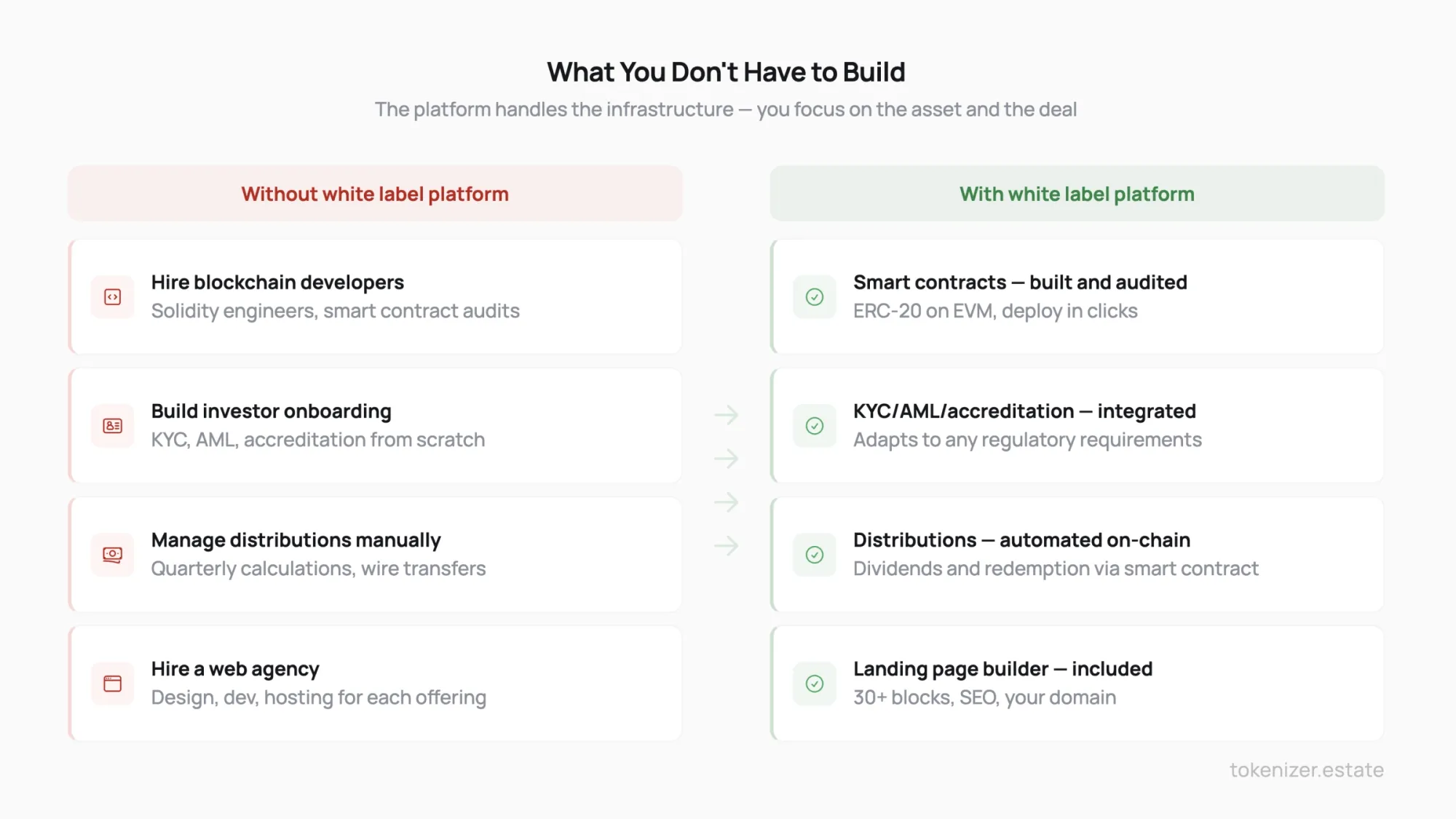
You do not hire blockchain developers. The smart contract infrastructure is built and audited.
You do not build investor onboarding from scratch. KYC, AML, and accreditation checks are integrated.
You do not manage distributions manually. Smart contracts handle this automatically.
You do not need a web team for your offering's landing page. The builder is included.
You focus on the asset itself, the deal structure, the investor relationships, and the commercial strategy. Everything else runs on the platform.
The platform is branded as yours. Your investors see your name, your design, your domain. The technology is Tokenizer.Estate's — but that is invisible to the outside world.
Structured tokenization with local regulatory frameworks, wherever tokenized real estate is permitted
How Much Does a White Label Tokenization Platform Cost?
The platform operates on a one-time license model. You purchase the platform once, deploy it under your brand, and pay a monthly fee for ongoing support and infrastructure maintenance. There are no revenue-share arrangements or per-transaction fees on your capital raises.
This is important: you keep 100% of what you raise. The platform provider earns from the license and support — not from your deal flow.
The exact cost depends on your configuration — number of jurisdictions, modules required, and compliance setup. Our pricing page has a detailed cost breakdown that covers the full picture, including legal and compliance costs.
Why Choose Tokenizer.Estate as Your Platform Provider?
Three facts that matter for your decision:
Real estate focus, not generic blockchain. The platform was designed by a team that understands property deal mechanics — legal structures, investor relations, compliance requirements — and built technology to match. Most blockchain companies do not understand real estate. Most real estate tech companies do not understand blockchain compliance. Both are present here.
Compliance built market by market. Not a single KYC form with a blockchain wrapper, but real regulatory frameworks adapted to each market where a deal is done, wherever local rules permit tokenized real estate.
10+ years of combined experience across blockchain, finance, and real estate. Headquartered in Dubai, operating from the market where tokenization has government-level support. The platform is actively being deployed by clients across multiple markets right now — this is not a roadmap slide.

Frequently Asked Questions
What is a white label tokenization platform?
A white label platform is a ready-built software solution that you deploy under your own brand. Your investors see your company name, your logo, and your domain — not the technology provider behind it. You get the full infrastructure for tokenizing real estate (smart contracts, investor dashboard, KYC/AML, landing pages) without building it from scratch.
How long does it take to launch a tokenized offering?
With the platform already built, the main variables are legal structuring and compliance setup for your specific jurisdiction. Typical deployment timelines range from a few weeks to a couple of months, depending on the asset type and target market.
Do I need blockchain developers on my team?
No. The smart contract generator handles token creation, dividend distribution, and redemption without writing code. The contracts are pre-audited and run as permissioned tokens on widely supported, EVM-compatible blockchains.
Which blockchains does the platform support?
The platform uses permissioned tokens on widely supported, EVM-compatible blockchains. This means your tokens carry their compliance rules internally while still working with existing wallets and infrastructure. For what actually runs inside that token, see smart contracts for real estate tokenization.
Can I tokenize only part of my property?
Yes. Many asset owners tokenize 20–30% of the equity to raise capital while retaining full operational control. The percentage is entirely your decision and depends on your capital needs.
Is real estate tokenization legal?
Yes, in all jurisdictions where Tokenizer.Estate operates. Tokenized real estate equity is treated as a security, and the platform includes the compliance infrastructure required for each supported market. For a deeper look at the regulatory landscape, see our article on common myths about tokenization legality.
What does an investor need to participate?
Investors go through KYC/AML verification on the investor dashboard, fund their account via traditional payment methods or crypto, and purchase tokens. The process is designed to be as straightforward as signing up for any modern financial platform.
What happens after the tokens are sold?
Smart contracts handle distribution of rental income or dividends automatically. Investors can track their holdings, view performance data, and access redemption or buyback options through the dashboard. You manage the asset — the platform manages the investor infrastructure.
One Thought to Close With
If you have a specific asset in mind, a building you would like to partially liquify, a development you need to fund, or a portfolio you want to open to international investors, the next step is a consultation.
On that call, the Tokenizer.Estate team walks through your specific use case: your asset type, your target jurisdiction, your investor base. You leave with a clear picture of what the setup looks like and what it costs.
Share this post
Build your own tokenization business with Tokenizer.Estate
Tokenizer.Estate provides a full end-to-end solution — from legal setup to blockchain infrastructure — to help you launch your project with confidence
Book a Free Consultation