Real estate tokenization in Brazil 2026: Latin America's biggest market makes its move
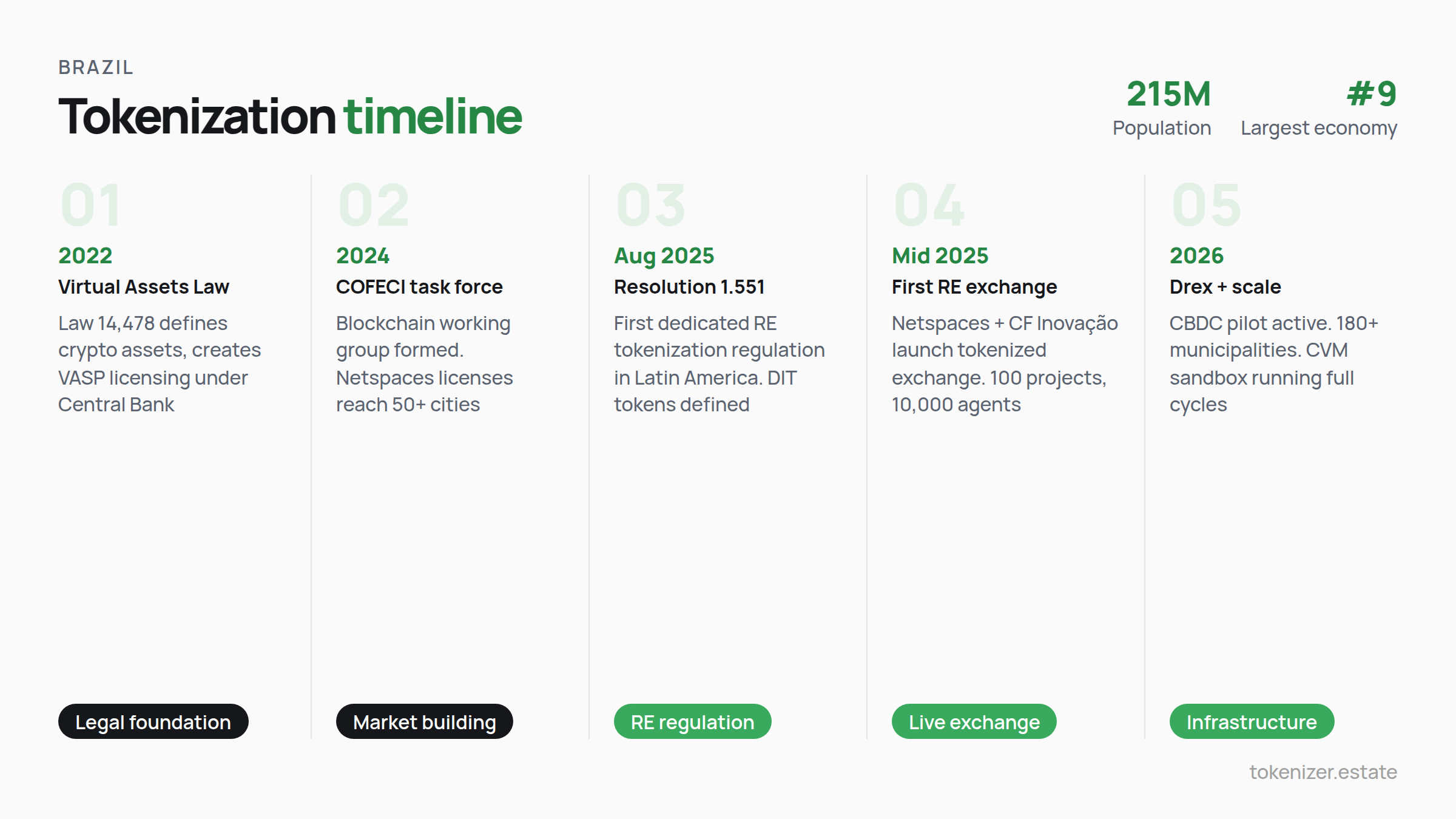
Brazil is not experimenting anymore. COFECI published the first real estate tokenization regulation in Latin America. Netspaces operates in 180+ municipalities. Drex — the CBDC — settles token trades instantly. This is the practical picture for asset owners in the largest property market in LATAM.

Brazil is not the first country people think of when they hear "tokenization." They think of Dubai, Singapore, maybe Switzerland. But in 2026, Brazil is doing something none of those countries have done yet: it has a dedicated real estate tokenization regulation, a government-backed CBDC designed to work with tokens, and a live tokenized real estate exchange — all in a market of 215 million people with one of the largest property sectors on earth.
Brazil is not experimenting anymore. It is building infrastructure. And the scale of what is happening here will surprise you.
Why Brazil matters for tokenization right now
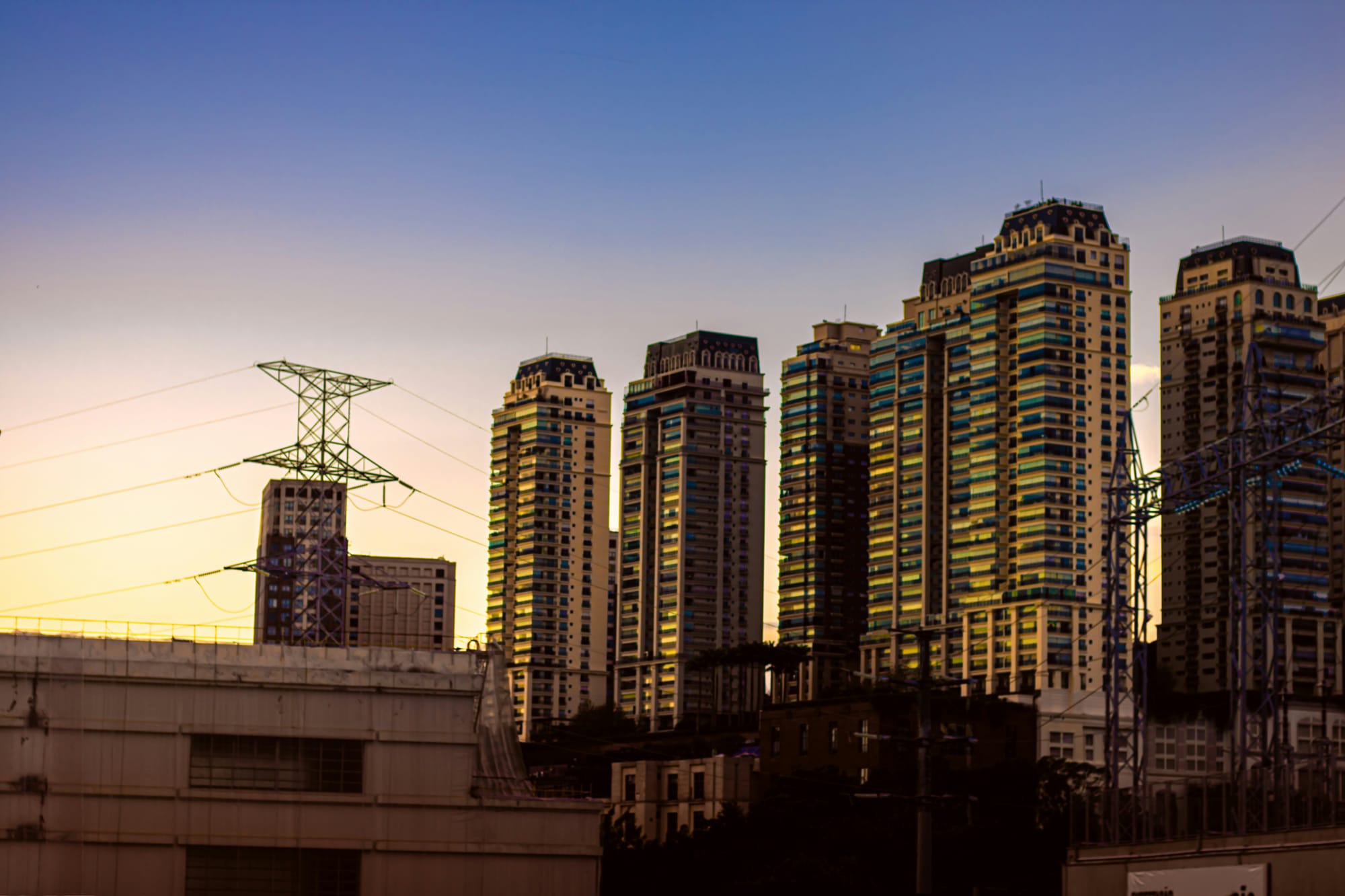
Brazil has the ninth-largest economy in the world and the largest real estate market in Latin America. Property is everywhere — from dense urban centers like São Paulo and Rio de Janeiro to fast-growing coastal cities like Florianópolis and Balneário Camboriú. For decades, investing in Brazilian real estate meant large capital, local connections, and paperwork that could take months. Tokenization is changing that equation.
But the real reason Brazil matters is not the market size. It is the regulatory speed.
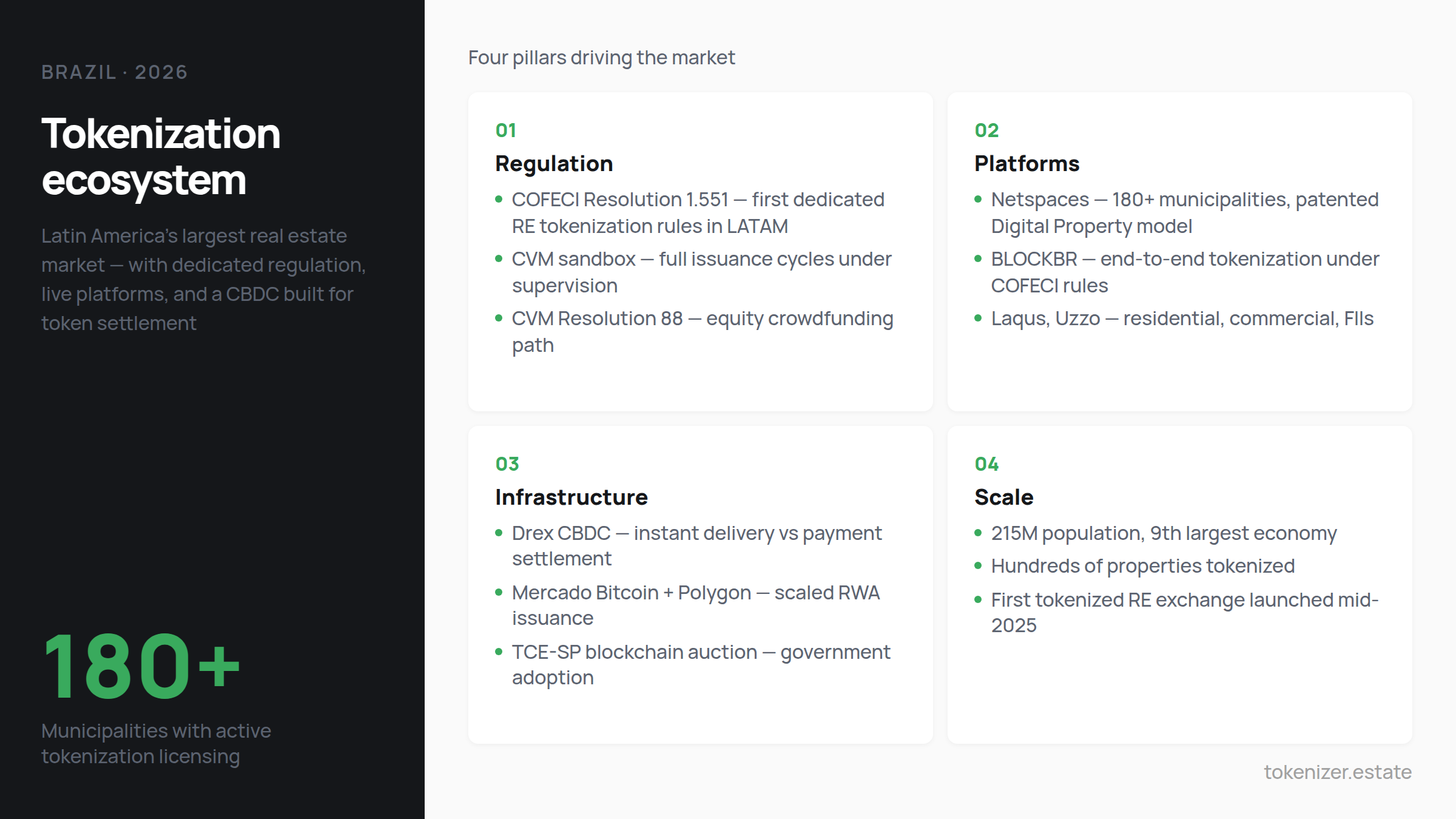
In August 2025, COFECI — the Federal Council of Real Estate Brokers — published Resolution 1.551, the first regulation in Latin America that specifically governs real estate tokenization. This was not a general crypto rule applied to property. It was a dedicated framework that defines what a digital real estate token is, who can issue it, what platforms need to be licensed, and how investor protection works.
At the same time, the CVM — Brazil's securities regulator, equivalent to the SEC — has been running a regulatory sandbox where tokenized real estate projects go through full issuance and distribution cycles under supervision. CVM Resolution 88 already governs equity crowdfunding including tokenized offerings, giving issuers a clear path to raise capital from investors using tokens.
And then there is Drex.
Drex — the CBDC designed to work with tokens
Most countries developing central bank digital currencies are thinking about payments. Brazil is thinking bigger.
Drex is Brazil's digital currency, developed by the Central Bank of Brazil (Banco Central). It is built on a blockchain-compatible infrastructure with a specific feature that matters enormously for real estate: delivery versus payment.
In simple terms, this means that when a buyer purchases a tokenized property share using Drex, two things happen at exactly the same time — the token moves to the buyer and the payment moves to the seller. No waiting for bank clearance. No escrow held by a third party. The transaction settles instantly, atomically, on the ledger.
For anyone who has ever waited three months for a property transaction to close — with lawyers, notaries, and banks all taking their time and their fees — this is a fundamental shift. Drex is not just a digital currency. It is the settlement layer that makes tokenized real estate transactions instant and final.
The Central Bank originally planned to launch Drex for consumers in 2025. The timeline has shifted, but the testing is real — major Brazilian banks are participating in the pilot, and the infrastructure is being built to connect directly with tokenized asset platforms.
What is actually happening on the ground
This is not a story about plans and pilots. Real projects are running.
Netspaces is the most visible player. Founded in São Paulo, Netspaces created and patented the "Digital Property" concept — a legal and technical framework for tokenizing real estate ownership on blockchain. By early 2026, Netspaces operates in over 180 Brazilian municipalities through a licensing model. Local entrepreneurs, developers, and real estate agents can license the platform and offer tokenized property transactions in their city.
The numbers tell the story: the first tokenized property in Brazil — a commercial office in Porto Alegre's tallest building — attracted over 400 owners within 120 days. An 82-year-old woman used an NFT to buy 20% of an apartment in Rio Grande do Sul. These are not crypto traders. These are ordinary people accessing property ownership for the first time through fractions.
In mid-2025, Netspaces and CF Inovação — a firm led by a former Central Bank director — formed a joint venture to launch what they describe as the world's first tokenized real estate exchange. The platform went live during the Blockchain Real Estate Summit in São Paulo in June 2025, starting with 100 developers, 10,000 real estate agents, and 100 tokenized projects in its first phase.
BLOCKBR is another key infrastructure player, offering end-to-end tokenization services — from legal structuring and smart contract development to token issuance and custody. BLOCKBR works specifically within the COFECI regulatory framework, helping platforms get licensed as PITDs (Plataformas Imobiliárias para Transações Digitais) — the official category of authorized real estate tokenization platforms in Brazil.
Laqus focuses on residential and commercial properties under CVM guidelines. Uzzo specializes in tokenized Real Estate Investment Funds (FIIs). And Mercado Bitcoin, one of the largest crypto exchanges in Latin America, partnered with Polygon Labs to scale tokenized RWA offerings — positioning São Paulo as the hub for regulated blockchain-based asset issuance in the region.
For a broader view of how tokenization platforms connect across legal structure, issuance, custody, and secondary markets globally, the market map on the Tokenizer blog explains the full four-layer ecosystem.
The legal structure: what a Brazilian real estate token actually represents
Here is the most important thing to understand about Brazilian real estate tokenization in 2026: holding a token does not automatically mean owning the property.
Brazil's property registry system (cartório) still requires ownership to be formally recorded at the local registry office, typically through a notary. This has not changed. A token on a blockchain is not — by itself — a title deed. The legal truth about who owns a building lives in the registry, not on-chain.
So what does a token represent?
In most Brazilian tokenization deals, the token represents one of three things: a share in an SPV (company) that owns the property, a right to receive income from the property (like rent), or a participation in a crowdfunding structure under CVM Resolution 88. The structure matters because it determines what legal rights the investor actually holds and how disputes are resolved.
COFECI's Resolution 1.551 introduced the concept of the DIT — Digital Imobiliário Token — which officially represents rights to real estate in digital form. But the resolution also drew criticism from IRIB (the Brazilian Real Estate Registry Institute), which argued that COFECI overstepped its authority and that the resolution has constitutional problems. The debate is ongoing.
What this means practically: tokenization in Brazil works, but it works within the existing legal system, not outside it. The token is a layer on top of the registry — it makes investing faster, cheaper, and more accessible, but it does not replace the notary or the cartório. Developers and asset owners who understand this distinction build stronger deals. Those who pretend the blockchain replaces the legal system run into problems.
The tax picture
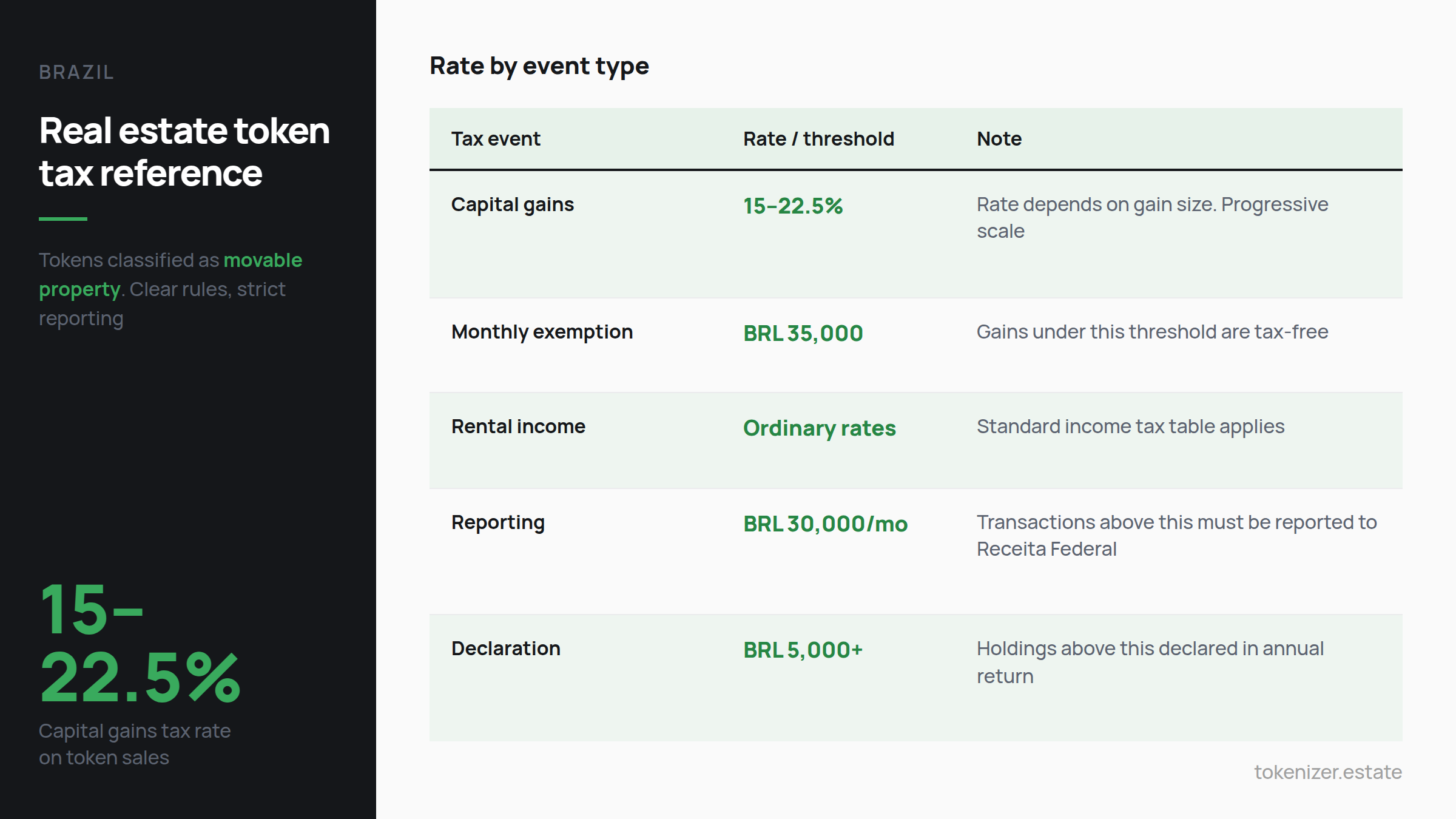
Brazil treats crypto assets — including real estate tokens — as movable property for tax purposes. Here is what that means for investors.
Capital gains on token sales are taxed at 15% to 22.5%, depending on the size of the gain. Monthly sales generating gains up to BRL 35,000 (roughly $6,500) are exempt. Investors must declare their crypto holdings in the annual tax return when acquisition cost exceeds BRL 5,000.
Rental income received through tokens is taxed as ordinary income, following the standard Brazilian income tax table.
Companies and individuals must report crypto transactions exceeding BRL 30,000 per month to the Receita Federal (Brazil's tax authority). Non-compliance can result in fines ranging from BRL 1,500 to 3% of the undeclared amount.
The tax framework is clear but strict. Brazil does not have a zero-tax tokenization incentive like Singapore or the UAE. What it offers instead is certainty — rules that exist, are enforced, and that investors can plan around.
For a comparison of how different jurisdictions handle tokenized real estate taxes — including the US, Germany, Singapore, and UAE — the tax guide on the Tokenizer blog covers the practical details side by side.
What still does not work — and what to watch for
Brazil's tokenization market is moving fast, but it is honest to say that several things are still in progress.
Registry integration is not solved. The gap between on-chain token ownership and off-chain property registry remains the biggest structural challenge. Until Drex and the cartório system are connected — so that a token transfer automatically updates the official registry — there will be two parallel records of ownership. This creates risk, especially in disputes.
Liquidity is thin. Secondary markets for tokenized real estate in Brazil exist but are still small. Most tokens are bought and held. If you need to exit quickly, you may not find a buyer at the price you want. This is not unique to Brazil — it is the reality in every tokenization market in the world right now — but it matters for investors who expect stock-like trading.
COFECI vs IRIB. The tension between the real estate brokers' council (which issued the tokenization rules) and the registry institute (which says those rules overstep legal boundaries) is unresolved. This creates regulatory uncertainty for platforms operating under COFECI licenses. The outcome of this debate will shape the next phase of the market.
Drex timeline. The digital currency is still in testing. When it launches for consumers and connects to tokenization platforms, it will transform settlement. But "when" is not yet "now."
Despite these gaps, the direction is clear. Brazil has more regulatory infrastructure for real estate tokenization than any other country in Latin America — and more than many countries in Europe.
Blockchain in government: not just tokenization
One signal that Brazil is serious about blockchain in property: in December 2025, the Court of Auditors of São Paulo held the country's first public property auction where every document was recorded on a blockchain. The auction covered ten state-owned warehouses, and the blockchain served as a tamper-proof record of every bid, contract, and transfer.
This was not about tokens or fractional ownership. It was about trust. In a country where document tampering in real estate auctions has been a known problem, putting the record on an immutable ledger solves a real issue. And it shows that Brazilian government institutions are not just talking about blockchain — they are using it in high-stakes property transactions.
Who should be paying attention
Brazil's tokenization market is relevant for three types of decision-makers.
Brazilian developers and asset owners who have capital locked in property and want to raise money from a wider investor base — including international investors — without giving up control. Tokenization lets you sell 20% of your building to 500 investors across 14 countries, while keeping 80% and managing the asset yourself. The legal tools to do this in Brazil now exist.
International investors and fund managers looking for exposure to the largest real estate market in Latin America. Tokenization lowers the entry barrier from millions of reais to thousands. It also brings transparency — rental income, occupancy rates, and ownership records are visible on-chain in a way that traditional Brazilian real estate deals never offered.
Asset owners in adjacent sectors — logistics operators, agribusiness, hospitality, industrial facilities, even marina and yacht operators — who have valuable, income-producing assets and want to unlock capital without selling. Tokenization is not just for residential buildings. Any asset that generates income and can be placed into an SPV can be tokenized.
The infrastructure exists. The regulation is forming. The investors are arriving. The question for anyone holding real assets in Brazil is the same as it is everywhere: do you move now while the market is early, or do you wait and explain to your investors why you were late?
Stay current on tokenization developments across Brazil and other jurisdictions at Tokenizer.Estate News.
This article is for informational purposes only and does not constitute legal, tax, or investment advice. Regulations in Brazil are evolving. Always consult qualified local legal and tax professionals before making structuring decisions.
Share this post
Build your own tokenization business with Tokenizer.Estate
Tokenizer.Estate provides a full end-to-end solution — from legal setup to blockchain infrastructure — to help you launch your project with confidence
Book a Free Consultation