Secondary Market Trading: How to Buy and Sell Property Tokens
You own a share in a tokenized hotel. Life changes, you need capital. With traditional real estate, you wait months. With token secondary markets, you trade the same day. This guide covers how it works, where to trade, what affects liquidity, and the risks nobody talks about.

Imagine you own a share in a luxury hotel in Aspen, Colorado. Not the whole hotel — just a small piece of it, represented by a digital token on a blockchain. Life changes. You need capital. In traditional real estate, you are stuck. You cannot sell just your fraction. You wait for the whole property to sell, or you find a buyer yourself — and that takes months, sometimes years.
With tokenized real estate, there is a different option. You open a platform, list your tokens, find a buyer, and complete the trade — often the same day. The property does not move. The investors do not need to meet. The blockchain handles everything in between.
This is the secondary market for property tokens. And in 2026, it is not just a concept anymore. It is a real, regulated, and growing market. Not yet as liquid as stocks — but working, and improving fast.
This article walks through how the secondary market works, where to find it, how to actually buy and sell, and what to watch out for.
Why Your Capital Is Stuck — and What Finally Changed
Real estate has always been one of the strongest long-term investments. But it has always had one serious weakness: you cannot get your money out quickly.
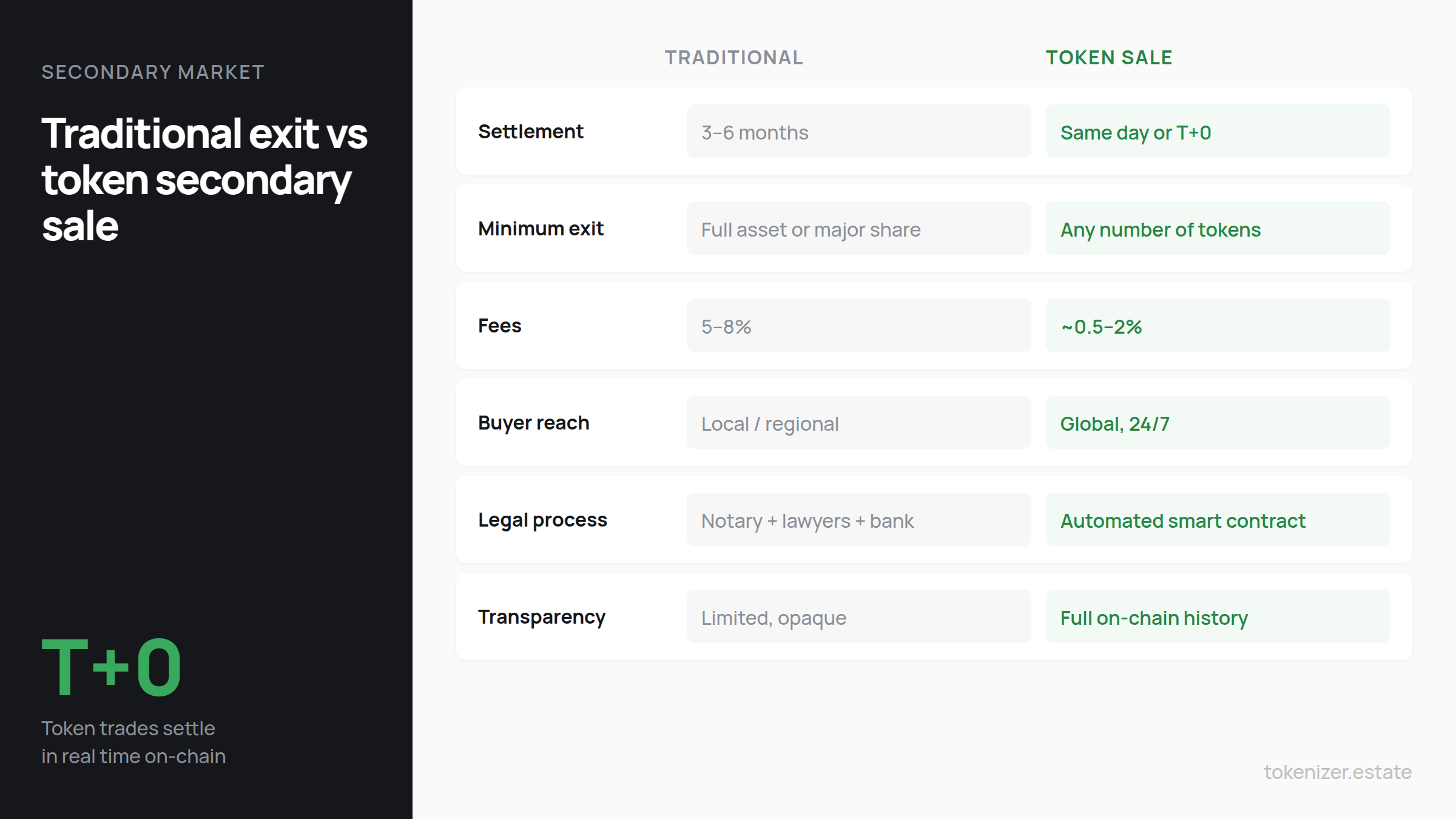
If you put $2 million into a commercial building, that capital is locked. You cannot sell 15% of the building to cover an unexpected need. You cannot exit in a week. A normal property transaction takes 3 to 6 months, involves lawyers, notaries, banks, and title searches, and costs 5 to 8% in fees on top of everything else.
Investors in private real estate funds and syndicates have an even harder time. They are often locked in until the sponsor decides to sell the asset — which can be five to ten years. If they want out early, the options are limited and usually unfavorable.
This is illiquidity. And for most of real estate's history, it was simply part of the deal.
Tokenization changes the structure of the problem. When a property's ownership is converted into digital tokens — each representing a fractional legal share — those tokens can be transferred between investors on a secondary market. The property itself does not change. What changes is how ownership moves: not through a law firm over three months, but through a platform, in real time.
The secondary market is where that transfer happens.
It's Not Crypto Trading. Here's How It Actually Works
The secondary market for property tokens works similarly to a stock exchange — but for fractional real estate.
When a developer tokenizes an asset and sells tokens to investors for the first time, that is the primary market. The developer raises capital; investors receive tokens.
The secondary market is everything after. When one investor wants to exit and another wants to buy in, they use the secondary market. The developer is not involved. The asset does not move. Only the token changes hands — and with it, the legal ownership rights, the right to receive rental income, and any governance rights the token carries.
The key difference from traditional property trading is compliance. Real estate tokens are securities. That means every transfer must check investor eligibility, verify identities, respect transfer restrictions, and be recorded in a compliant way. Unlike crypto trading, you cannot send property tokens to an anonymous wallet. The buyer must be verified. The platform must confirm that the transfer is legal in both jurisdictions.
This is what makes secondary market trading for property tokens different from buying Bitcoin — and also what makes it trustworthy enough for institutional investors to participate.
How the Trading Mechanics Work
Once you understand what secondary markets are, the next question is: how does a trade actually happen?
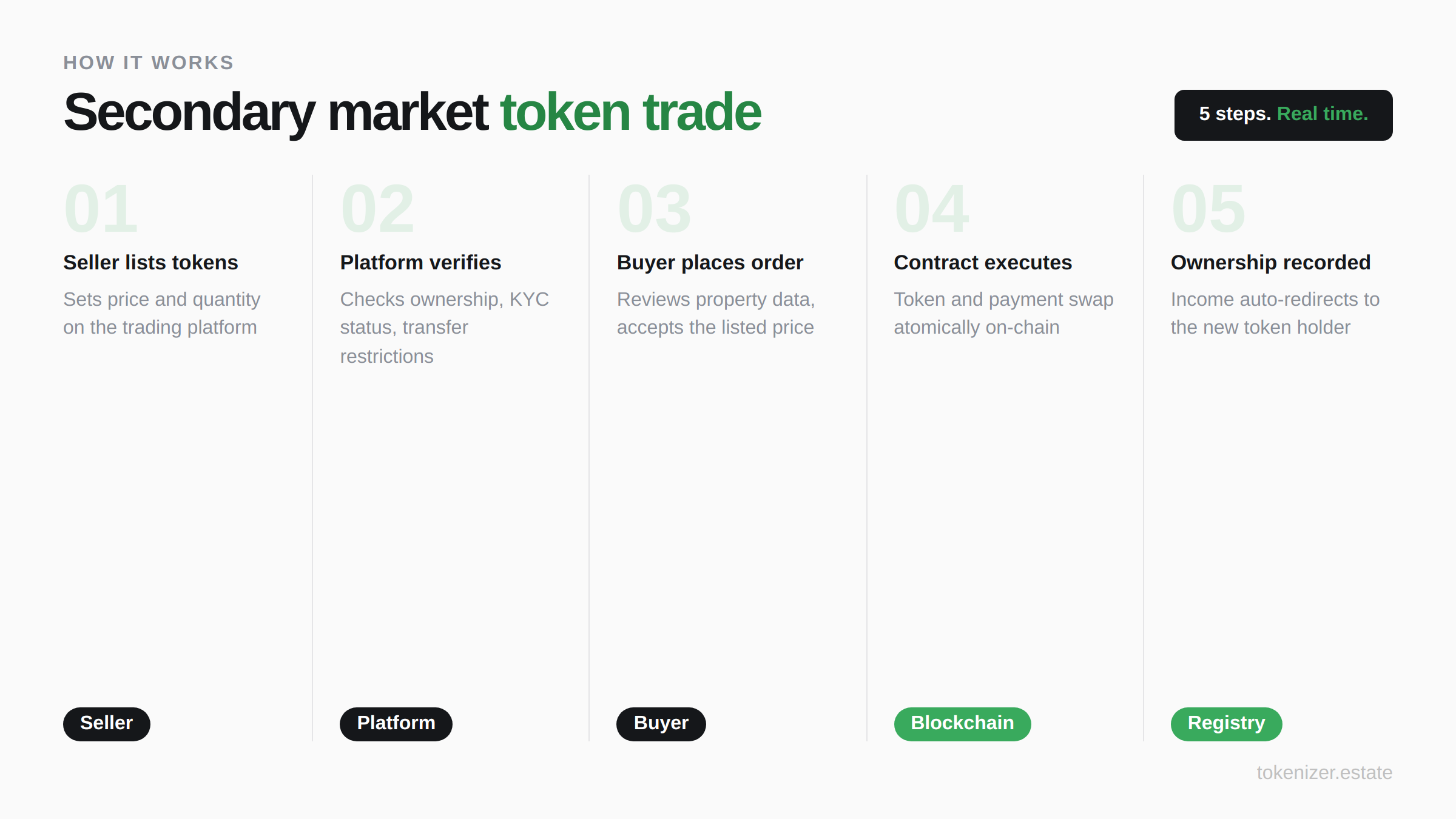
The process follows this sequence. A seller who holds tokens decides they want to exit. They log into the platform, select their tokens, and place a sell order — specifying a price and the number of tokens. The platform checks that the seller is the verified owner and that the tokens are not in a lock-up period.
On the other side, a buyer is browsing available tokens. They see the listing, review the property details, yield history, and current token price, and place a buy order. When the prices match, the trade executes automatically. The smart contract transfers the tokens to the buyer and the payment to the seller simultaneously.
Settlement — the point when ownership is officially transferred — happens in real time on many platforms. tZERO, the leading regulated trading venue for tokenized securities in the US, completes execution and settlement at the same moment, meaning the trade and the ownership transfer happen together. Compare that to traditional securities trading, where settlement can take 1–2 business days, or traditional property transfers, which can take months.
After the trade, the smart contract that handles income distribution automatically recognizes the new owner. From that point, rental payments, dividends, or profit distributions go to the buyer.
Where You Can Trade Property Tokens Right Now
The secondary market for real estate tokens is not one single place. It is a collection of regulated platforms across different jurisdictions, each focused on slightly different types of assets and investors.
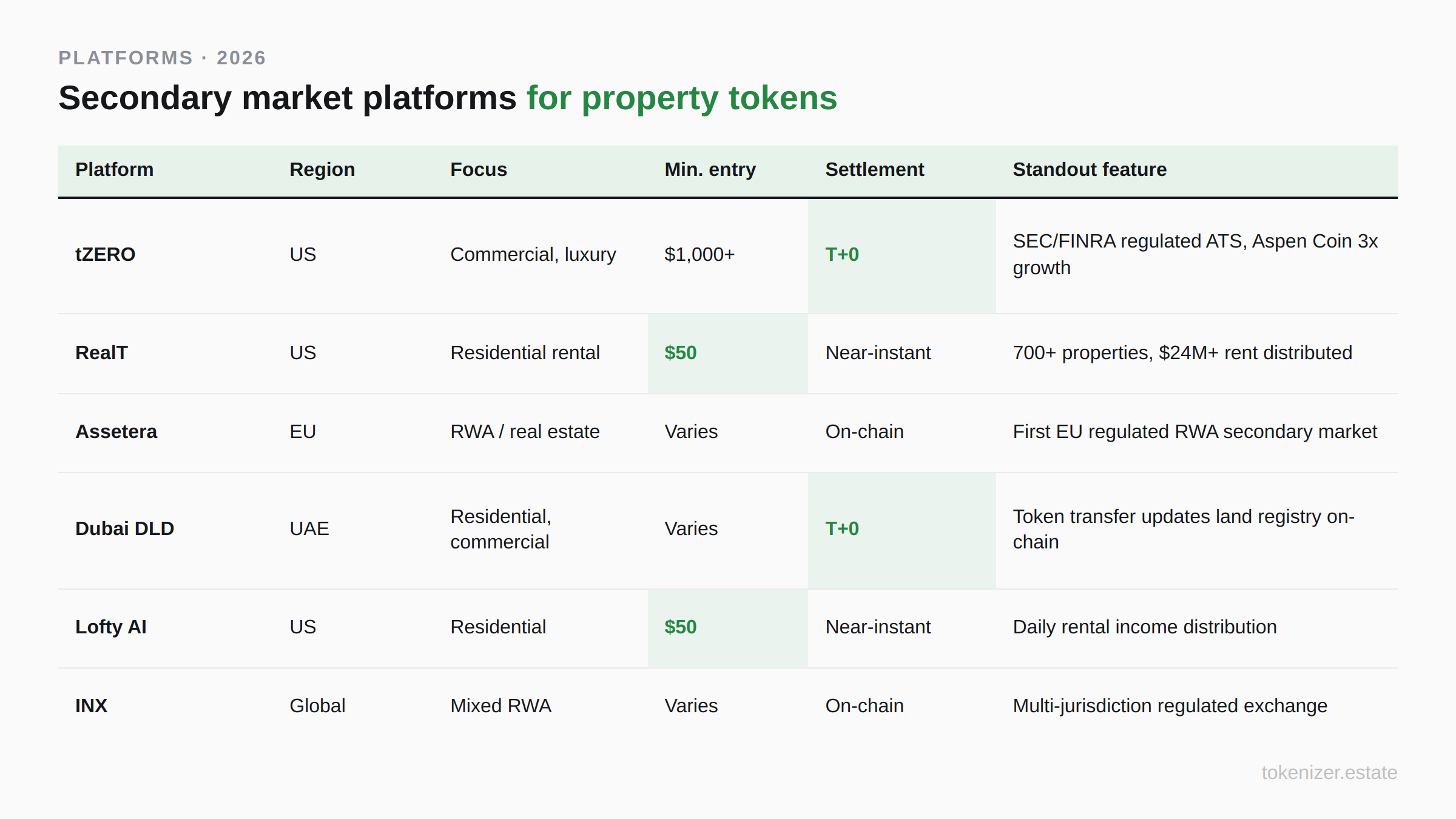
tZERO is the best-known and most established platform in the United States. It operates as a registered Alternative Trading System (ATS) under SEC and FINRA regulation. Its most prominent listing is the Aspen Coin (ASPD), representing fractional ownership in the St. Regis Aspen Resort — one of the earliest luxury real estate tokenization deals in the world. The token's price has grown over 3x since its first listing, and the platform has processed over 44 million shares in private placements.
RealT focuses on US residential rental properties. It runs an internal marketplace where verified investors trade tokens among themselves. As of 2025, RealT has tokenized over 700 properties worth more than $130 million in total, and has distributed over $24 million in rental income to token holders.
Assetera is Europe's first regulated secondary market for tokenized real-world assets, including real estate. It launched in 2024 on the Polygon blockchain and allows compliant trading under EU securities frameworks, making it a natural venue for European investors and developers.
Dubai Land Department (DLD) launched a government-backed secondary trading platform in early 2026 — the first in the world where a completed token transfer automatically updates the official land registry. That means buying a real estate token in Dubai legally changes the ownership record in real time. The rest of the tokenization world is watching this model closely.
Lofty AI serves retail investors with fractional US rental property tokens starting at just $50. It runs on the Algorand blockchain and distributes daily rental income automatically.
For a full picture of how these platforms connect to legal structure, custody, and issuance — what the industry calls the "four-layer model" — explore the complete market map on the Tokenizer.Estate blog. It covers every piece of the ecosystem in one place.
How to Buy Property Tokens: Step by Step
The process is simpler than most people expect. It is closer to opening a brokerage account than buying a property.
You start by choosing a platform. The right choice depends on your location, your investor status (some platforms in the US require accredited investor verification), and the type of asset you want. Commercial buildings, residential rentals, hotels, industrial assets — different platforms cover different categories.
Next, you create an account and complete identity verification. This KYC process usually requires a government-issued ID and sometimes proof of address. For institutional investors, additional documentation may be needed. Most platforms complete verification in 1 to 3 business days.
Once verified, you fund your account. Bank transfers are accepted on all major platforms. Some also accept stablecoins or cryptocurrency. You deposit the amount you want to invest.
Then you browse available tokens. The best platforms show you detailed property information: location, expected rental yield, current token price, trading history, and ownership structure. You can compare options clearly — with far more transparency than most traditional real estate deals offer.
When you find a property you want, you place a buy order. You specify the number of tokens and the price you are willing to pay. If there is a seller at that price, the trade completes. Your tokens appear in your portfolio, and income distributions begin automatically according to the smart contract terms.
Some platforms have minimum investments of just $50 to $500. Others are designed for larger investors with minimums of $5,000 or more. Entry requirements vary widely depending on the platform and the specific offering.
How to Sell Property Tokens: What to Know First
Selling follows the reverse process. You open your portfolio, select the tokens you want to exit, and place a sell order with your target price. When a buyer matches it, the trade completes and your payment arrives.
Simple — with one important detail: lock-up periods.
In the United States, tokens issued under Regulation D (the most common structure for real estate offerings) cannot be freely traded on secondary markets for the first 12 months after issuance. This is a securities law requirement. After the lock-up expires, tokens trade freely on a registered ATS.
Tokens issued under Regulation A+ — which opens investment to retail (non-accredited) investors — have no lock-up restriction. They can be traded on secondary markets immediately after the primary offering closes.
In the EU, UAE, and Singapore, the rules vary by structure and jurisdiction. A developer using a Dubai DIFC structure will have different transfer restrictions than one using a Luxembourg fund vehicle. The platform or legal advisor handling the issuance should document these terms clearly before investors commit.
Beyond lock-ups, the main variable when selling is market depth — whether there are buyers at the price you want, and how quickly.
What Affects Liquidity — and Why It Matters
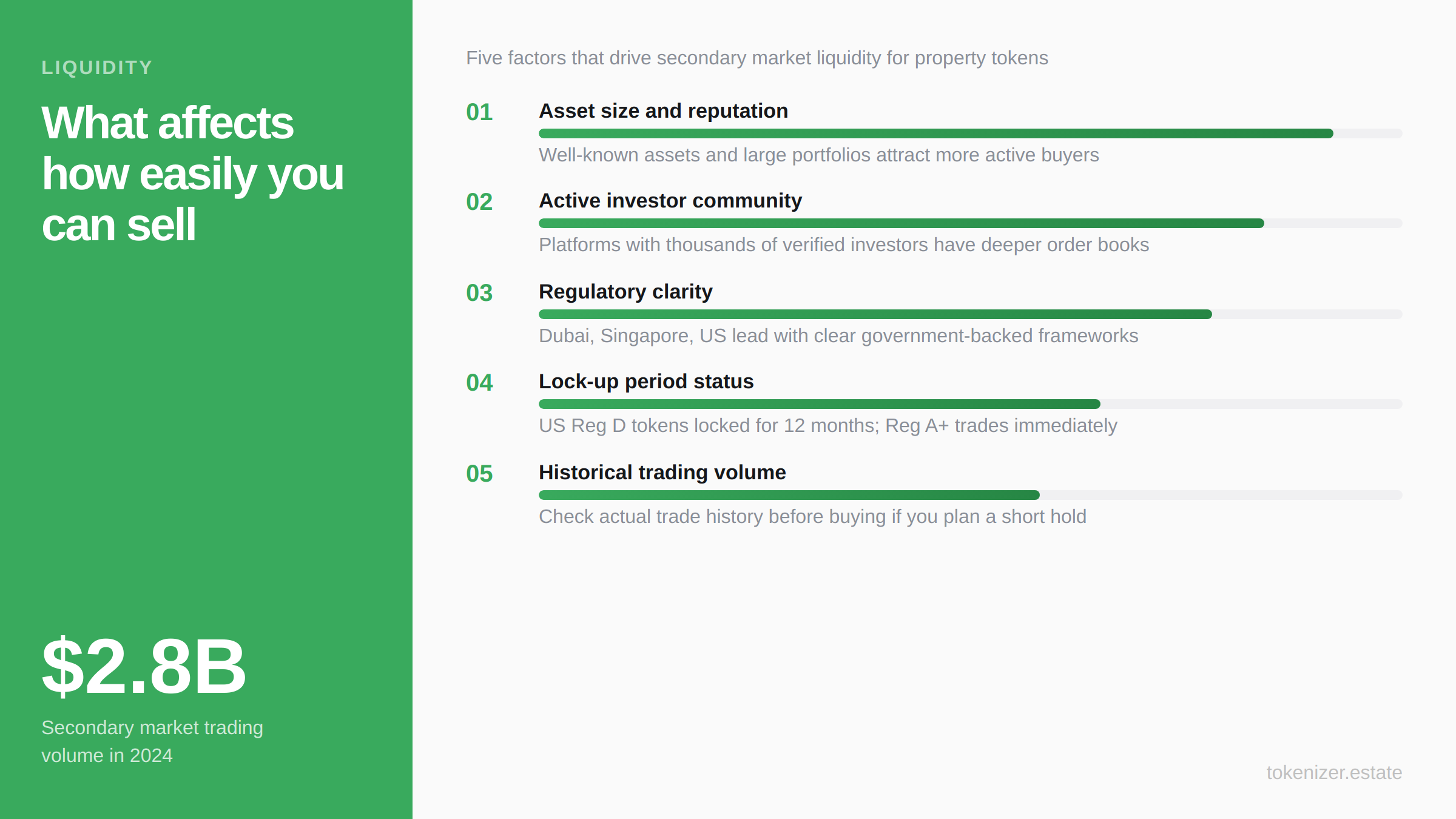
Not all property tokens are equally easy to sell. Understanding what drives secondary market liquidity helps you make better investment decisions.
The reputation and size of the asset matters most. A token representing a share in a well-known hotel or a large commercial portfolio will attract more buyers than an obscure property in a low-demand market. Larger investor bases mean more active trading.
The platform you trade on matters too. Platforms with thousands of verified investors have deeper order books — more buyers and sellers at any given time. This reduces the gap between buy and sell prices and makes exits faster.
The jurisdiction also plays a role. Dubai and Singapore currently have the most active secondary markets for tokenized real estate, partly because of clear government-backed frameworks and strong institutional participation. The US is growing rapidly, driven by the Reg D and Reg A+ structures that established ATS platforms can list.
Trading volume across secondary market platforms for property tokens exceeded $2.8 billion in 2024, which shows real market activity — but the market is still young and uneven. Some assets trade actively every day. Others sit quietly for weeks. Checking a token's actual trading history before you buy — if you plan to sell within a short horizon — is always a good idea.
The Risks Nobody Talks About — and One Real Story
Secondary market trading for property tokens is a real and growing market. But it comes with risks that are worth understanding clearly. Let's look at what they actually are — including one story that makes platform risk very concrete.
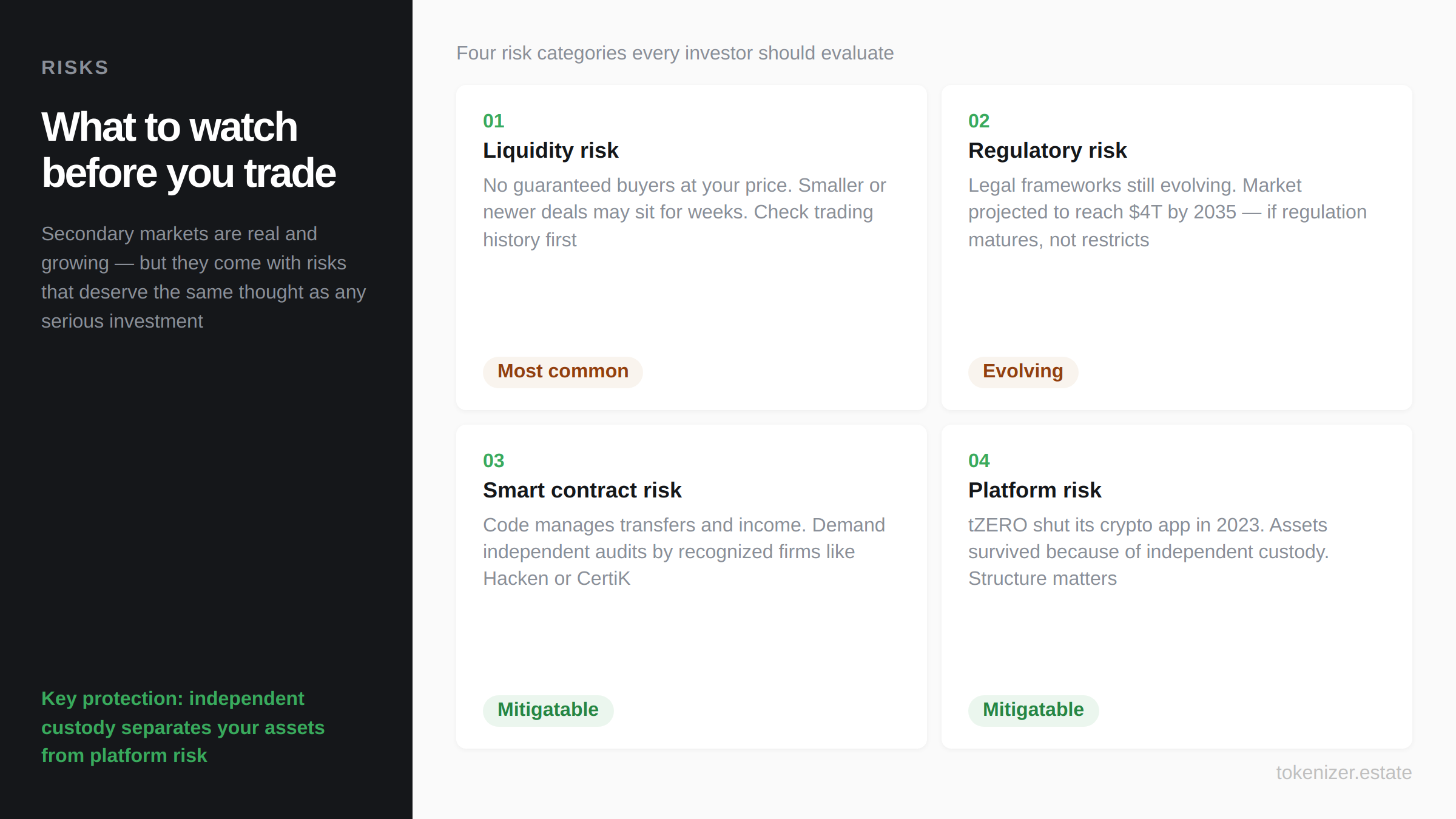
Liquidity risk is the most common one. Even on a regulated platform, there may be no buyers at the price you want, especially for smaller or newer deals. You may need to wait, or accept a lower price. This is fundamentally different from stock trading, where large public companies have millions of buyers and sellers active at any moment.
Regulatory risk is real and evolving. The legal frameworks for tokenized securities are still developing in many countries. According to Deloitte's analysis of tokenized real estate, the market is projected to grow from under $0.3 trillion in 2024 to over $4 trillion by 2035 — but that trajectory assumes regulatory frameworks continue to mature rather than becoming restrictive.
Smart contract risk is technical but important. The code that manages your token's income distribution, transfer rules, and compliance must be independently audited. Platforms that have not had their contracts audited by a recognized firm (like Hacken, CertiK, or OpenZeppelin) introduce a layer of technical risk that you cannot easily evaluate as a non-developer.
Platform risk is perhaps the hardest to see coming. Here is a real example. In early 2023, tZERO — at the time the most prominent regulated trading venue for property tokens in the US — shut down its crypto trading app entirely due to regulatory pressure. Investors on that app had until March 6 to withdraw their assets. For many, it was a shock. They had trusted a large, established name.
But here is the key part: the assets were fine. Because tZERO kept user funds with a qualified custodian that was legally separate from the trading platform, no tokens were lost. The platform closed. The assets stayed safe. Investors moved on to other venues.
This is exactly why custody structure matters when you evaluate any platform. The trading interface can fail, get acquired, or pivot to a different market. What protects you is whether your ownership is held by an independent, regulated custodian — not inside the platform's own wallet system.
None of these risks make secondary market trading for property tokens a bad idea. They make it a decision that deserves the same careful thought you give to any serious investment in hard assets.
The Infrastructure Bet That's Already Being Won
The secondary market for property tokens is not standing still. Two major developments are reshaping it right now.
The first is interoperability — and it has moved from theory to live production. Today, most tokens can only be traded on the platform where they were issued. That limits the pool of potential buyers. But in September 2025, Swift and Chainlink announced a working solution that lets major banks manage tokenized asset transactions using the same Swift messaging system they have used for decades — no new infrastructure, no separate blockchain team needed. UBS was the first global asset manager to adopt the standard. In May 2025, J.P. Morgan's Kinexys and Ondo Finance completed a live cross-chain test where a tokenized fund asset and its payment settled at exactly the same moment, automatically, across two different blockchain networks. These are not proofs of concept. They are production tests involving the world's largest financial institutions — and they point directly to a near future where tokenized real estate trades across networks, not just within one platform. When that happens, the pool of potential buyers for any property token grows dramatically.
The second is institutional capital arriving in volume. Pension funds in the UK and Canada are now allocating portions of their portfolios to tokenized real estate. Sovereign wealth funds in the UAE are moving in the same direction. When institutional capital enters a market, it brings volume, stability, and credibility. It also attracts more retail investors, which deepens liquidity further.
For anyone managing large real assets — commercial properties, resort hotels, industrial facilities, or even non-traditional assets like yachts and infrastructure — the practical implication is direct: the investors you raise capital from today will increasingly expect a clear exit path. Secondary market trading is that path. And structuring a deal correctly from the start is what makes that path actually usable.
To stay current on regulatory developments, new platform launches, and institutional moves, the Tokenizer.Estate news feed tracks the tokenization market in real time.
The Bottom Line
Secondary market trading for property tokens is not a theory. It is a working system, operating across the US, Europe, UAE, and Asia, with real volume and real exits happening right now.
The honest picture: liquidity is still uneven. Some assets trade daily. Others are quiet. The market is younger than public equities and will take years to reach the same depth.
But the direction is clear, and the infrastructure is real. For asset owners and investors, the question is no longer "can I exit a tokenized position?" It is "how do I choose the right structure, platform, and jurisdiction so that exit is smooth when I need it?"
Those answers exist. The tools exist. The regulated markets exist.
The secondary market for property tokens is open for business.
Share this post
Build your own tokenization business with Tokenizer.Estate
Tokenizer.Estate provides a full end-to-end solution — from legal setup to blockchain infrastructure — to help you launch your project with confidence
Book a Free Demo