KYC/AML for tokenized securities: what issuers must know in 2026
When you tokenize a building, the bank is no longer in the middle. You become responsible for KYC/AML on every investor. In 2026, regulators are handing out nine-figure fines. This guide covers four jurisdictions, on-chain compliance.

Over the past year, regulators have fined major crypto platforms hundreds of millions of dollars for weak KYC checks and unmonitored suspicious transactions. These were large exchanges with real compliance teams, and they still got caught.
The lesson applies directly to anyone issuing tokenized securities, real estate included. Tokenize a building and sell tokens to investors across several countries, and you are issuing securities, acting as a financial services provider, and subject to KYC/AML rules in every jurisdiction where your investors live.
Most asset owners weigh legal structure, smart contracts, and onboarding, and treat compliance as a checkbox. It is not. It is the layer that decides whether institutional money can enter your deal, whether your tokens can trade on secondary markets, and whether you stay on the right side of regulators. This guide covers what KYC and AML mean for issuers, the rules in the jurisdictions that matter most, how on-chain compliance works, and what to build into your deal from day one.
What KYC and AML actually mean for token issuers
KYC, Know Your Customer, means verifying the identity of every person who buys your token: name, address, date of birth, government ID, proof of residence, and for accredited investors, proof of income or net worth. AML, Anti-Money Laundering, means monitoring transactions for suspicious patterns, unusually large purchases, rapid in-and-out trading, or funds tied to sanctioned countries or flagged addresses, and filing a Suspicious Activity Report when something looks wrong.
In traditional real estate, banks, lawyers, and title companies handle all of this. When you sell a building, the bank runs KYC on the buyer. When you tokenize, that responsibility shifts to you: the bank is no longer in the middle. Removing intermediaries is one of tokenization's biggest advantages, but it means the issuer inherits the compliance work banks used to do. Skip it or do it poorly and the consequences are real: fines, criminal liability, and being locked out of regulated markets.
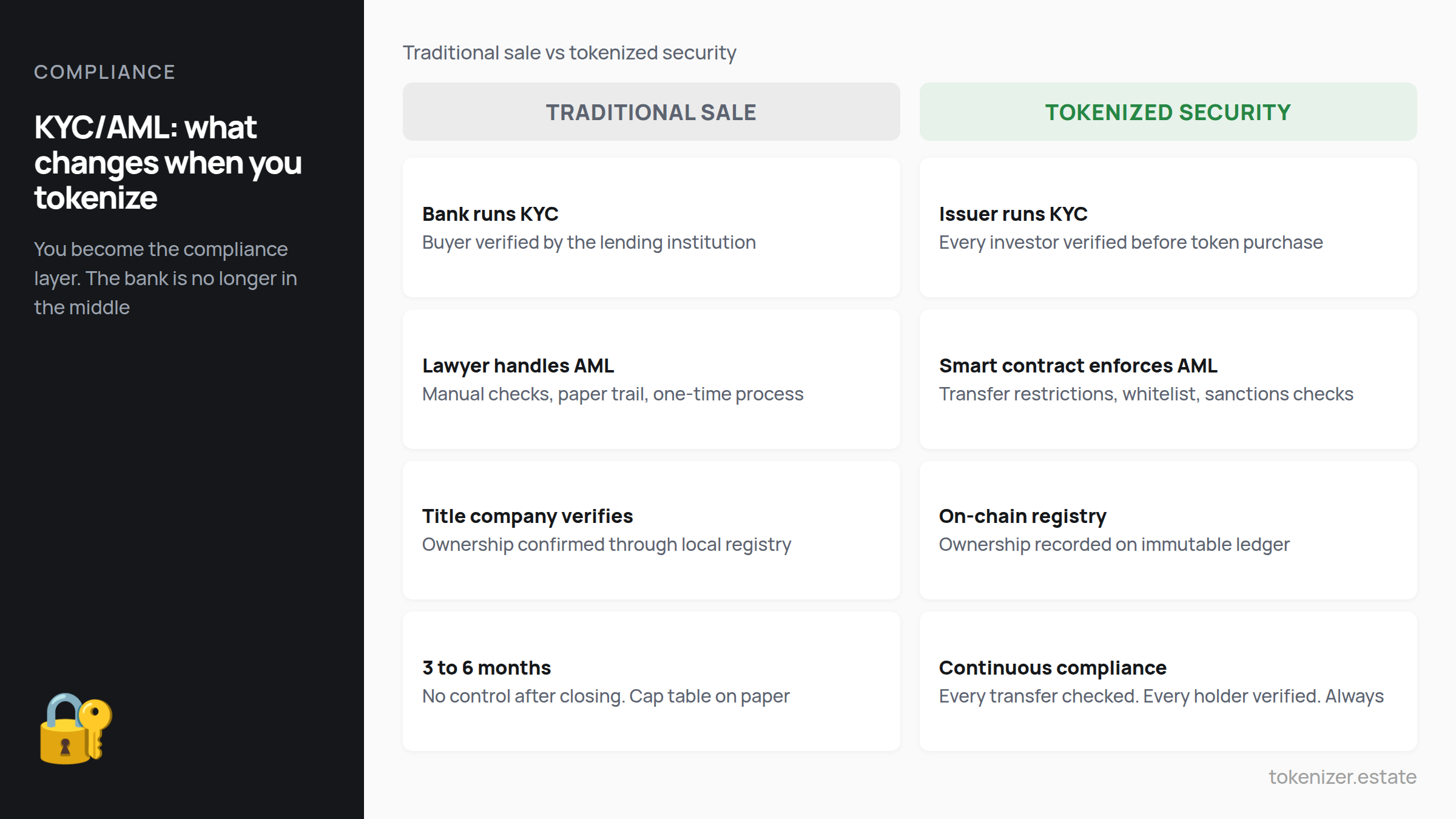
What changes when you tokenize
The four jurisdictions that matter in 2026
KYC/AML rules are not global; they vary by country. Four jurisdictions cover the majority of tokenized real estate deals, and each has tightened its framework recently.
United States. New federal legislation has brought payment rails for tokenized assets under clearer regulation, and financial institutions, including digital-asset service providers, must run AML programs with customer identification, transaction monitoring, and suspicious-activity reporting. The securities regulator continues to treat most tokenized real estate offerings as securities, whether sold to accredited US investors or to non-US investors, and every investor must be verified before buying a token.
European Union. The EU's crypto-asset regime is fully live across all member states: service providers must be licensed, run KYC/AML controls, and comply with the FATF Travel Rule. A new EU-wide anti-money-laundering authority is bringing direct supervision under a single rulebook, and tokenized securities also fall under existing investment-product rules. This combination makes Europe the most heavily regulated market for tokenized assets in the world.
UAE. Dubai's virtual-asset regulator licenses and supervises service providers, and the Abu Dhabi framework has adopted the Travel Rule and requires firms to avoid anonymous counterparties, with the central bank leading national AML enforcement. For issuers operating out of Dubai or ADGM, full KYC/AML compliance is mandatory from day one.
Singapore. The Monetary Authority of Singapore enforces strong KYC, transaction monitoring, and suspicious-activity reporting, and has run a multi-year government initiative testing tokenized assets with institutional participants. The framework is clear, the enforcement is real, and Singapore-based family offices are increasingly active in tokenized real estate.
The bottom line: there is no jurisdiction where you can skip KYC/AML. The rules exist everywhere. The only question is which set applies to your deal.

How on-chain KYC actually works
This is where tokenization turns a compliance burden into a compliance advantage. In traditional finance, KYC is a one-time paper check: you verify the investor at the start and then lose control of what happens next, so cap tables drift and compliance breaks down over time. With a permissioned security token, the rules are built into the token itself.
Whitelisting. Before an investor can hold or receive a token, their wallet address has to be added to a whitelist of verified addresses. Only whitelisted addresses can hold or transfer the token, and a send to an unverified wallet fails automatically.
Identity registries. A permissioned token links every holder to a verified identity through an on-chain registry, and the contract checks that registry before every transfer. Compliance is enforced at the protocol level, not by manual review.
Transfer restrictions. The contract can enforce lock-up periods, jurisdictional limits (no transfers to sanctioned regions), and investor-count caps, all automatically, with no human in the loop.
Ongoing monitoring. Monitoring tools scan on-chain activity for suspicious patterns, unusual volumes, rapid in-and-out trading, or interaction with flagged addresses, and specialized blockchain-analytics providers can screen in real time.
The result is compliance that is continuous, automated, and auditable: every transfer recorded, every holder verified, every restriction enforced by code. That is the opposite of a paper system that degrades over time. For how this works inside the token, our smart contracts guide covers what runs behind every token.
The Travel Rule and why it matters for secondary trading
The FATF Travel Rule is one of the least understood but most important requirements for tokenized securities. It requires regulated service providers to share sender and receiver information for every transaction above a set threshold. In practice, when an investor sells a token on a secondary marketplace, that venue must collect and transmit the identity of both seller and buyer, and this applies across every regulated marketplace in the US, EU, UAE, and Singapore.
Why it matters for issuers: if your tokens trade on a venue that ignores the Travel Rule, they become toxic. Institutional investors won't touch them, regulated platforms won't list them, and regulators trace the failure back to the issuer who allowed non-compliant trading. The fix is to work only with Travel-Rule-compliant venues, make sure your token supports the required data fields, and write Travel Rule compliance into your offering documents.
What issuers need to build into their deal from day one
KYC/AML has to be designed into the deal from the start, not bolted on after the token exists. The practical checklist:
Choose a KYC provider first. Specialized identity-verification providers handle document checks, sanctions screening, and politically-exposed-persons checks, and the one you pick must cover every jurisdiction your investors sit in. Choose before you design the token, not after.
Use a permissioned token with built-in compliance. A permissioned security-token framework enforces identity registries, transfer restrictions, and compliance rules at the protocol level. The framework you choose determines how compliance is enforced on-chain.
Define investor eligibility upfront. Accredited US investors, non-US investors, European qualified investors, each category carries different KYC requirements, so set these rules before the smart contract is written.
Budget for ongoing compliance. KYC is not a one-time cost: it includes continuous transaction monitoring, periodic re-verification, sanctions-list updates, and the ability to file suspicious-activity reports.
Document everything. Regulators want the records, not just your word: when each investor was verified, what was checked, what screening ran, and how monitoring continues. The chain gives you the transaction record; the KYC documentation still has to be stored off-chain in an auditable format.
Plan for re-KYC. Investors move, companies restructure, sanctions lists change. Most jurisdictions require periodic re-verification, so build it into your budget and your investor communications from the start.
What happens when you get it wrong
The fines are real and growing, and they have hit established companies with large compliance teams. For a tokenized real estate issuer, the risk goes beyond a fine: a KYC/AML failure can freeze your token contract, force delisting from secondary markets, expose directors to criminal liability, and shut you out of regulated capital markets. One failure can end a tokenization program for good.
The flip side is a real advantage. Institutional investors, family offices, and regulated funds can only invest in deals with proper KYC/AML, so a well-structured compliance program is not a cost center, it is the gateway to institutional capital.
For how compliance connects to legal structure, issuance, custody, and secondary markets, the market map covers all four layers.
This article is for informational purposes only and does not constitute legal or compliance advice. KYC/AML requirements vary by jurisdiction, asset type, and investor category. Always consult qualified legal and compliance professionals before structuring tokenized offerings.
Share this post
Build your own tokenization business with Tokenizer.Estate
Tokenizer.Estate provides a full end-to-end solution — from legal setup to blockchain infrastructure — to help you launch your project with confidence
Book a Free Consultation