Blockchain in Real Estate: What It Actually Changes in a Property Deal
A measured look at the four distinct layers of blockchain in real estate, what runs in production in 2026, and what tokenization still cannot fix.

When a commercial building changes hands, a chain of intermediaries touches the file: a notary, brokers, a bank, an escrow agent, and a corporate secretary maintaining the cap table in a spreadsheet. What blockchain in real estate removes from that list has a different answer depending on which layer of the stack the sponsor deploys.
The industry conflates four separate technologies under one label. A national title registry running on distributed ledger is not the same as escrow-on-chain, which is not the same as a Special Purpose Vehicle (SPV) wrapper with a token issued against equity, which is not the same as posting that token as collateral to a lending desk. Each layer removes a different line from the closing above. Some remove nothing at all.
Why blockchain in real estate is four things, not one
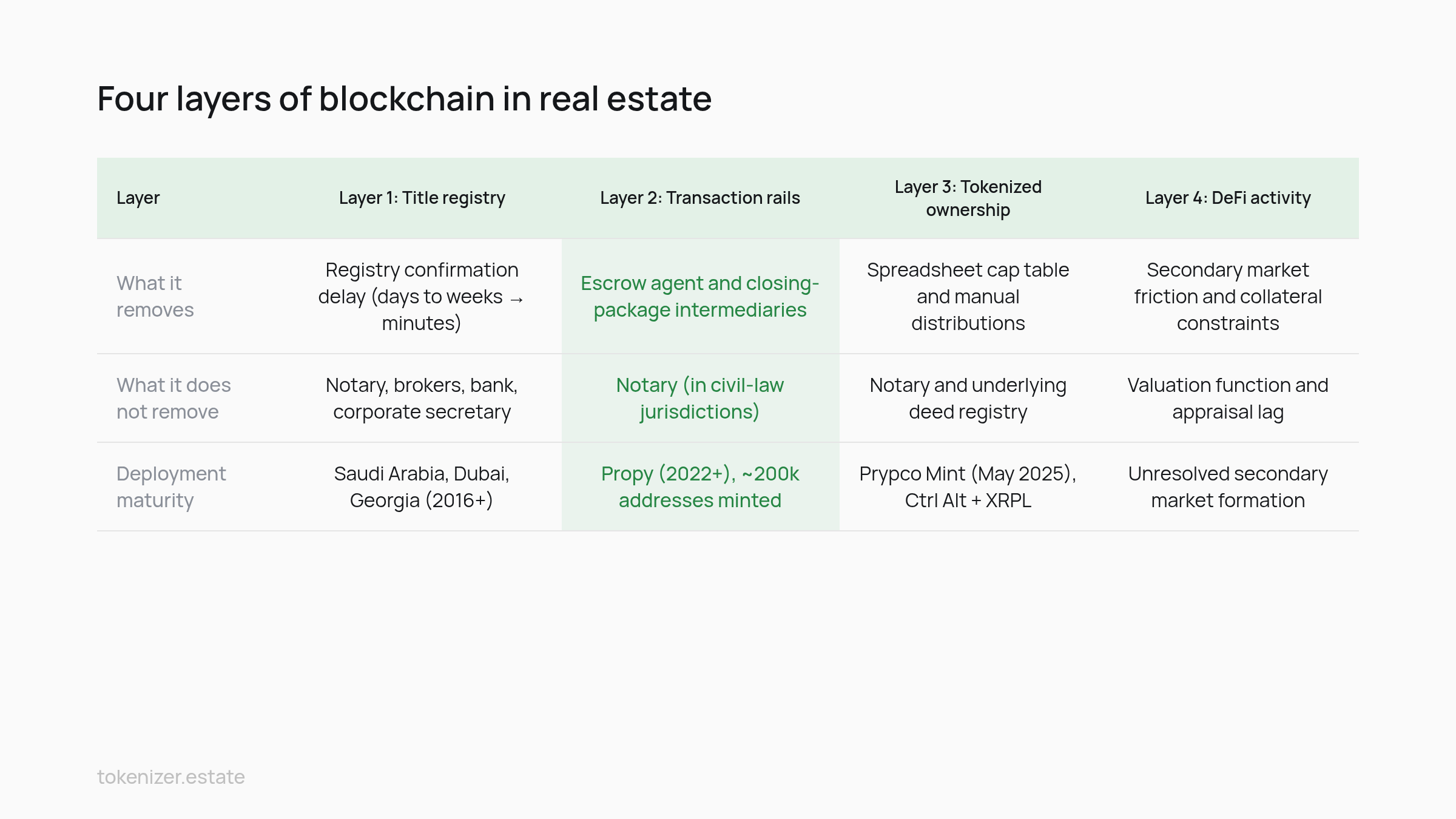
The four layers operate at different points in the property lifecycle and answer different questions. Layer one is the government title registry: the ledger where ownership of the deed itself is recorded, at the level of the national land authority. Layer two is transaction rails: escrow, purchase agreement execution, and closing settlement running as programmable contracts. Layer three is tokenized ownership through an SPV that holds the asset and issues tokens representing equity claims. Layer four is the decentralized finance activity built on top of layer three: lending against tokens, secondary trading venues, structured products.
Confusing these layers costs sponsors real money. A developer who reads that Dubai registered a tokenized villa on-chain and assumes the same route exists in Frankfurt has misread the maturity of layer one in Germany. A fund manager who assumes a token issuance creates instant liquidity has skipped the distribution and secondary-venue economics that layer four requires.
The scale gap is worth stating plainly. Forecasts for tokenized real estate reach into the trillions over the next decade, but today's on-chain base is a tiny fraction of that: total on-chain real-world asset value excluding stablecoins stood near $33.5 billion in mid-2026 per rwa.xyz, and real estate is under two percent of it. Most tokenized property also sits in private SPV interests that never appear on a public dashboard, so any single figure is an estimate, not a mark.
Blockchain land registry: what runs at government level?
National title registries running on blockchain infrastructure moved from pilot to production during 2024 and 2025 in three jurisdictions worth naming individually. The maturity varies. Saudi Arabia holds the strongest claim to a full national-scale deployment, Dubai runs a live tokenization project tied to the Land Department, and Georgia continues to expand a registry that has operated on distributed ledger since 2016.
Saudi Arabia: the Real Estate Registry under REGA
SettleMint announced Saudi Arabia as the first country to deploy a national-scale blockchain infrastructure dedicated to real estate registration, fractionalization, and marketplace integration. The Real Estate Registry sits under the Real Estate General Authority (REGA) and the framework synthesises practices from Switzerland, Singapore, Germany, Japan, and the United Kingdom, adapted to the Saudi institutional context. This is not a marketplace bolted onto a legacy registry. The ownership ledger itself runs on-chain.
Dubai: DLD and the Real Estate Tokenization Project
The Dubai Land Department (DLD) describes its work as positioning the authority as the first real estate registration entity in the Middle East to adopt blockchain-based tokenization. The Pilot Phase runs in collaboration with the Virtual Assets Regulatory Authority (VARA), Dubai Future Foundation, and the Central Bank of the UAE. The distinction matters: DLD is not operating a marketplace, it is issuing title-linked tokens from within the registration authority. Sponsors evaluating jurisdiction options can also review the ADGM and VARA guide for the private-side wrapper structures that complement this public infrastructure.
Georgia: an early adopter that keeps expanding
Georgia's National Agency of Public Registry has recorded property titles on distributed ledger since 2016, initially through a Bitcoin anchoring arrangement with Bitfury. In 2024, the agency signed a memorandum with the Hedera network covering an extension of the registry toward tokenized title records. The publicly announced scope stops at exploratory work, with no live issuance reported since. The Georgia case shows the direction of travel over a decade rather than a single-year announcement.
What layer one removes from the closing above is the delay between title transfer and public-registry confirmation. In legacy systems that gap runs from days to weeks. In Saudi Arabia and Dubai it closes to minutes. What layer one does not remove is any other line in the file: the notary, the escrow agent, the corporate secretary, and the intermediaries are all still there. The registry is faster. The transaction around it is not, unless layer two is also deployed.
Blockchain property transactions: escrow, closing, deed transfer

Layer two is where transaction mechanics run as programmable contracts rather than paper and wire instructions. The reference deployment is Propy, which launched title and escrow on blockchain in 2022 and by 2026 had moved from partnering with US title and escrow companies to acquiring them outright, backed by a $100 million credit facility to consolidate them into a single closing platform.
The mechanics are practical. A purchase agreement is encoded as a smart contract with signature blocks, contingency conditions, and an escrow account that holds funds until conditions clear. When conditions are met, the contract releases funds, updates the ownership record, and produces a signed closing package. Fiat rails stay in place for buyer payments.
The limits are jurisdictional. In civil-law jurisdictions where a notarial act is a legal prerequisite for deed transfer, the on-chain closing sits inside a notarial workflow rather than replacing it. In those jurisdictions the notarial act remains a legal prerequisite regardless of how the escrow settles. Layer two removes the escrow-agent line and compresses the closing-package line. It does not remove the notary line where local property law makes notarisation constitutive.
Tokenized ownership: SPV plus token in real estate on blockchain

Legal analyses of the market document the SPV-plus-token wrapper as the dominant private-side structure across the US, EU, and UAE. It is also the model that white-label infrastructure platforms deploy for developers, funds, and brokers. The structure is straightforward: an SPV holds the property, and the SPV issues tokens that represent equity claims on the SPV. Investors hold tokens; the SPV holds the deed. This wraps the property in a securities instrument that trades within compliance rails, without requiring the underlying land law to change. Which wrapper fits which asset, and how SPV, trust, and fund structures differ, is covered in our guide to legal structures.
Prypco Mint: Dubai's fractional retail deployment
The clearest live deployment sits in Dubai. Prypco Mint launched in May 2025 as the retail-facing platform, and CoinDesk reported that investors can purchase fractional ownership in Dubai properties using local currency starting from $540 equivalent. Access in the initial phase was restricted to UAE ID cardholders paying in dirhams, with global expansion planned. Zand Digital Bank provides banking rails, and regulatory oversight comes from the Central Bank of the UAE, VARA, and the Dubai Future Foundation.
The infrastructure choice: XRPL
The DLD project runs its tokenization on the XRP Ledger, chosen for its track record in tokenizing real-world assets. The trade-offs between the main chains used for property issuance are compared in our guide to the blockchains powering real estate tokenization. Minimum investor participation was set at AED 2,000, a threshold that opens fractional ownership to retail investors while staying within securities-law parameters.
What the SPV wrapper actually does
The SPV holds legal title. The token holders hold economic and governance rights against the SPV. Rental distributions, capital events, and exit proceeds flow from the property, through the SPV, to the token holders. The mechanics of that flow, and the smart-contract logic that executes it, are covered in more depth in the legal, technical, and distribution layers article. The variations across jurisdictions sit in two places: which securities exemption the offering relies on, and how the trustee arrangement is constructed.
Layer three removes the spreadsheet cap table, the manual distribution run, and the paper-based transfer restrictions. The notary and the underlying deed registry are unchanged. What changes is the ownership layer sitting above the deed.
Where blockchain in real estate does not help

The valuation problem does not move. A tokenized building is worth what an appraiser says it is worth, adjusted by whatever the last observed transaction implies, and the on-chain record adds nothing to that determination. Appraisers still walk the property. Cap rates still respond to interest rates. The valuation function sits entirely outside the smart-contract layer, and the appraisal lag this creates is one of the least discussed risks in the sector. We covered it in detail in how tokenized property is valued.
The notary does not disappear where local law requires the notarial act to be constitutive of the deed transfer. Germany, France, the Netherlands, Switzerland, and most of the civil-law world fall into this category. The token can trade on-chain, but the underlying deed transfer still runs through a notarial workflow whenever the SPV changes what it owns. This is a feature of property law rather than a technology limitation, which is why jurisdiction selection has to precede platform selection rather than follow it.
Liquidity does not appear because tokens exist. Liquidity comes from two things: distribution reach on the primary sale side, and a functioning secondary venue with matched buyers and sellers. The scarcity of the second is the binding constraint. Japan is the clearest case of a jurisdiction that actually built one: the Osaka Digital Exchange launched its START market for security tokens in December 2023, majority-owned by SBI Holdings with Sumitomo Mitsui, Nomura, and Daiwa Securities among the stakeholders. Most jurisdictions issuing tokenized real estate have no regulated secondary venue of comparable standing, which is why secondary volumes stay thin no matter how many tokens are issued. Tokenizing without solving distribution produces a cap table that trades slightly better than the paper version and no more.
2026 maturity table: layer, status, operator, requirements
The four layers sit at four different maturity levels in 2026. The table below summarises where each stands, who operates the reference deployment, and what an issuer needs in order to use the layer.
Layer | Status in 2026 | Production operator | What an issuer needs |
|---|---|---|---|
1. Government title registry | Production in Saudi Arabia and Dubai; expansion in Georgia | REGA (Saudi), DLD (Dubai) | Property located in the relevant jurisdiction; nothing else |
2. Transaction rails | Production in US residential; scaling by acquiring title and escrow companies | Propy | Jurisdiction where notarial acts are not constitutive; title and escrow provider integrated |
3. SPV plus token | Production across UAE, US, EU under securities exemptions | Public pilots and private white-label deployments | SPV structure, securities counsel, tokenization platform, KYC/AML stack |
4. DeFi on top of tokens | Pilot; limited secondary venues and collateral acceptance | Centrifuge for private credit; no public venue accepts real estate SPV tokens as collateral at scale | Layer three token that meets collateral criteria; institutional counterparty |
What the DLD projection actually implies
DLD's own communications, as reported by CoinDesk, project that tokenized real estate could account for 7% of the city's total property transactions by 2033, equivalent to roughly $16 billion in annual volume. This is a jurisdiction-specific projection tied to a single land department's roadmap, not a global market forecast. Sponsors should treat it as a Dubai signal rather than a worldwide multiplier.
Which layer to deploy first
The decision reduces to one filter. If the goal is to raise capital from retail or accredited investors against an existing building, layer three is the operative layer. If the goal is to reduce residential closing friction in a common-law jurisdiction, layer two applies. Layer one is a jurisdictional choice made by the government, and layer four remains a future upgrade path for issuers whose layer three tokens meet the collateral criteria of the venues that emerge.
The issuers closing layer three deals in 2026 are accumulating something none of the other layers can supply: a holder register, a distribution history, and a compliance record under a named regulator. Those are the exact inputs that layer four counterparties will underwrite against once collateral venues mature, and they cannot be assembled retroactively. Developers and funds preparing an SPV-plus-token structure can review the platform configuration options at Tokenizer.Estate to match the layer three deployment to their jurisdiction and portfolio profile.
Share this post
Build your own tokenization business with Tokenizer.Estate
Tokenizer.Estate provides a full end-to-end solution — from legal setup to blockchain infrastructure — to help you launch your project with confidence
Book a Free Consultation