Smart contracts for real estate tokenization: what runs behind the token
Somewhere between "I want to tokenize my building" and "investors are receiving rent" sits a piece of code. That code is a smart contract. It decides who can buy your tokens, how rent gets distributed, whether a transfer is legal, and what happens when someone tries to sell to an investor in a restricted country.

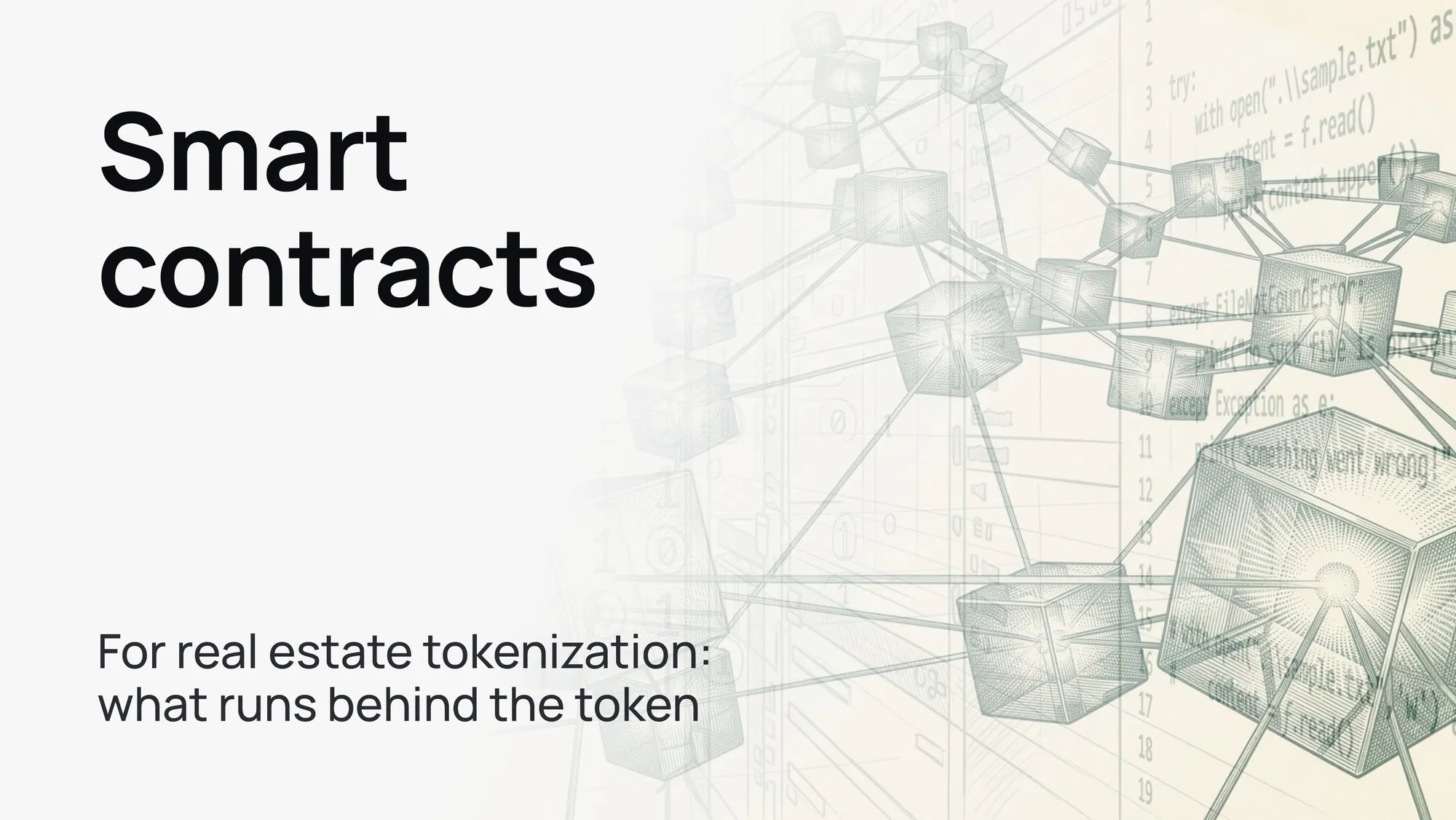
Most articles about smart contracts show you code. This one shows you what the code does, and why it matters. Whether you own a building, manage a fund, or just want to understand how tokenized property works under the hood, this is the practical picture. No programming required, just the logic, the money flow, and the risks.
By the end you will understand what a real estate smart contract does, how compliance gets built into the token itself, how dividend automation works in practice, why security audits matter, and where the real risks sit.
What a Smart Contract Actually Does in a Tokenized Deal
A smart contract is a program that lives on a blockchain and runs automatically when its conditions are met. Nobody can change it after deployment, and nobody can override it. If the contract says distribute a set share of collected rent to all token holders on the first of every month, that is exactly what happens.
In a tokenized real estate deal, the contract handles five jobs.
Ownership tracking. The contract keeps a record of who holds how many tokens. This is the cap table, except it updates in real time, on every transfer, without a spreadsheet or a manual transfer agent.
Compliance enforcement. Before any token moves from one wallet to another, the contract checks the buyer: are they verified, in a permitted jurisdiction, past KYC, and outside any lock-up period? If any check fails, the transfer is blocked automatically.
Dividend distribution. Rental income enters the contract. It calculates each holder's share from their token balance and sends payment, usually in a stablecoin. No human touches the money between collection and distribution.
Transfer restrictions. Many offerings carry a hold period or jurisdictional limits set by the exemption they were issued under, and whether the token is structured as debt or equity shapes what those rules look like. The contract encodes those restrictions so they can't be bypassed. A holder who tries to sell during a lock-up simply sees the transaction fail.
Corporate actions. Voting on property decisions, capital calls, buybacks, and court-ordered transfers can all be coded in. In practice most deals use simpler versions, but the capability is there.

Compliance Built Into the Token, Not Bolted On
The single most important thing a real estate smart contract does is make compliance a property of the token itself. This is what separates a regulated security token from an ordinary cryptocurrency, and it's worth understanding as a concept, independent of any particular technical standard.
A plain token treats every wallet the same: anyone can send it to anyone. That is fine for a currency and disqualifying for a security, where the law dictates who is allowed to hold the asset. A permissioned token solves this by splitting the job into two connected parts.
One part is the token itself, which tracks balances and transfers. The other is an identity layer: an on-chain registry that records verified facts about each approved holder, such as their KYC status, their accreditation where required, and their country of residence. Before any transfer completes, the token checks that registry, on both sides of the trade. If the receiving wallet isn't a verified, eligible holder, the transfer fails. The rule lives inside the asset, and it runs on every single transaction, forever, without anyone reviewing trades by hand.
The rules the token enforces are downstream of the legal wrapper the offering sits in, which is why the issuer's compliance rules have to be right before launch. The contract enforces exactly what it's told. Set the wrong jurisdiction limits or miss a restriction, and the contract will enforce the wrong rules perfectly. (Tokenizer.Estate uses a customized, permissioned token built on a widely supported token framework and adapted for regulated real estate offerings, so these checks are configured to the issuer's specific deal rather than left generic.)
There's one more capability worth naming, because it surprises people from a pure-crypto background: a permissioned security token usually supports recovery, the ability for an authorized agent to freeze or reissue tokens. In crypto that sounds like heresy. In real estate it's essential. If a court orders a seizure, or an investor loses access to their wallet, the issuer needs a way to keep the on-chain cap table aligned with legal reality.
For how this token layer sits alongside the legal wrapper and the distribution setup, the platform architecture guide covers the full stack an issuer needs.

How Dividend Automation Actually Works
This is the part that makes asset owners pay attention. Once the contract is set up, rental income reaches token holders without manual intervention. The flow is simple.
Rent is collected from tenants through the normal channels the building already uses, bank transfers, property management software, nothing changes there. The net rent, after operating costs and reserves, is converted to a stablecoin and sent to the contract's distribution address. The contract reads its own registry to see who holds how many tokens at that moment, calculates each holder's proportional share, and pays every holder directly in their wallet. The transaction is recorded on-chain: visible, auditable, permanent.
The math is plain. If you hold 2.5 percent of the tokens, you receive 2.5 percent of that distribution. The contract does the calculation and the payout.
The harder operational cases, a vacancy that skips a distribution, a sale or refinance, a capital call, are handled the same way any tokenized property manages post-issuance operations. What the automation replaces is real work: a fund administrator calculating distributions by hand, preparing wires, handling cross-border banking for international investors, and reconciling everything at year end. For a deal with hundreds of investors across many countries, that administrative load is a meaningful drag on returns. The contract does the same job for a negligible transaction fee, which is a large part of why tokenization scales to a wide investor base without the admin scaling with it.

The Oracle Problem: Connecting Buildings to Blockchains
Smart contracts have one hard limitation: they only know what's on the blockchain. A contract can't check a bank account, read a lease, or confirm a building was appraised at a given value on its own.
That gap is filled by oracles. An oracle is a service that feeds real-world data into a contract: property valuations from appraisers or automated models, rent-collection data from property management systems, occupancy, insurance status, regulatory updates. In practice, most real estate tokenization today runs on a mix of automated feeds and manual attestations, a property manager confirms the rent came in, a compliance officer updates a jurisdiction rule, an appraiser signs off on the annual valuation.
The direction of travel is toward more automation here, with major financial institutions working on standards for connecting real-world data to on-chain assets. But the practical rule for now is blunt: your oracle setup is only as good as your data source. If rent collection is messy off-chain, it's messy on-chain too. Smart contracts automate execution. They don't fix bad inputs.
Security Audits: Why You Can't Skip Them
A smart contract holding millions in investor capital is a target. On-chain exploits have drained very large sums from projects with unaudited or poorly-audited code, often through a handful of well-known flaw types.
A security audit is a line-by-line review of your contract code by a specialized firm. Auditors look for reentrancy attacks, where a contract is tricked into sending funds multiple times; access-control flaws, where unauthorized parties can call restricted functions; arithmetic bugs; and logic errors that could let someone drain the contract or manipulate distributions.
The cost of an audit scales with the complexity of the contract, and a serious deal budgets for it as a matter of course. Weigh it against the alternative: a bug in a contract holding millions, exploited, costs the capital plus the legal fallout plus destroyed investor trust. The audit is cheap insurance relative to what it protects.
One point owners miss: an audit isn't a one-time event. If you upgrade the contract, change compliance rules, or add features after deployment, you need a re-audit. Budget for it.
This is also why the audit trail behind a platform matters. Tokenizer.Estate's smart contracts are independently audited by Hacken, one of the established security firms in the space, so an issuer building on the platform inherits an audited contract base rather than commissioning a first-time audit from scratch. When you evaluate any tokenization platform, ask who audited its contracts, when, and whether the report is available to review.

What the Owner Decides vs What the Dev Team Handles
If you own the building, you don't need to write code. But you do need to make decisions your technical team can't make for you, because they're business and legal decisions, not technical ones.
You decide: which jurisdictions investors can come from, the minimum investment, whether there's a lock-up, how often distributions happen, who has authority to freeze or recover tokens, and what happens if you want to sell the whole building later.
Your technical team decides: which blockchain to deploy on, how to implement your compliance rules in code, the oracle setup, the audit firm, and how to handle wallet recovery.
You decide together: the development approach and timeline, whether to build custom or use an existing tokenization platform, and how much ongoing maintenance the contract needs.
The biggest mistake asset owners make is treating the contract as a purely technical thing and delegating all of it. The compliance rules coded into the token are business decisions with legal consequences. The token enforces whatever you tell it, so what you tell it has to be right.
What Goes Wrong: Real Risks, Not Theoretical Ones
Smart contracts in real estate tokenization aren't experimental. Permissioned security tokens have been running live for years, with billions of dollars settled through them. But real risks exist, and honest discussion matters.
Immutability cuts both ways. Once deployed, a contract can't be casually changed. If there's a bug, you can't just patch it. You either use an upgrade pattern, which adds complexity and its own trust question about who controls the upgrade, or you migrate to a new contract, which requires every investor to act.
Key management is an operational risk. The wallet that controls the contract's admin functions, whitelisting investors, updating rules, triggering recovery, has to be secured. Lose that key and the contract becomes unmanageable; have it stolen and an attacker can take control. Multi-signature setups, where several authorized parties must approve any action, are the standard defense.
Regulatory mismatch. A contract enforces the rules you program. If those rules don't match what the regulator actually requires, the code doesn't protect you. Legal advice comes before code, not after.
Oracle failure. If the feed reporting rent collection goes offline or reports wrong data, the contract distributes wrong amounts. Garbage in, garbage out, even with perfect code.
None of these is a reason to avoid smart contracts. They're reasons to build carefully, audit properly, and operate with the same seriousness you bring to any large financial decision.
For how the token layer connects to the legal structure and the distribution setup, see the platform architecture guide, and for what a token legally represents to its holder, digital property ownership.
This article is for informational purposes only and does not constitute legal, tax, technical, or investment advice. Smart contract development involves technical and regulatory risk; always engage qualified legal counsel and security auditors before deploying tokenized securities.
Share this post
Build your own tokenization business with Tokenizer.Estate
Tokenizer.Estate provides a full end-to-end solution — from legal setup to blockchain infrastructure — to help you launch your project with confidence
Book a Free Consultation