
Tokenized hotels 2026: from Maldives overwater villas to Aspen ski suites
In 2018, the St. Regis Aspen raised $18 million through token sales. In 2025, the Trump Organization announced the first hotel tokenized during construction. Between these two deals, hospitality tokenization crossed from experiment to capital strategy. Here is how it works.

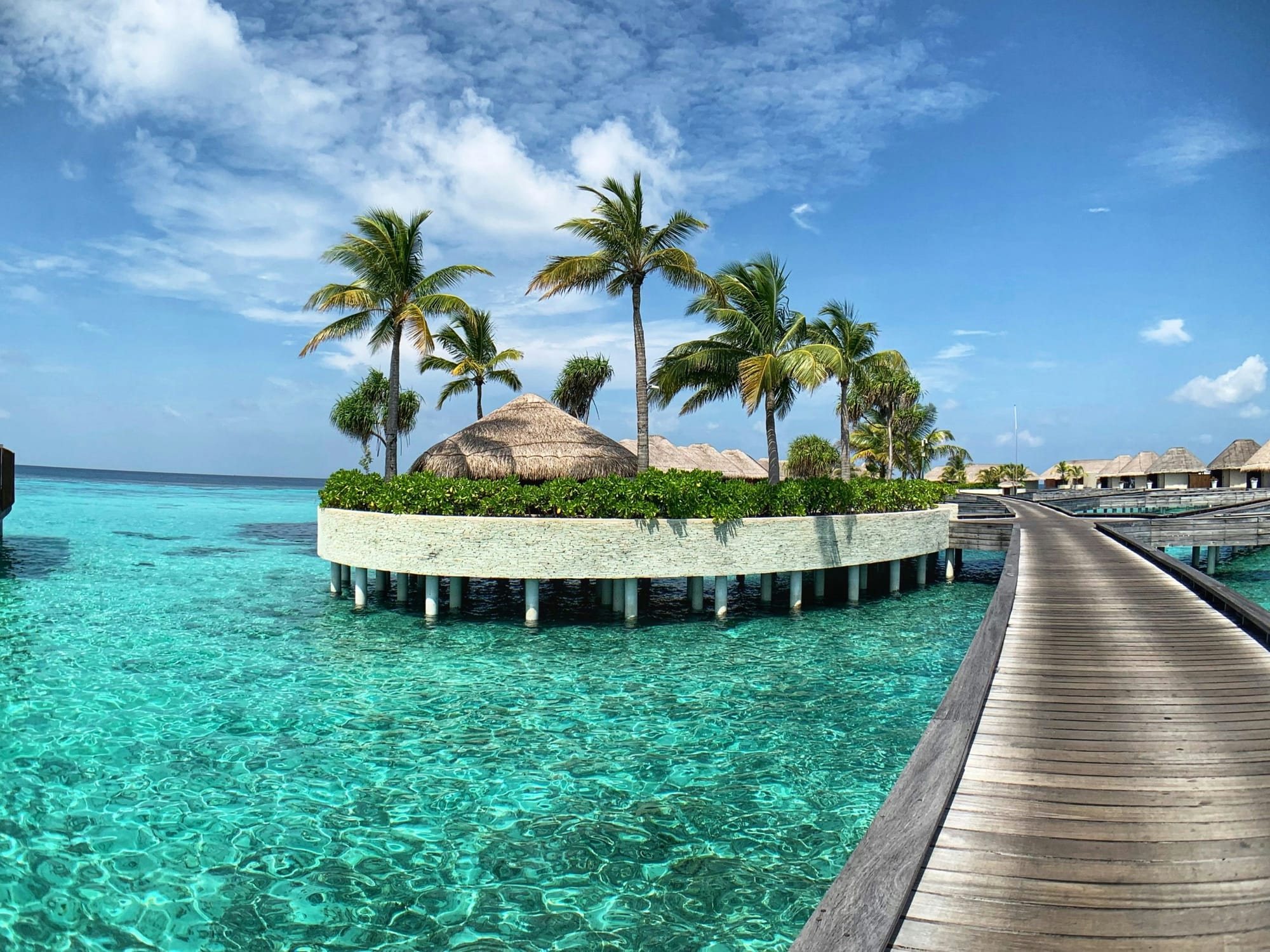
In November 2025, the Trump Organization and Saudi developer Dar Global announced something that the hospitality industry had not seen before: a luxury resort that would be tokenized during construction, not after. The Trump International Hotel Maldives — 80 ultra-luxury overwater villas, 25 minutes by speedboat from Malé — would sell digital shares to investors before a single room was built.
That made headlines. But it was not the first tokenized hotel. Seven years earlier, a Belgian investor named Stephane De Baets had already tokenized 18.9% of the St. Regis Aspen Resort in Colorado — a 179-room five-star property in the Rocky Mountains — and raised $18 million through digital token sales on Indiegogo. Token holders got ownership rebates of up to 50% on hotel stays.
Between these two deals — 2018 and 2025 — the industry crossed a line. Hotel tokenization moved from proof of concept to a capital strategy that major brands are willing to put their name behind.
Why hotels are the most interesting — and riskiest — tokenization target
Hotels are different from every other real estate asset class. An office building has one tenant on a 10-year lease. A warehouse has Amazon for 15 years. The income is predictable.
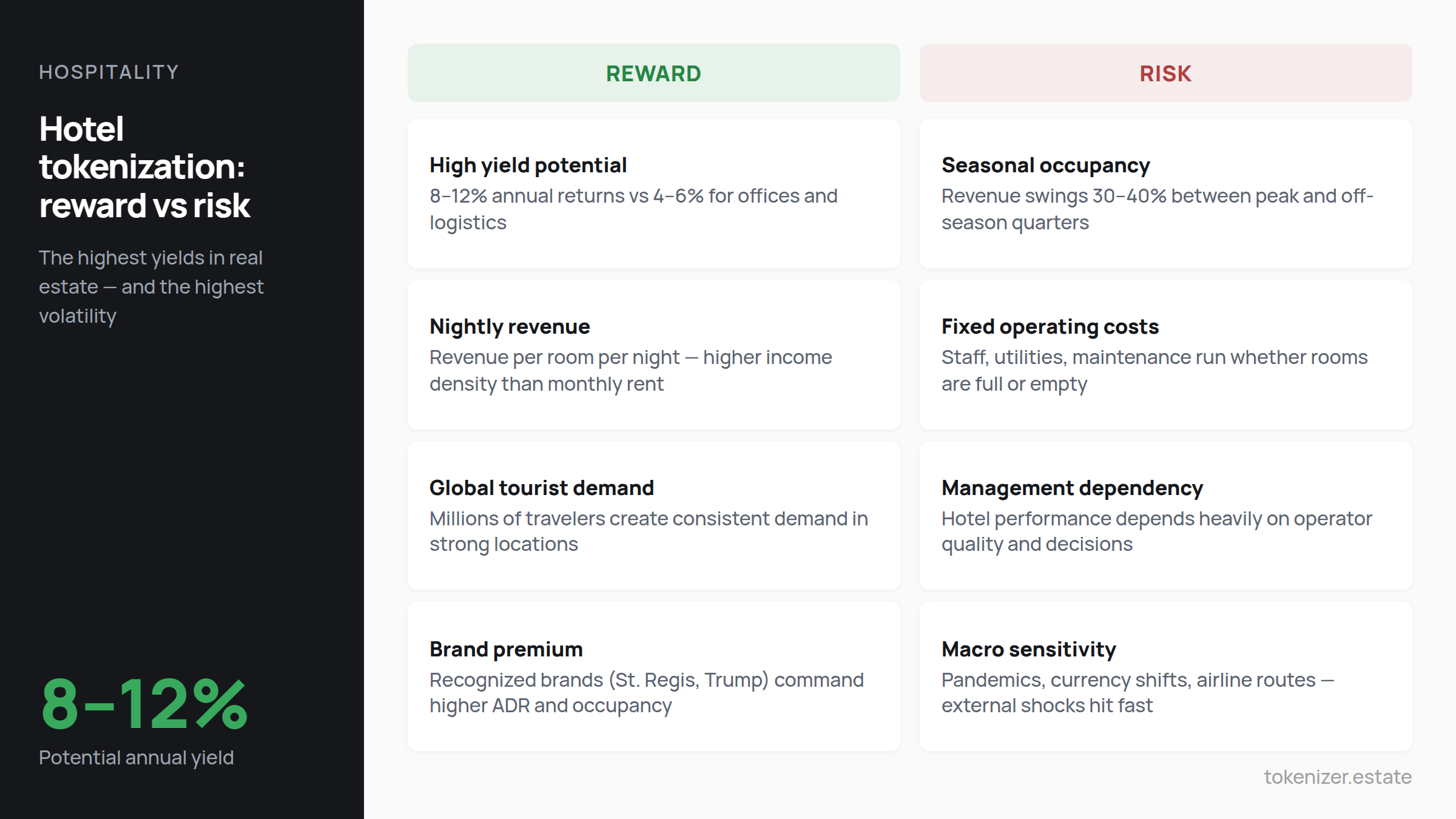
A hotel has a new tenant every night. Revenue depends on occupancy, which depends on season, economy, weather, airline routes, and a dozen other variables. A 200-room hotel at 75% occupancy and $300 ADR (average daily rate) generates $16.4 million per year. Drop occupancy to 55% and you lose $4.4 million. That swing makes hotel investors nervous — and it makes hotel tokenization both attractive and dangerous.
Attractive because: nightly revenue can produce yields of 8–12%, much higher than the 4–6% typical of office or logistics assets. A well-run hotel in a strong market earns more per square meter than almost any other property type.
Dangerous because: that revenue can vanish fast. A pandemic, a currency shift, a new competitor, a bad TripAdvisor season. Hotels have operating leverage that works both ways. When it works, owners earn well. When it does not, they bleed cash while the building sits there, fully staffed, consuming electricity and salaries regardless of whether anyone checks in.
For tokenization, this creates a specific challenge. When 300 investors own pieces of a hotel through tokens, they expect regular income. If occupancy drops for two quarters, the smart contract distributes less — or nothing. Unlike a bond with a fixed coupon, hotel token returns fluctuate. Investors must understand this going in.
The deal that started it all: St. Regis Aspen
In 2018, Elevated Returns — a New York-based asset management firm run by Stephane De Baets — wanted to recapitalize the St. Regis Aspen Resort. Traditional fundraising was not producing results.
De Baets turned to SolidBlock, an Israeli tokenization firm, and they structured something that had never been done in US hospitality: a Reg D 506(c) security token offering that sold 18.9% of the resort to accredited investors through digital tokens.
The raise happened on Indiegogo. They sold $18 million worth of Aspen Digital tokens. Each token represented fractional ownership in the property. But the deal had something extra that most real estate tokenizations miss: a utility layer. Token holders received cash rebates on hotel stays — 20% with 10,000 tokens, 35% with 100,000, and 50% with half a million. This turned investors into guests and guests into stakeholders.
The tokens later migrated to tZERO, an SEC-regulated alternative trading system, giving holders secondary market liquidity. The Aspen Coin has since appreciated — one of the few tokenized real estate projects where early investors saw capital gains on top of income.
What the St. Regis deal proved: a five-star hotel can be partially tokenized under existing US securities law, using standard Reg D exemptions, with real secondary trading. It also proved that tokenization can create customer loyalty that traditional marketing cannot — when your guests own part of the building, they come back.
Trump International Maldives: tokenizing before the building exists
The Trump-Dar Global deal in the Maldives is structurally different from Aspen. The St. Regis was a completed, operating hotel. The Maldives resort does not exist yet. Opening is planned for 2028.
Dar Global is tokenizing the development phase — selling digital shares in a resort that is still under construction. Investors participate from inception, not from the first night of revenue. The pitch: early-stage access to a luxury hospitality project that would normally be available only to sovereign funds and family offices.
The details remain thin. Which blockchain will be used has not been announced. Regulatory framework, investor jurisdictions, and secondary market structure are still unclear. Dar Global's CEO told Reuters they hope to fund much of the project by selling tokens to US retail investors.
What makes this deal significant is not the specifics (which are still forming) but the signal. The Trump Organization is among the most recognized property brands in the world. When a brand at that level chooses tokenization as a financing method — and announces it at Consensus, the largest crypto industry conference — it tells the rest of the hospitality industry that this is not a fringe experiment.
DAMAC Group, another UAE-based property conglomerate, made a similar signal. In January 2025, DAMAC announced a $1 billion tokenization agreement with MANTRA, a layer-1 blockchain designed for RWAs. DAMAC's portfolio includes real estate, hospitality, and data centers. The deal covers at least $1 billion in assets, with hotel properties among the first targets.
The Carmen Hotel: a boutique property on the blockchain
Not every tokenized hotel is a mega-resort. RedSwan — the Texas-based platform with $5 billion in tokenized commercial real estate — listed the Carmen Hotel in Playa del Carmen, Mexico. This is an adults-only beachfront boutique hotel with 37 ocean-view suites, steps from Fifth Avenue's shopping and dining district.
The Carmen is a different proposition from the Maldives. It is smaller, operating, and generating revenue today. For investors, it offers exposure to Mexico's booming Riviera Maya tourism market at a fraction of what buying the whole property would cost.
RedSwan structures these deals under Reg D for US accredited investors and Reg S for international participants. The tokens are minted on the Hedera network, with KYC/AML compliance built into the smart contract. Investors receive distributions from hotel revenue proportional to their token holdings.
What the Carmen deal shows: tokenization is not only for trophy assets. A 37-room boutique hotel can be tokenized just as effectively as a 500-room resort. The technology scales down. What matters is the legal wrapper, the revenue model, and the investor demand.
Lake Lucerne, Switzerland: Europe's early move
The hospitality tokenization story is not limited to the Americas. In Europe, Blockimmo — a Swiss tokenization platform — tokenized a hotel property on Lake Lucerne, one of Switzerland's most scenic locations. The project used Swiss DLT law and FINMA's framework for blockchain trading platforms.
Switzerland's legal clarity made this deal possible. The 2021 DLT Act recognizes digital securities as valid financial instruments. FINMA licenses blockchain exchanges. The property was divided into digital tokens, each representing a share of the hotel, and sold to international investors looking for Swiss real estate exposure.
The deal was smaller than Aspen or the Maldives, but it proved that hospitality tokenization works under European regulation — an important signal for EU-based hotel operators watching from the sidelines.
For a broader view of how tokenization platforms, legal structures, and secondary markets work across jurisdictions, the market map on the Tokenizer blog covers the full ecosystem.

The economics of a tokenized hotel — a worked example
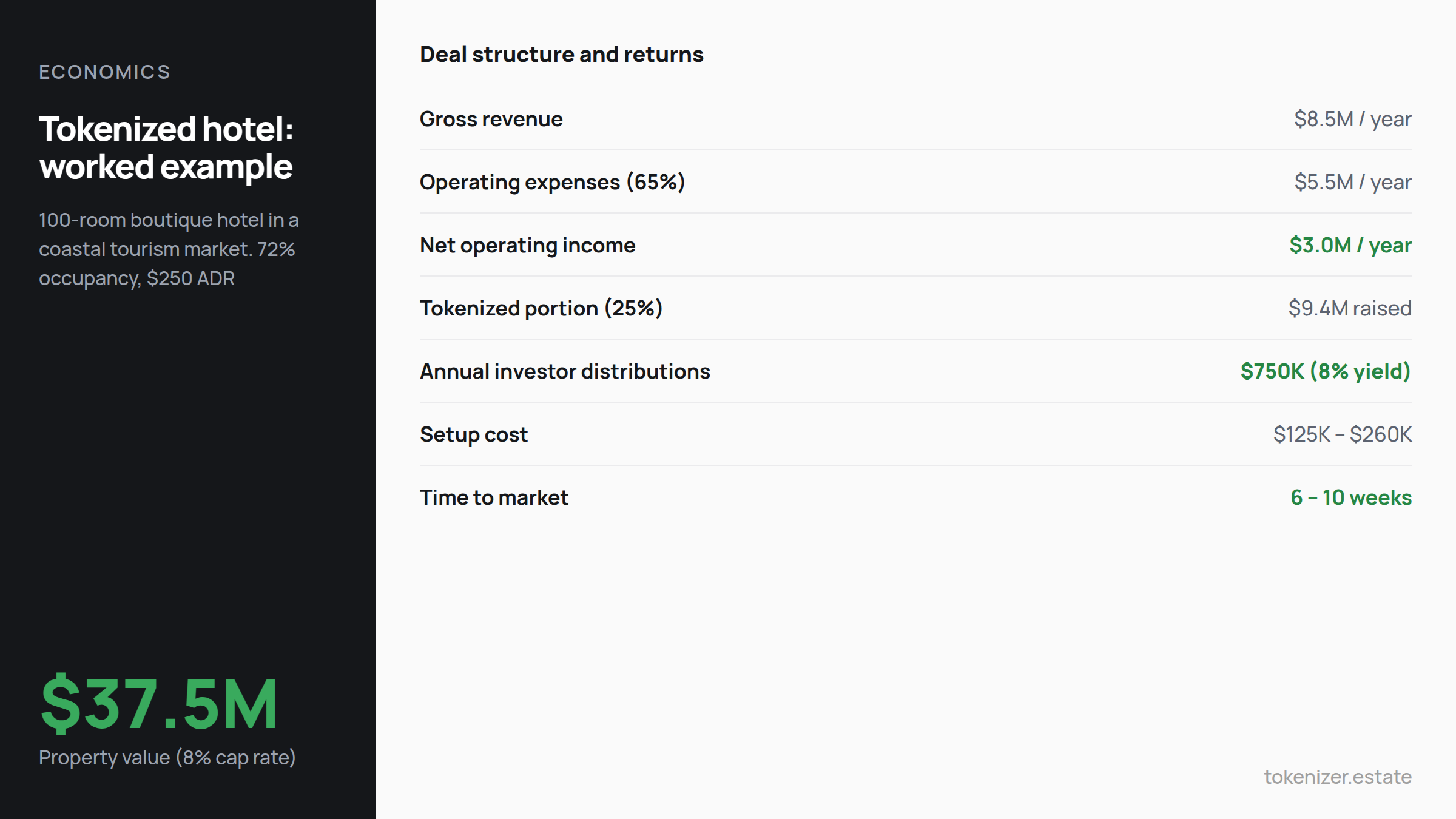
Let us use real numbers. You own a 100-room boutique hotel in a coastal tourism market. Average occupancy: 72%. ADR: $250. Revenue per available room (RevPAR): $180. Total room revenue: $6.57 million per year. Add F&B and ancillary revenue, and gross revenue reaches roughly $8.5 million.
Operating expenses eat about 65% of that: $5.5 million in staff, utilities, maintenance, marketing, insurance, and management fees. Net operating income: $3 million. The hotel is worth roughly $37.5 million at an 8% cap rate.
You want to tokenize 25% — $9.4 million. Here is how the math works.
Setup costs. Legal structuring (SPV, PPM, subscription agreements), smart contract development, KYC/AML integration, platform fees: roughly $100,000 to $180,000. A security audit of the smart contract adds $25,000 to $80,000 depending on complexity.
Time to market. From decision to first investor: 6 to 10 weeks, depending on legal jurisdiction and platform readiness. Faster than a traditional private placement.
Investor returns. Token holders receive 25% of the $3 million NOI: $750,000 per year. That is an 8% cash yield on $9.4 million invested. If occupancy rises to 80%, the yield increases. If it drops to 60%, the yield falls.
What you keep. 75% ownership, full management control, the brand, the team, the operations. You raised $9.4 million without a bank lien and without selling the building. And you now have 200+ investors who are personally motivated to stay at your hotel — the same dynamic that made the Aspen deal work.
Secondary liquidity. Your investors can trade tokens on RedSwan's marketplace, tZERO, or another ATS. They are not locked in for seven years. This makes the investment more attractive and lowers the yield investors demand — which means you give up less for the same capital.
What makes a hotel tokenizable — and what does not
Not every hotel is a good candidate. After looking at completed deals and failed attempts, here are the patterns.
Works well: stabilized hotels with 2+ years of operating history, strong brand or location, occupancy above 65%, diverse revenue streams (rooms + F&B + events + spa), and clear legal structure. The Aspen and Carmen deals fit this profile.
Works with caution: development-stage hotels (like the Maldives) where investors accept higher risk for early-stage pricing. These need a strong brand, a credible developer, and very clear disclosure about construction risk, timeline, and capital structure.
Does not work: distressed properties with declining occupancy, hotels in oversupplied markets where ADR is falling, properties with unresolved legal or title issues, and any hotel where the management team is not committed to transparency and regular reporting to token holders.
The technology is neutral. It does not care whether your hotel is good or bad. But investors do. And in a tokenized structure, where 300 people can see your occupancy data on-chain, there is nowhere to hide a bad quarter.
Stay current with hospitality tokenization developments and new deals at Tokenizer.Estate News.
What this means beyond hotels
If you have followed the logic of this article, you have probably noticed something: the model is not limited to hotels. Any income-producing asset with variable revenue — a marina, a co-working space, a sports facility, a conference center, an entertainment venue — can be tokenized using the same structure.
The hotel is the testing ground because it combines the hardest variables: nightly revenue, high operating leverage, seasonal demand, and intensive management. If tokenization works for hotels — and the Aspen, Carmen, and Lucerne deals show it does — it works for simpler assets too.
For hotel operators and hospitality groups, the question is timing. The first movers in hospitality tokenization — De Baets with Aspen, RedSwan with Carmen, Dar Global with the Maldives — got attention, investor interest, and first-mover pricing. The window is still open, but it will not stay open forever.
For a comparison of how different tokenization platforms handle hospitality and commercial assets, see our platform comparison guide.
This article is for informational purposes only and does not constitute legal, tax, or investment advice. Hotel investments carry operating risk including variable occupancy and revenue. Always consult qualified professionals before making investment or structuring decisions.
Share this post
Build your own tokenization business with Tokenizer.Estate
Tokenizer.Estate provides a full end-to-end solution — from legal setup to blockchain infrastructure — to help you launch your project with confidence
Book a Free Demo