
Tokenization for Developers: How to Fund Construction with Tokens
Bank construction loans got expensive. Tokens give developers a new way to fill the mezzanine and equity gap with real investors and real money. This is the practical guide for owners of yet-to-be-built assets in 2026.

In February 2026, tokens were sold in a Trump-branded hotel that does not exist yet. The villas will be built by 2030. The investors who bought in receive a fixed yield and a share of future villa sales, all from a property that is still a plan and a piece of beachfront in the Maldives.
Five years ago this would have been a private bank loan. Today it is a token, distributed under US private placement rules to accredited investors around the world.
This deal is not unusual anymore. Banks tightened credit. Construction loan rates climbed past 11% on most US development loans, with NAHB data putting average rates above 11.77% for land development and 12.82% for speculative single-family construction in Q2 2025. Mezzanine lenders ask for 15% plus equity kickers. The deal a developer penciled at 8% two years ago does not work anymore.
Tokens fill the gap. Smaller developers and asset owners, including those with yachts, factories, and industrial sites, are starting to ask the same question: can tokens fund my project? The short answer is yes, in specific layers of the capital stack. This article covers which layers, what it really costs, and where the model breaks.
Why developers are looking at tokens in 2026
For most of the last decade, developer financing followed a simple pattern. Senior debt from a bank covered 60–70% of the project cost. Mezzanine debt or preferred equity from a private fund filled another 10–20%. The developer put in the rest.
That model is under pressure. Three things changed at once.
Bank credit tightened. Tight credit conditions ran for fourteen consecutive quarters through Q2 2025. Banks now cap senior leverage at 65–75% loan-to-cost and 65–70% loan-to-value, often less. Mezzanine lenders raised rates and demanded more equity protection. And the public market for new development bonds shrank.
At the same time, the technology stack for tokenization matured. Compliant token issuance with KYC, transfer restrictions, and on-chain distribution is now standard infrastructure, and major institutions have issued tokenized funds at scale. The plumbing works.
For a developer, this opens a new option. Instead of negotiating with a single mezzanine lender at a steep rate, you can issue a tokenized debt or revenue instrument to dozens or hundreds of accredited investors at a lower blended cost, with quarterly distributions automated by smart contract.
This is not magic. It is a different distribution channel for the same kind of capital that has always financed construction. But the channel changes who can participate, how fast the money arrives, and what the developer has to give up in return.
The asset owner does not need to be a New York skyscraper sponsor. The same logic applies to a marina developer in Croatia, a factory expansion in Poland, or a hotel operator adding a wing in Dubai. As long as the asset is real and the legal wrapper is clean, the model works.
A token does not change what gets built. It changes who pays for it.
The three token types developers actually use
When a developer issues tokens to fund construction, they pick one of three instruments. Each one fits a different stage of the capital stack and a different investor.
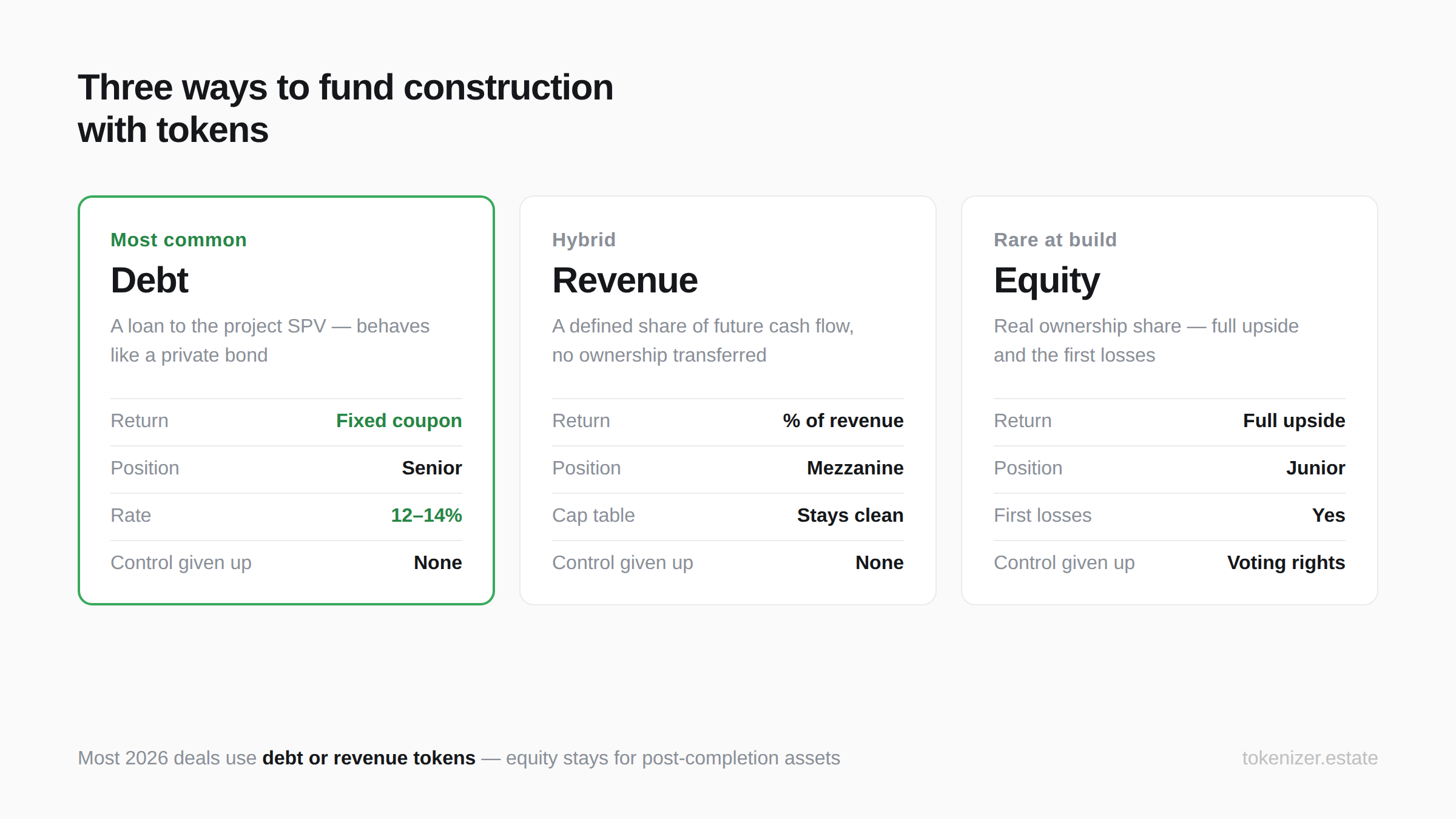
Debt tokens are the workhorse of developer tokenization in 2026. The token typically represents a loan to the project SPV. Investors usually receive a fixed coupon, often paid quarterly, and generally stand senior to equity in the capital stack. In most structures the developer keeps full control of the project, and the principal is scheduled to be returned at maturity. Where the offering documents provide for it, debt token holders rank ahead of equity holders if the project is sold or refinanced early. The exact terms depend entirely on how the instrument is drafted.
This is the model most developers reach for, because it looks and behaves like a private bond. Compliance teams understand it. Investors price it like fixed income. We covered the mechanics in detail in our guide on debt vs equity tokens for real estate.
Revenue participation tokens are a hybrid. The investor does not own equity, but they get a defined share of future cash flow, rental income, hotel revenue, or sale proceeds. The developer keeps the cap table clean and avoids governance rights. This works well when the project will generate revenue at completion (a hotel, an apartment building, a logistics warehouse with pre-leased space) but the developer does not want to hand over ownership.
Equity tokens transfer real ownership. Investors share the full upside if the project succeeds and the first losses if it does not. They may have voting rights on major decisions like refinancing, sale, or large capital expenditure. This is the strongest form of investor protection and the heaviest one in terms of disclosure and governance.
Most construction-stage deals in 2026 use debt or revenue tokens. Equity tokens during construction are still rare, because investors prefer to take equity exposure after completion when the asset has measurable value. Equity tokens during construction work mainly when the developer has a strong track record and is targeting institutional family-office capital that demands ownership.
How tokens fit into the capital stack
Tokenization does not replace bank financing. In most working models, it sits next to it.
A typical $50 million development project still gets a senior construction loan from a bank. That loan covers 60% of the cost at the cheapest available rate. What tokenization changes is the layer above that: the mezzanine, the preferred equity, or part of the sponsor's own capital.
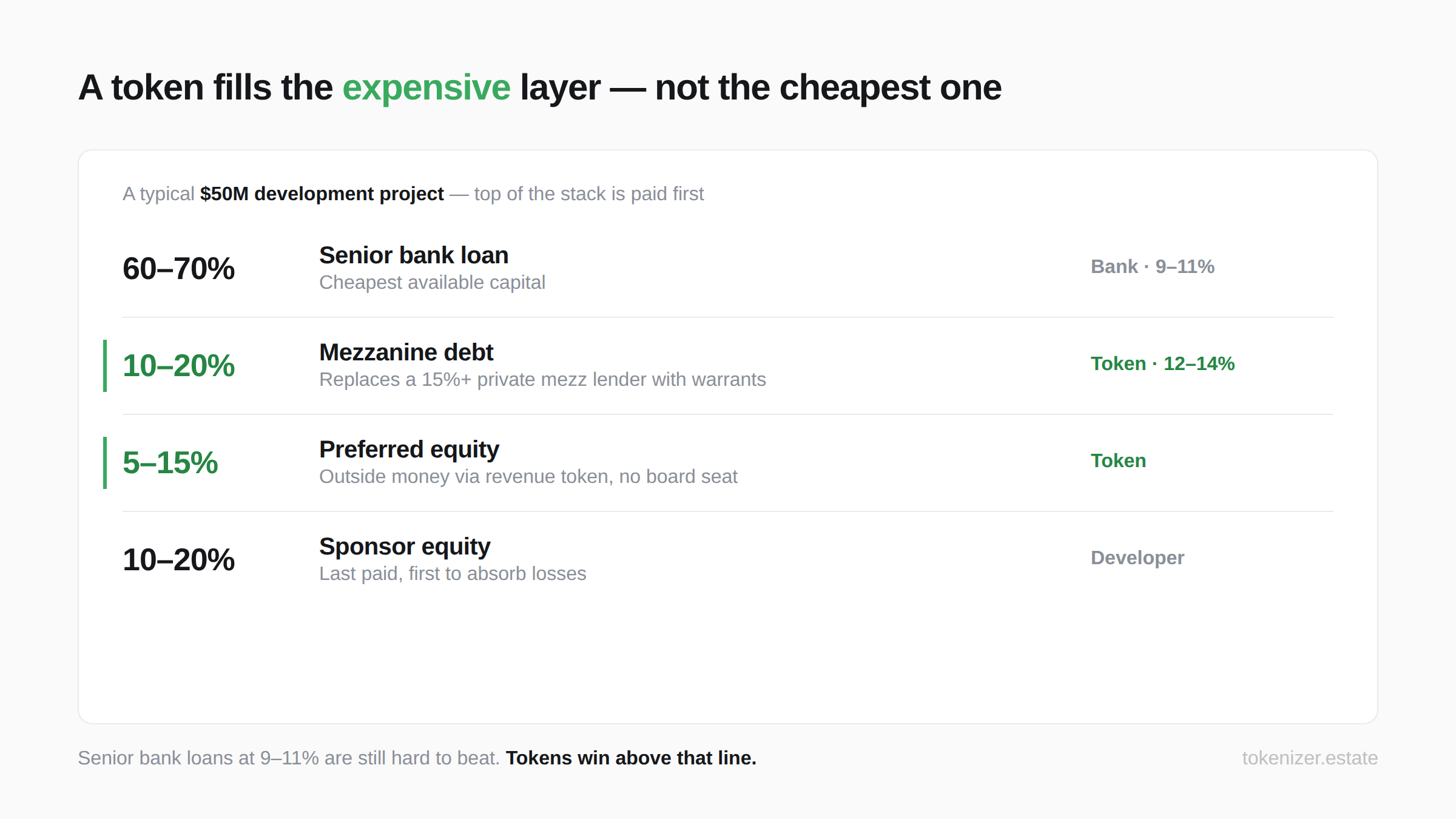
This is the part that catches most developers off guard. Tokenization is not always the cheapest option, and it is not meant to be. Against cheap senior bank debt, the bank usually wins. Against a private mezzanine lender charging a steep rate plus warrants, a tokenized debt instrument with cleaner terms is where tokens earn their place.
For sponsor equity, the layer that takes the most risk and waits the longest, tokens give the developer a way to bring in outside money without giving up control of the project. Revenue participation tokens, in particular, let an investor share the upside without sitting on the board.
The smart contract enforces the order of payment on every distribution. Senior debt gets paid first, mezzanine second, revenue tokens or preferred equity third, sponsor equity last. This is exactly how a traditional waterfall works. The difference is that the smart contract does the math automatically every quarter, instead of a fund administrator running spreadsheets.

Deals matching this pattern are already live in 2026. Construction-stage loan revenue interests, once the domain of a single private lender, are now being split across many accredited investors under existing securities frameworks, both as single-project raises and as pooled debt funds lending across multiple developments. These are operating structures, not pilots.
What it really costs and what it really delivers
This is where developers need to think carefully, because the marketing around tokenization sometimes oversells the cost story.
The headline benefit you hear is the elimination of intermediaries, no transfer agents, no quarterly distribution checks, no investor relations team cutting paperwork. The smart contract handles all of that. Operational costs at scale do drop materially compared to a traditional fund structure.
That advantage compounds at scale. Setup costs for a tokenized offering, legal structuring, smart contract development, audits, and KYC infrastructure, are largely fixed, so they weigh more heavily on smaller raises and become marginal on larger ones. For the larger deals where tokenization fits best, the same compliance and distribution platform handles a bigger raise almost as efficiently as a smaller one, and the marginal cost of adding investors approaches zero. That is where the model is strongest.
Tokenization also delivers speed. A traditional mezzanine raise can take several months from term sheet to close. A tokenized offering on an established platform can close materially faster when the legal wrapper and asset documentation are ready. For a developer trying to lock in a construction window, that compression matters. Tokenization works best as a complement to bank financing rather than a replacement for it. Where a bank offers cheap senior debt, that stays the efficient choice. Tokens earn their place in the layers banks tend to avoid: the mezzanine layer, the construction-stage equity layer, and the cross-border investor base a domestic bank cannot reach.
There is also a less-obvious benefit. Onboarding mechanics matter more than developers expect. Modern tokenization platforms now support embedded-wallet flows that work through email login, removing the need for investors to manage their own private keys. Without that, a meaningful share of accredited investors abandon the process at the wallet step. With it, the offering actually completes.
What to get right before a construction-stage raise
Construction-stage tokenization works, and the developers who run it well are the ones who plan for six things up front. None of these is a dealbreaker. Each is a checklist item that experienced counsel and an established platform handle as a matter of routine.
The first is comparing cost of capital to the right benchmark. The token coupon should be measured against the layer it actually replaces, the mezzanine or preferred-equity tranche, not against retail wealth products. Judged that way, a tokenized instrument routinely comes in below what a private mezz lender would charge.
The second is senior-lender consent. If a bank construction loan is already in place, confirm in writing that the bank will subordinate to a tokenized mezzanine layer before the offering starts. Some traditional lenders are still getting comfortable with tokenized debt above their position, so this is a conversation to have early rather than late.
The third is the construction-stage NAV vacuum. There is no operating cash flow to anchor the token's price during construction. If the secondary market opens before the project is complete, prices can swing on sentiment rather than asset performance. Some platforms address this with scheduled milestone valuations and independent verification by quantity surveyors. Others do not.
The fourth is jurisdictional re-registration. A token offering structured for Dubai investors under VARA does not automatically work for European investors under MiFID II. Cross-border distribution sounds frictionless on-chain, but in practice it requires manual jurisdiction-by-jurisdiction configuration of investor eligibility. Some emerging markets now require tokenization pilots to seek regulator approval before launch, so cross-border eligibility is worth configuring before onboarding starts.
The fifth is the Reg D 506(c) lockup. US accredited investors expect to trade their tokens immediately because the blockchain settlement implies tradability. They cannot. Securities Act Rule 144 imposes a 12-month holding period on restricted securities. This needs to be communicated clearly at the offering, not after the fact.
The sixth, and the one to draft most carefully, is enforcement. The smart contract reliably enforces the payment waterfall, while remedies against the SPV itself, such as placing a lien on a partially built asset, still run through the courts in the jurisdiction where the property sits. Because construction-stage instruments are a newer category, strong offering documents and experienced counsel are what make holder protections clear from the start.
Handled up front, none of these is an obstacle. Together they are simply the difference between a raise that closes cleanly and one that runs into avoidable friction. The developers who treat them as a pre-launch checklist, with experienced counsel and a platform that has done this before, are the ones whose deals work.
The bottom line for developers and asset owners
Tokenization is a real financing channel for construction in 2026. It is not a replacement for bank lending and it is not free money. It is a structured way to bring outside capital into the layers of the capital stack where banks will not go and where private mezz lenders charge too much.
For a developer, the question to ask before tokenizing is not whether the technology works. It does. The question is whether the layer of the capital stack you are trying to fill matches what tokens do well. Senior debt from a bank is still cheaper. Sponsor equity from yourself is still safer. Tokens are the right answer for the mezzanine layer, the preferred equity layer, and any deal where you need to bring in dozens of accredited investors instead of one private fund.
For an owner of a yacht, a factory, a marina, or any other asset that needs construction or expansion capital, the same logic applies. The token does not change the asset. It changes who provides the money and on what terms.
Tokenization fits best on larger projects with a clear legal wrapper, where senior bank debt is already lined up or unavailable on reasonable terms, and where the mezzanine or equity gap is large enough to justify the setup. On smaller raises a traditional private placement can be the simpler route, and tokenization is never a substitute for real underwriting and disclosure.
When a developer, a fund manager, or an asset owner sits down to decide whether to tokenize, the first question is always the same: which layer of the capital stack am I filling, and is a token the cheapest credible source for that layer? The token does not change what gets built. It only changes who pays for it. Answer the question honestly, and the rest of the deal follows a defined path. Developers weighing a construction-stage raise can see how the platform fits their use case on Tokenizer.Estate's property developers page.
This article is for informational purposes only and does not constitute investment, legal, or tax advice. Always conduct your own due diligence and consult qualified professionals before structuring a tokenization project or investing in a tokenized offering.
Share this post
Build your own tokenization business with Tokenizer.Estate
Tokenizer.Estate provides a full end-to-end solution — from legal setup to blockchain infrastructure — to help you launch your project with confidence
Book a Free Consultation