Why tokenized funds scaled first, and why real estate is next
Tokenized Treasuries and funds lead the RWA market while property equity lags, yet real estate is already on-chain in another form. The reasons are structural, and here's what issuers should take from it.

If you only read the headline numbers, tokenized real estate looks like it is losing. The on-chain real-world-asset market, stablecoins excluded, reached about $29 billion in the first quarter of 2026, roughly 263% above its 2024 level. Very little of that growth came from property.
Treasuries and money-market funds lead. Private credit and gold follow. Real estate sits so far down the list that most trackers can't measure it cleanly.
Anyone tokenizing property should take that seriously. Our reading is that the easy assets went first, for reasons that say little about real estate as an asset, and that the infrastructure built for them is starting to reach property. There is also a strong argument against that view, and we'll get to it.
Key takeaways
Tokenized Treasuries and money-market funds are the largest RWA category: about $13 billion in April 2026 and roughly $16 billion by August.
Funds scaled first because they are standardized, priced daily, legally simple and already liquid. Real estate is the reverse on each count.
Property is already on-chain at scale in one form: loans secured by homes. Tokenized property equity is what lags.
The market rails launched in 2026 cover listed stocks, ETFs and Treasuries only. Property can already use the settlement, custody and compliance pieces; access to regulated venues will take longer.
Issuers who structure clean, transfer-ready deals now will be first in line when that access opens.
What the numbers actually say
The RWA market is several markets growing at different speeds, and the totals depend on how you count. RWA.xyz, the tracker most figures come from, reported about $26.7 billion in distributed value in June 2026. Distributed means tokens investors actually hold and can transfer. A much larger represented figure also counts assets recorded on-chain but never sold as tokens.
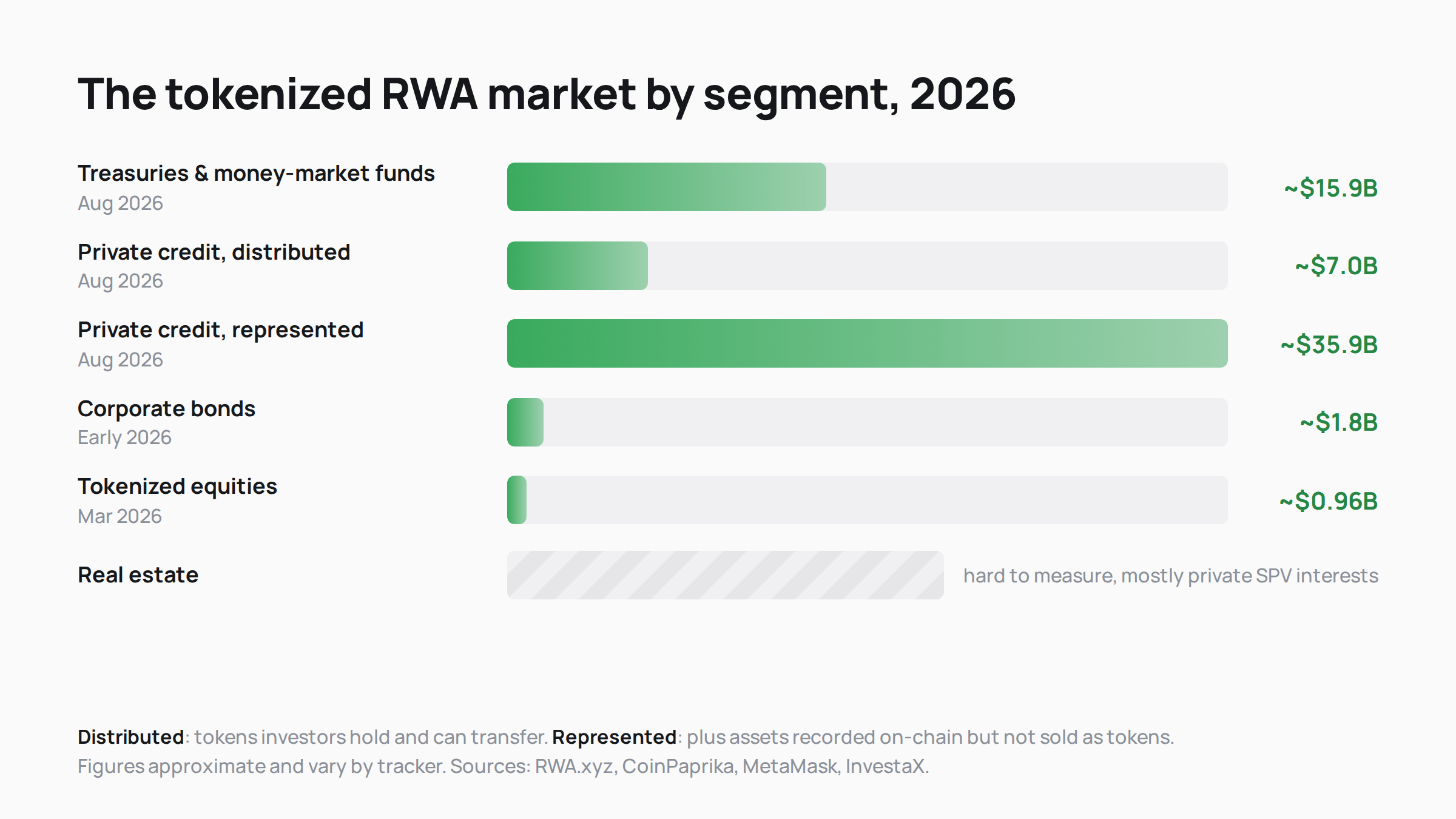
On distributed value, Treasuries lead and private credit comes second. On represented value, private credit is larger than everything else combined. Keep that second number in mind; it matters for real estate below.
Tokenized property equity has no clean figure. Most of it sits in private SPVs whose interests rarely trade, so trackers barely register it. Even the best-known retail platforms have each stayed below $100 million in on-chain value.
Why the easy assets went first
Real estate is already on-chain, as debt. Here is the number most "real estate is losing" takes miss. The gap between private credit's $7 billion distributed and $36 billion represented value comes almost entirely from one US fintech lender that records its home equity lines of credit on its own blockchain.
In other words, the largest pool of real-world assets recorded on-chain by that measure is loans secured by houses. Property is there in size. It arrived as debt rather than as equity.
That fits the rest of the story. A pool of home equity loans behaves more like a fund than a building does: standardized underwriting, predictable cash flows, servicing systems that already exist. The market tokenized the fund-shaped part of real estate first. For equity issuers, the lesson is to make their deals as fund-shaped as possible.
The honest counterargument
A skeptic would point to the retail platforms that pioneered tokenized rental homes. They have offered on-chain transfer and regular rent payouts in stablecoins for years, and none has grown past $100 million on-chain. The largest of them, which raised about $140 million against roughly 700 Detroit homes, announced voluntary liquidation in July 2026 after suspended payouts, a lawsuit from the city and a court-appointed fiduciary.
If missing infrastructure were the whole problem, the pioneers should have fared better.
We think the skeptic is partly right. Tokens do not create buyers, and they do not manage buildings. The Detroit failure came down to property operations and concentration: hundreds of homes in one city, many out of line with local housing rules. No settlement rail fixes that.
Secondary liquidity also needs people willing to price a specific house they have never seen, which is a demand and information problem as much as a technical one. The early platforms sold mostly small single-family homes to retail buyers, with no institutional capital and no regulated venue behind them.
What the new infrastructure changes is the cost and the buyer pool. Regulated settlement, institutional custody and compliant token standards make a deal cheaper to run and open it to investors who could not touch it before. They do not make a weak asset or a fuzzy valuation attractive. Property tokenization will grow where deals are good and priced transparently, and stay small where they are not.

What 2026 changed, and what it hasn't yet
The core of US market plumbing moved on-chain this year:
DTCC. The SEC gave DTC a no-action letter in December 2025 to run a tokenization service. On July 15, 2026, DTCC processed its first live production trades with tokenized stocks, ETFs and Treasuries, with more than 30 firms taking part. Full launch is planned for October 2026.
Nasdaq. In March 2026 the SEC approved Nasdaq's rule change allowing trading in tokenized form, on the same order book as the traditional shares.
NYSE. ICE and the NYSE are working with OKX on tokenized stock trading.
Stablecoins. The GENIUSThe honest counterargument Act, signed in July 2025, gave payment stablecoins a federal legal framework, which makes them usable as a settlement layer for regulated products.
The scope is narrow. The Nasdaq and DTC pilots cover Russell 1000 stocks and major index ETFs, plus Treasuries at DTC. Interests in a private property SPV are not on that list, and they will not be soon.
So it would be wrong to say property tokens will trade on Nasdaq next. What does carry over is everything underneath the venue: stablecoin settlement for rent distributions, institutional custody for tokenized securities, permissioned token standards with transfer rules built in, and regulators who now have a working model for tokenized ownership. A property issuer can use all of that today.
What real estate issuers should take from it
Make the deal look like a fund. Funds scaled on clean structure, clearly defined rights and reliable valuation. The property deals that go furthest will copy that: one SPV per asset or a clearly defined pool, token-holder rights written precisely, and valuation updated often enough to price a trade. Home equity loans reached on-chain scale because they already worked this way.
Design for the exit from day one. Nobody can create a deep secondary market alone. What an issuer can do is make the token eligible for one when venues open: transfer rules enforced in the token, a qualified custodian, and documentation a regulated venue could accept.
Use what already works. Stablecoin settlement, institutional custody and permissioned-token compliance were built for funds and are in production now. Waiting for tools made specifically for property means waiting while others build track records.
Be realistic about demand. Infrastructure lowers costs; it does not sell the asset. The retail pioneers showed that a smooth platform cannot carry weak assets or weak operations. Start with assets you would be comfortable defending to an institutional buyer.

Frequently asked questions
Is tokenized real estate failing? Tokenized property equity is small, but real estate is already a large part of the on-chain market as debt, mainly tokenized home equity loans. Equity lags because each building is unique, valued periodically and slow to sell.
Why are tokenized Treasuries so much bigger? They are standardized, priced daily, legally simple and already liquid. Tokenizing them adds faster settlement without solving new problems. Property needs title, valuation, custody and an exit path solved at once.
Can tokenized property trade on Nasdaq or through DTCC? Not today. Both pilots cover large listed stocks, index ETFs and Treasuries. Property issuers can already use the settlement, custody and compliance tools those markets rely on.
Should I wait before tokenizing a property? Only if the deal itself isn't ready. The tools are in production now, and early issuers build the track record that later investors and venues will look for.
Will tokenized real estate catch up with Treasuries? Probably not in raw size soon. Treasuries are a deeper, standardized base asset. Property gains more from tokenization in relative terms, though, because fractional access and a working exit are exactly what it has lacked.
Tokenizer.Estate provides the white-label software layer for real estate tokenization: token issuance, investor onboarding, and automated distributions under your own brand, with the legal structuring left to your own counsel. If you are building property deals for the infrastructure that is arriving, see how the platform architecture fits together.
This article is for informational purposes only and does not constitute investment, legal, or financial advice. Market figures are drawn from third-party trackers, vary by methodology, and change over time. Tokenized real estate is a security in most jurisdictions. Consult qualified professionals before issuing or investing.
Share this post
Build your own tokenization business with Tokenizer.Estate
Tokenizer.Estate provides a full end-to-end solution — from legal setup to blockchain infrastructure — to help you launch your project with confidence
Book a Free Consultation