Tokenized funds: how fund managers tokenize fund units, step by step
A tokenized fund is still a fund: only its units and register move on-chain. Here is what that changes for subscriptions, NAV, distributions and redemptions, and how to tokenize a fund step by step.

On 4 June 2026, a real estate fund in Luxembourg issued its units on Goldman Sachs' distributed ledger. The cast list was ordinary: an AIFM, an administrator, a depositary, a bank, and a property manager making the investment calls. Ledger Insights described it as "a standard third party management company (ManCo) arrangement where the fund units happen to be issued onchain."
That sentence is the most useful definition of tokenized funds you will find. The fund stays a fund. Its units, shares, or LP interests become tokens, and the register that records who owns them moves onto a blockchain. Your strategy, your fund documents, and your regulator stay where they were. What changes is the plumbing: how investors subscribe, how ownership is recorded, how NAV and distributions reach people, and how one investor sells to another.
This guide is for a manager who has already decided a fund is the right vehicle and wants to know how fund tokenization works in practice. If you are still choosing between tokenizing one building and pooling several, start with our decision framework for single-asset vs. fund tokenization. If you want the market story of why money market funds went first, read why tokenized funds scaled first, and why real estate is next. Here we stay in the back office.
What a tokenized fund is (and what it isn't)
A tokenized fund is a regulated or private investment fund whose units are recorded and transferred as tokens on a blockchain. The token is the unit. It is not a derivative of the unit, a receipt for it, or a crypto asset that tracks it. When an investor holds 1,250 tokens of your fund, your register says they hold 1,250 units, and the fund documents give those units their rights.
Franklin Templeton's on-chain US government money fund is the cleanest public example of how far this goes. Its 2024 SEC registration filing states that "the Fund's transfer agent maintains the official record of share ownership via a proprietary blockchain-integrated system", using Stellar as the primary chain with Polygon, Aptos, Avalanche and Arbitrum available for some accounts. It is still a 1940 Act mutual fund. It still prices at the next NAV after an order arrives. It still has a 1 p.m. Pacific cut-off. The blockchain is the register, not a new product.
In practice, managers take one of two routes.
Route 1: tokenize the fund's own units
The fund issues its units directly as tokens. BlackRock's BUIDL works this way: at its launch on 20 March 2024, a specialist tokenization firm was appointed transfer agent and tokenization platform, while Bank of New York Mellon remained custodian of the fund's assets and its administrator. The Goldman Sachs and Apex fund in Luxembourg is the real estate version. Per Paperjam, Apex's Fundrock LIS acts as AIFM, Apex Fund Services Luxembourg provides administration and depositary services, LRC Group is the manager, a regulated digital asset exchange holds the digital securities and is the first distribution partner, and GS DAP carries the units.
Route 2: tokenize a feeder or SPV that holds the fund
You leave the existing fund untouched and create a new vehicle that invests into it, then tokenize that vehicle. Apollo did this in January 2025 with ACRED, described at launch as a feeder that "offers tokenized access to Apollo Diversified Credit Fund", with a specialist provider acting as digital transfer agent and fund administrator. The feeder investor holds an interest in the feeder, and its terms, not the master fund's, define what that interest carries.
Native units (Route 1) | Feeder / SPV wrapper (Route 2) | |
|---|---|---|
What the token is | The fund unit itself | An interest in a vehicle that holds fund units |
Changes to the main fund | Register, dealing process, often constitutional documents | Usually none |
Investor rights | Same as any other unitholder | Defined by the feeder or SPV terms, sometimes economic only |
Best fit | New funds, or funds whose investors all move on-chain | Existing funds that want a new, digital distribution channel |
Extra cost | Migration work | A second vehicle with its own accounts, audit and fees |
Neither route is a shortcut around securities law. The wrapper decision has tax and governance consequences of its own, which we cover in SPV, trust, and fund wrapper: which legal structure fits which asset type.
Tokenized funds in numbers, October 2026
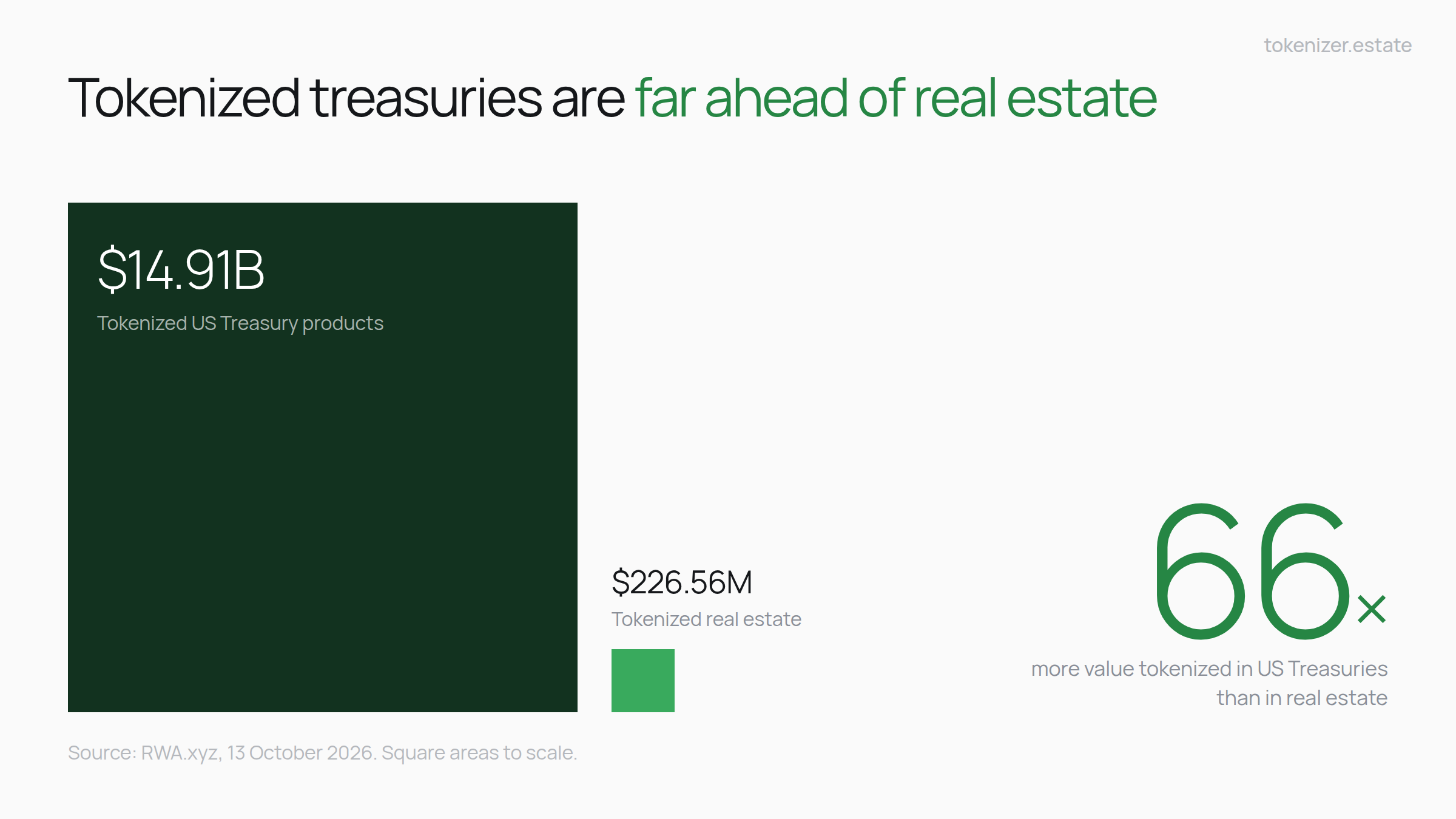
As of 13 October 2026, RWA.xyz counts $14.91 billion in tokenized US Treasury products, while its real estate page shows $226.56 million distributed. We explain why that gap exists in why tokenized funds scaled first. For a manager, the useful reading is practical: money market funds scaled first because their operations were already standardised, and a real estate fund has to do the same operational work with less frequent valuations and lumpier cash flows. The rest of this guide is about that work.
What changes in fund operations when you tokenize
Here is the part most guides skip. Every line below is something your administrator, transfer agent, or investor relations team does today. Tokenization changes how each one is done, and sometimes who does it.
Function | Traditional fund | Tokenized fund |
|---|---|---|
Investor onboarding | Subscription pack, manual KYC, side letters | Online KYC/AML, eligibility recorded, wallet whitelisted |
Subscriptions | Wire, admin matches cash to forms, units booked days later | Payment confirmed, tokens transferred to the investor's wallet |
Register | Transfer agent's database or spreadsheet | On-chain token balances, controlled by the transfer agent or issuer |
NAV | Administrator calculates, PDF statements sent | Administrator still calculates; NAV per unit published to the platform and investor dashboard |
Distributions | Admin computes each LP's share, batch of wires | Smart contract provides a snapshot of unit holders at the time of distribution |
Redemptions | Notice letters, gate calculation in Excel | Request in the dashboard, tokens burned on settlement |
Transfers between investors | Consent letters, register update, weeks | Peer-to-peer between whitelisted wallets, rules enforced by the smart contract |
Subscriptions
An investor completes onboarding, pays in fiat or stablecoin, and once payment clears, tokens are transferred to their wallet at the dealing price. The paperwork that used to sit between "money received" and "units issued" disappears, but the dealing rules do not. Franklin's fund still prices orders "at the NAV next calculated after we receive your request," exactly as its filing says. Your cut-off times, minimums and closing dates carry over. BUIDL kept a $5 million initial minimum at launch: tokenization does not force you to cut tickets, it gives you the option.
The register and the transfer agent
This is where the real change happens. The token balances become the register of unitholders, so whoever controls the token contract controls the register. In the US that role usually sits with an SEC-registered transfer agent, as it does for BUIDL. Franklin's filing says that all fund and shareholder records in its blockchain system "are under the full and complete control of the Fund's transfer agent."
Regulators are now writing this down. On 30 April 2026 the UK FCA published PS26/7, which confirms that for authorised funds "an on-chain record of transactions may be considered the primary books and records for unit deals", and that a firm does not need a full off-chain "mirror" if it has appropriate resiliency plans. The FCA also added guidance for units of one class recorded on several blockchains, as long as holders' rights and charges stay the same. Even if you are not a UK manager, that is a good checklist for what your own regulator will ask: who controls the record, how you recover it, and whether every holder of a class is treated alike.
The practical consequence: someone must be able to freeze, force-transfer, or re-issue tokens when a court order, a lost key, or a death in the family requires it. A permissioned token with administrator controls is not a compromise of the idea. It is what makes the register legally usable.
NAV publication
Tokenization does not value your buildings. Your administrator or external valuer still produces NAV, on the same schedule your documents set. What changes is distribution of the number: the NAV per unit can be published to the platform the moment it is signed off, every investor sees their position revalued in their dashboard, and the same figure drives the next subscription and redemption price. For a real estate fund with quarterly or semi-annual valuations, the old problem of stale NAV is unchanged, and we explain why in how tokenized property is valued. Publish the valuation date next to the price. Investors who trade between valuations need to know how old it is.
Distributions
Distributions are where managers feel the time saving first. At the time of distribution, the smart contract provides a snapshot of unit holders and their balances, so the list of who is owed what comes straight from the register instead of a spreadsheet. The payments themselves usually go out the way they always have, by bank transfer or through a payment provider, because in practice very few funds pay investors directly through smart contracts. Some products do: BUIDL at launch paid accrued dividends to investors’ wallets as new tokens each month, per its press release. A real estate income fund will more often pay cash quarterly.
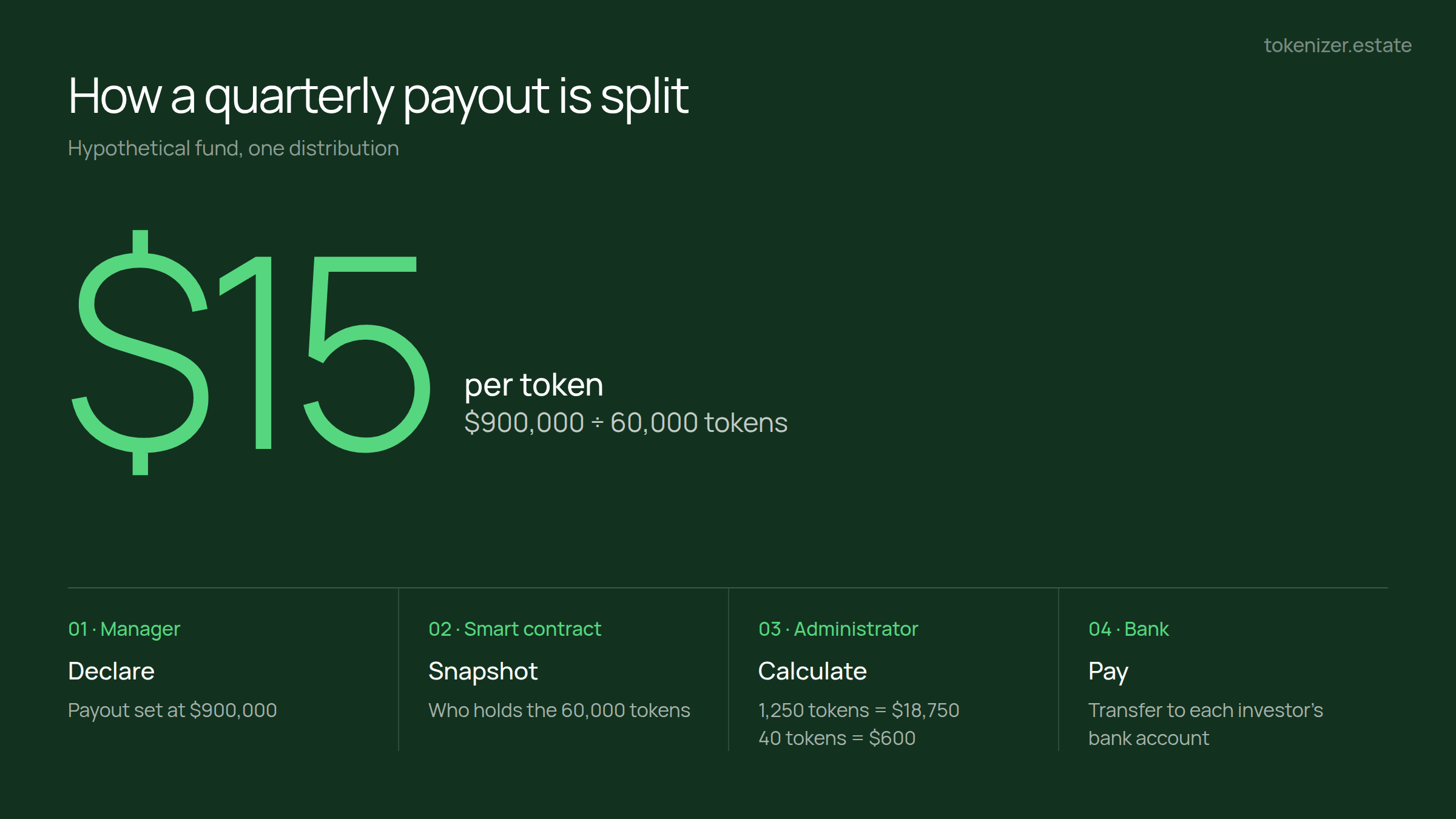
Say your fund has 60,000 tokens outstanding and declares a $900,000 quarterly distribution. That is $15 per token. The snapshot shows that an investor with 1,250 tokens is owed $18,750 and an investor with 40 tokens is owed $600, and nobody in your office rebuilds the investor list by hand before 140 payments go out. Withholding tax and investor-specific deductions still need to be applied correctly before payment.
Redemptions
Money market funds can promise daily redemptions. A property fund cannot, and the token does not change that. Apollo's ACRED offers native redemptions at a daily NAV because its underlying credit portfolio supports it. BUIDL added a route through Circle, a smart contract offering a 1:1 swap into USDC, which BUIDL's own documents describe as not guaranteed.
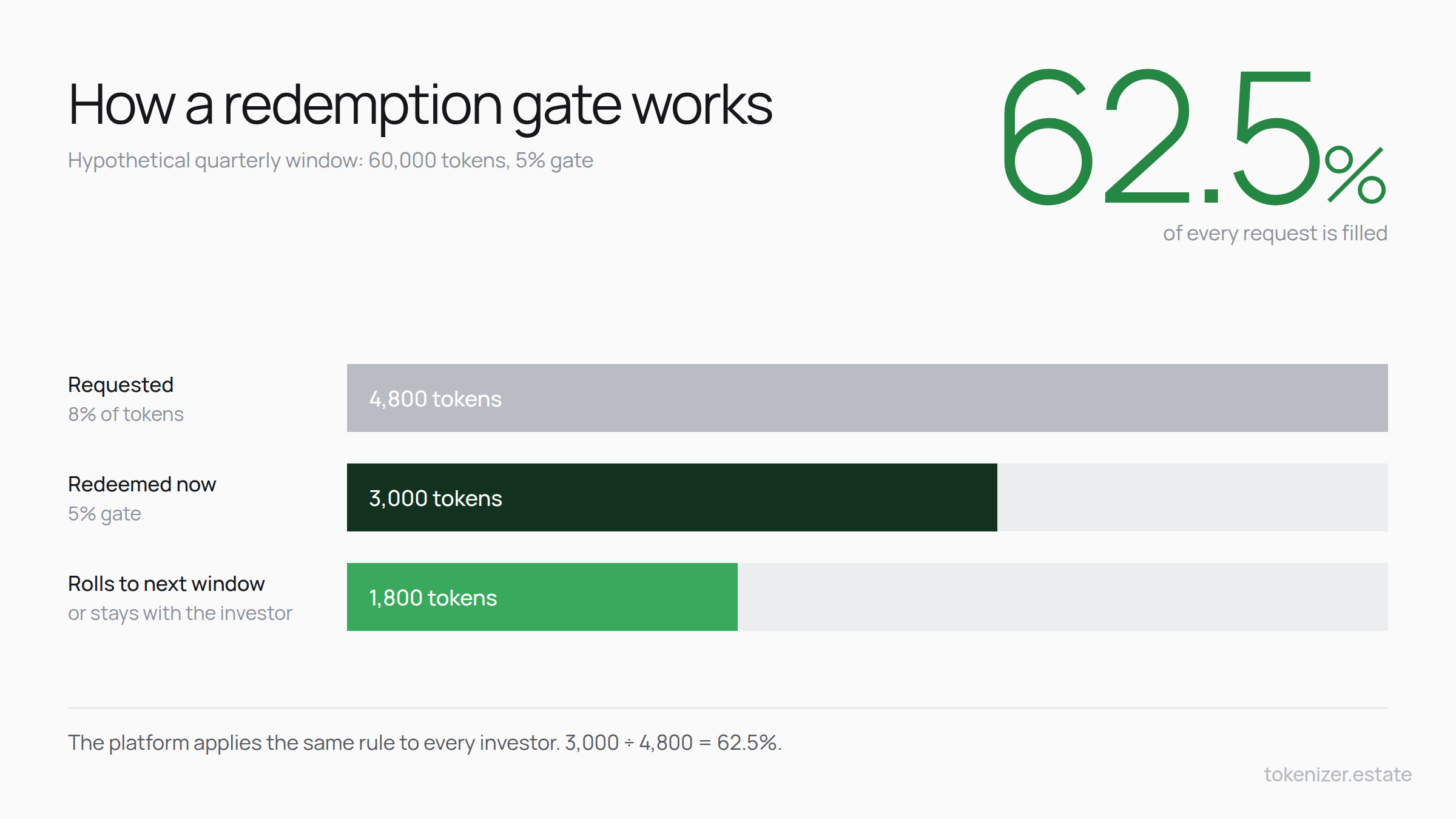
For a tokenized real estate fund, keep the redemption terms you would have anyway: windows, notice periods, gates. Then let the platform run them. If your quarterly window gets requests for 4,800 tokens against 60,000 outstanding (8%), and your gate is 5%, the platform redeems 3,000 tokens and fills every request at 62.5%. The remainder rolls to the next window or stays with the investor. The math was always simple. Executing it consistently across a hundred investors is the part that used to break.
Investor onboarding
Every investor passes KYC/AML before they can hold a token, and their eligibility (accredited, professional, qualified purchaser, country of residence) is recorded against their wallet. The token contract then refuses transfers to wallets that are not on the list. BUIDL's documents state it plainly: primary and secondary trading are limited to whitelisted investors who pass KYC/AML onboarding. Our KYC/AML guide for tokenized securities covers what to check and how often to refresh it.
Transfers between investors
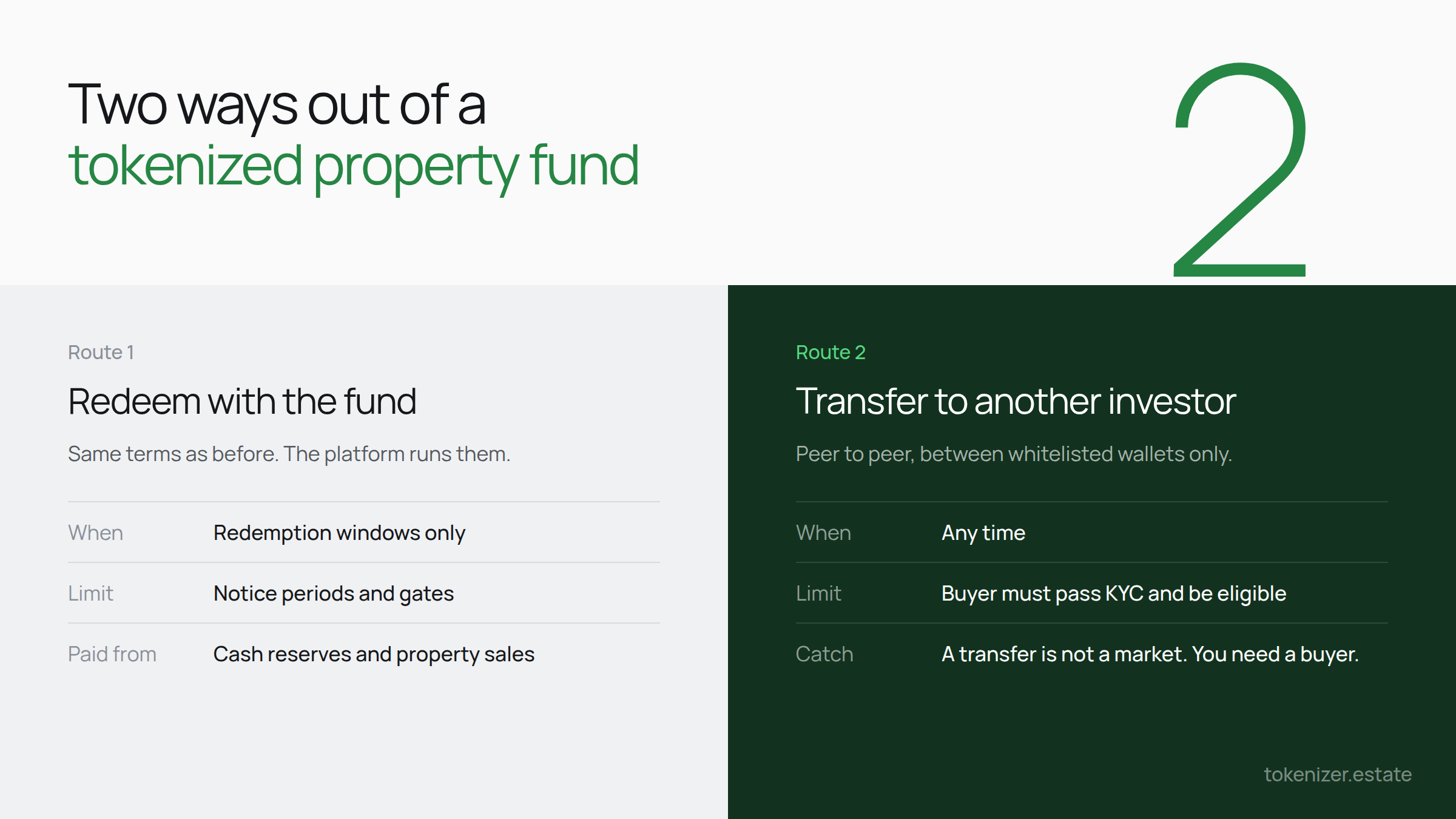
This is the feature LPs ask about, and the one to promise carefully. Whitelisted holders can move tokens peer to peer: BUIDL investors "can transfer their tokens 24/7/365 to other pre-approved investors," and Franklin's filing allows transfers "from one shareholder wallet to another shareholder wallet." But a transfer is not a market. IOSCO's final report on tokenisation (11 November 2025) found that many promised benefits, "particularly concerning secondary market liquidity," have not materialised yet, and that secondary trading of tokenized MMFs is limited and restricted to whitelisted investors. Sell transferability. Do not sell liquidity.
How to tokenize a fund: a step-by-step plan
The order matters more than the speed. Most delays in fund tokenization come from making a technology choice before the legal one.
Choose the route. Native units for a new fund, or for an existing fund whose investors will all migrate. A feeder or SPV if you want to add a digital channel without touching the master fund. Write down what the token legally represents in one sentence. If your lawyer cannot sign that sentence, stop here.
Confirm jurisdiction and regulator position. Check whether your fund law allows an electronic or DLT register, who must keep it, and whether the regulator expects notification. The FCA's PS26/7 is an example of a regulator answering these questions in writing; in other jurisdictions you may need to ask.
Design the token. One token per unit or a fractional unit. Which share classes become tokens. Who may hold it and in which countries. Lock-ups. Distribution currency (fiat, stablecoin, or both). Redemption mechanics and gates. Administrator powers: freeze, force transfer, re-issue. These choices should mirror your fund documents line by line. On a platform with ready-made contracts, most of them are settings rather than code: Tokenizer.Estate's smart contracts are fully compliant with most regulatory regimes, and deployment takes one click.
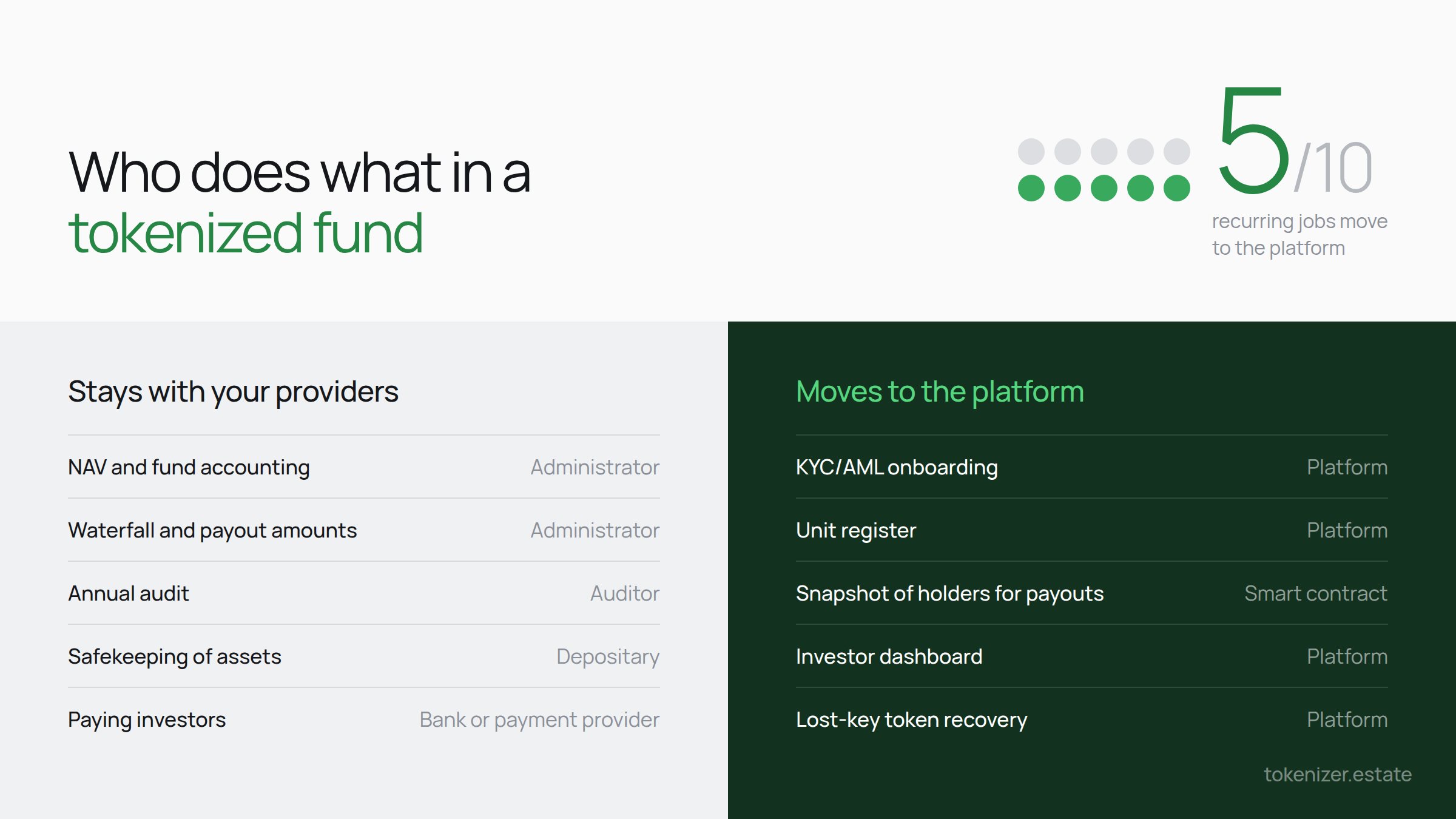
Map your service providers. Your administrator still calculates NAV, your auditor still audits, your depositary or custodian still holds the assets. Add the tokenization platform, the KYC provider, payment rails, and, if investors hold their own tokens, a wallet or custody option for those who do not want to manage keys. Decide who is the record keeper of last resort.
Update the documents. Prospectus or PPM, LPA or articles, subscription agreement, and risk factors need to describe the token, the register, the chain, and what happens if the chain or platform fails.
Deploy and audit the smart contract. Test every dealing event on a testnet with fake investors: subscription, distribution, gated redemption, transfer to a non-eligible wallet (which must fail), lost-key recovery.
Migrate existing investors (existing funds only). Set a cut-over date. Reconcile the old register to the unit. Get consents where your documents require them. Onboard each LP and assign a wallet, then transfer tokens equal to their existing holdings. Run the old and new registers in parallel for at least one dealing cycle and reconcile them before you switch the old one off.
Launch and report. Open subscriptions, publish the first NAV on the platform, run the first distribution, and keep investor reporting on the schedule your documents promise.
A worked example. Say you manage a $60 million income fund with 140 LPs and quarterly valuations. Route 1 makes sense if all 140 LPs agree to move and you want lower minimums for new money. Route 2 makes sense if a dozen LPs refuse to touch a wallet: the master fund stays as is, and a tokenized feeder raises the new money. Many managers pick Route 2 first and fold it into Route 1 once the operations prove themselves.
Common fund tokenization mistakes
Promising liquidity the assets can't support. Daily dealing on a fund of buildings is a liquidity mismatch with a nicer interface. Keep the redemption terms honest and explain them in the dashboard, not only in the PPM.
Two registers that disagree. If the same units are recorded both off-chain and on-chain, the two records can diverge, and you will find out during a distribution. The clean fix is to separate them: keep the register for tokenized units or share classes on-chain, keep the register for the rest off-chain, and never record the same unit in both.
A token that doesn't match the documents. Transfer rules in the code that differ from transfer rules in the LPA create a legal problem the first time someone tests the gap.
No plan for lost keys and deceased holders. Investors lose keys and investors die. Your contract needs administrator recovery, and your documents need to say when you will use it. On Tokenizer.Estate this is solved in the architecture: if an investor loses their keys, their tokens can be recovered to a new verified wallet.
Forgetting the people who don't want wallets. Some of your best LPs will never self-custody. Offer a custodial option, or they will stay out.
Treating launch as the finish line. The work of a tokenized fund is the next forty quarters of NAVs, distributions, redemptions and investor questions. Pick infrastructure for that, not for the press release.
Running tokenized funds on your own branded platform
BlackRock and Apollo used a large specialist tokenization provider. Goldman's fund runs on GS DAP. A real estate manager with $50 million to $500 million under management usually has a different problem: the large tokenization providers are built for large tickets, and building your own register, investor portal and contracts in-house is a year-long software project you did not set up the firm to run.
This is the gap Tokenizer.Estate for funds is built for. It is a white-label platform that you run under your own brand and domain, so the investor relationship stays with you. Mapped to the operations above:
Register and token rules. The smart contract generator issues permissioned ERC-20 tokens on EVM-compatible chains without a Solidity team. Contracts are audited by Hacken and manage token sale stages, dividend distribution and token redemption, the three dealing events a fund repeats every quarter.
Onboarding. KYC/AML runs through Sumsub, so eligibility checks happen before a wallet can hold a unit.
Subscriptions, NAV and distributions from the investor's side. The investor dashboard carries your logo, colours and domain. Investors buy tokens, see their holdings, and use redemption or buyback options. It accepts traditional payment providers and crypto payments, so LPs who want to wire fiat can.
The back office your administrator and compliance team need. Portfolio and transaction monitoring, investor request handling, analytics, role-based access and audit logs. Private keys are kept on separate secure infrastructure.
Distribution. A landing page builder with 30+ ready blocks gives each fund or share class its own SEO-ready offering page.
The company says a launch takes 2–4 weeks. Legal structuring and regulatory approval stay with your counsel. The platform runs the fund's operations once those are in place. You can see the pricing or book a free consultation and walk through a subscription, a distribution and a gated redemption on a test fund.
FAQ about tokenized funds
Is a tokenized fund a different legal product from a normal fund?
Usually not. In a native tokenization the units are the same units with the same rights, recorded on a blockchain. Franklin's on-chain money fund remains a registered mutual fund, and the Luxembourg fund on GS DAP is a conventional ManCo structure. In a feeder or SPV model, investors hold an interest in a different vehicle, and its terms define their rights.
Do I still need a transfer agent and a fund administrator?
In most jurisdictions, yes, or someone legally doing those jobs. Tokenization changes the tool the transfer agent uses and automates much of the administrator's routine work. It does not remove the legal responsibility for the register or the NAV.
Can a tokenized real estate fund offer daily liquidity?
Not honestly, if the assets are buildings. Tokens can transfer between eligible investors at any time, but redemptions from the fund still depend on property sales and cash reserves. Keep windows and gates, and let investors find buyers among other whitelisted holders between windows.
How do I tokenize an existing fund without forcing every LP onto a blockchain?
Use a feeder or SPV that invests into the existing fund and tokenize that, as Apollo did with ACRED. Alternatively, keep a custodial option so LPs who don't want a wallet hold their tokens through a custodian or the platform.
What is the minimum fund size for tokenization to make sense?
There is no legal minimum. The economics depend on your platform cost and on how many funds or share classes will run on the same infrastructure. Compare the provider's fees with what your administrator and transfer agent charge today. Our decision framework discusses size thresholds in more detail.
Which blockchain should a tokenized fund use?
One your regulator, custodians and investors can live with. Large managers have used public chains (Ethereum, Stellar, Polygon, Solana and others) and private ones (GS DAP). For most real estate funds, a permissioned token on an EVM-compatible chain gives you transfer controls and a wide choice of wallets and custodians.
The managers who move first won't be the ones with the cleverest token. They will be the ones whose NAV, distributions and redemptions run on time, every quarter, in front of every investor. If that is the fund you want to run, see how it works for funds.
This article is for information only and is not legal, tax or investment advice. Fund tokenization rules differ by jurisdiction; confirm your structure with qualified counsel.
Share this post
Build your own tokenization business with Tokenizer.Estate
Tokenizer.Estate provides a full end-to-end solution — from legal setup to blockchain infrastructure — to help you launch your project with confidence
Book a Free Consultation