Real estate tokenization business model: how a platform operator makes money
A tokenization platform can earn at launch, every year while assets are live, and at exit. This guide maps 9 revenue streams, shows which fees need a license, and works through two examples: an agency tokenizing clients' properties and a developer funding its own pipeline.

A real estate tokenization business model is the way a platform operator earns revenue from issuing, selling and administering property tokens. The operator is the company that runs the platform under its own brand: a real estate broker or agency, a developer, an asset manager or a fintech that offers tokenized property to its clients.
There is no single standard model. Operators combine several fee types, and each one depends on who pays, when, and which licenses the operator holds. This guide lays out the main revenue streams, which ones fit which kind of operator, and a simple template to calculate your own model. Treat it as a map of options, not a ready answer: the right combination has to be worked out for your market, your investors and your legal setup.
Key takeaways
Three groups can pay: asset owners who issue tokens, investors who buy them, and partners who use your platform.
Most revenue comes from two moments: when an offering launches (one-off fees) and while the asset is held (recurring fees). Secondary trading is usually the smallest stream today.
Some fees need a license. In the US, for example, a fee tied to the amount of securities sold is one of the signs of broker activity that can require registration.
Recurring fees decide whether the business lasts. One-off launch fees pay for growth; servicing fees pay the bills between launches.
Every model has to be calculated individually, from your expected number of offerings, raise sizes, investor numbers and costs.
Who pays in a tokenization business
Before choosing fees, decide who you charge. A tokenization platform has three possible payers, and each one reacts to fees differently.
Asset owners (issuers). Developers, landlords and funds that bring a property to your platform to raise capital. They pay for getting an offering live and for running it afterwards. They compare your fees with the cost of a bank loan or a traditional private placement, so they will pay for speed, reach and less administration.
Investors. The people who buy tokens. Fees charged to them come straight out of their return, so they are visible and sensitive. That is why some operators keep investor fees low or at zero and charge issuers instead.
Partners. Other brokers, agencies or advisers who want to use your platform for their own clients, or service providers who pay to be part of your process. This group only matters once your platform is established, but it can turn your platform into a product of its own.
If you own the properties yourself, as a developer or a fund does, issuer and operator are the same company. Then the question is not "what do I charge" but "how do I recover the platform cost across my own offerings."
Revenue streams in a real estate tokenization business model
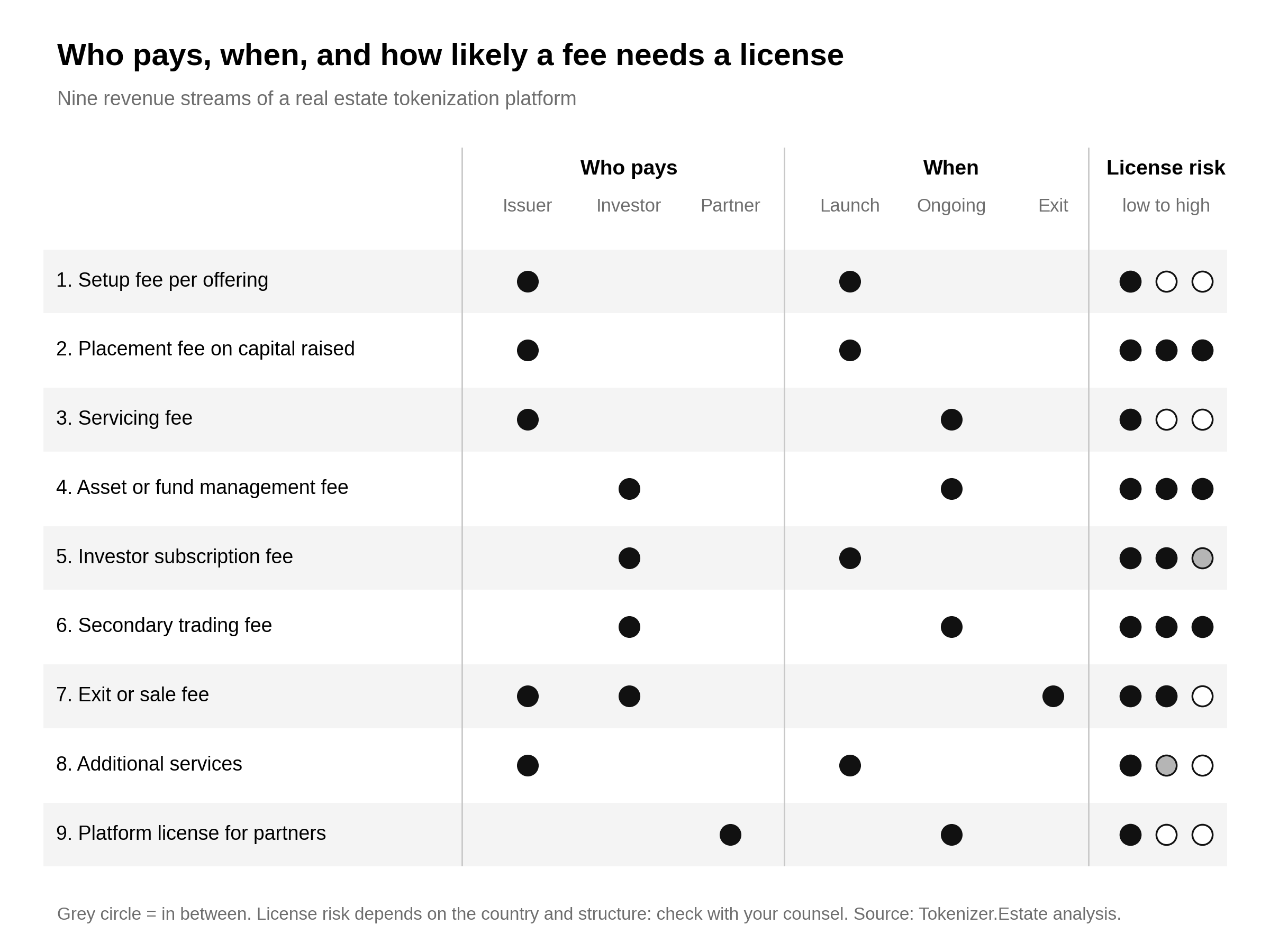
The table lists the main fee types an operator can use. You will rarely use all of them: most models combine two to four.
Revenue stream | Who pays | When | One-off or recurring | Licensing sensitivity |
|---|---|---|---|---|
1. Setup fee per offering | Issuer | Before launch | One-off | Low |
2. Placement fee on capital raised | Issuer | At closing | One-off | High |
3. Servicing fee | Issuer | While the asset is held | Recurring | Low |
4. Asset or fund management fee | Investors, via the asset or fund | While the asset is held | Recurring | High |
5. Investor subscription fee | Investor | At purchase | One-off | Medium to high |
6. Secondary trading fee | Buyer, seller or both | At each trade | Recurring, volume-based | High |
7. Exit or sale fee | Issuer or investors | When the property is sold | One-off | Medium |
8. Additional services | Issuer | When requested | One-off | Low to medium |
9. Platform license for partners | Partner | Monthly or yearly | Recurring | Low |
"Licensing sensitivity" shows how likely a fee is to need a financial license, depending on the country. The section "What changes the math" explains why.
1. Setup fee per offering
A flat fee for preparing an offering on your platform: configuring the token and its rules, the offering page, documents and investor onboarding. It is predictable and easy to explain.
Formula: number of offerings per year × setup fee.
2. Placement fee on capital raised
A percentage of the money raised in an offering. It feels fair to issuers, because they pay only when the raise succeeds, and it scales with deal size. It is also the fee most likely to require a license, because it ties your income to the sale of securities.
Formula: capital raised × placement rate.
3. Servicing fee
A recurring fee for running the offering after launch: distributions, the register of holders, investor reports and support. It can be a percentage of the tokenized value per year, a flat amount per offering per year, or a small percentage of each distribution.
Formula: tokenized value × annual rate, or live offerings × flat annual fee.
4. Asset or fund management fee
If you also manage the property or the fund that holds it, you can charge a management fee on assets under management, and sometimes a share of profits above an agreed return. This is a different business from running a platform, with its own license requirements in most countries.
Formula: assets under management × management rate, plus profit share where agreed.
5. Investor subscription fee
A percentage of each investment, paid by the investor on purchase. It is simple, but investors see it directly and compare it with other options.
Formula: capital raised × subscription rate.
6. Secondary trading fee
A fee on each transfer or trade between investors. It only works if trading actually happens, and running a venue where securities trade usually requires a license or a licensed partner.
Formula: trading volume × fee rate.
7. Exit or sale fee
A fee when the property is sold and investors are paid out. For brokers and agencies this is familiar territory: it works like a sales commission, only the proceeds go to token holders.
Formula: sale value × exit rate.
8. Additional services
Services around the offering that some issuers want to buy: coordinating legal structuring with partner law firms, investor marketing campaigns, valuation, extended reporting. Identity checks are often passed through at cost or with a small margin.
Formula: number of services sold × price per service.
9. Platform license for partners
Once your platform runs smoothly, other brokers or advisers may want to use it for their own clients. You can charge them a subscription and keep a share of their offering fees.
Formula: number of partners × subscription, plus share of partner fees.
Which real estate tokenization business model fits which operator
The right mix depends less on the technology and more on what kind of company runs the platform.
Operator | Typical combination | Watch out for |
|---|---|---|
Broker or real estate agency tokenizing clients' properties | Setup fee + servicing fee + exit fee on sale | Placement fees on the capital raised may require a license or a licensed partner |
Developer tokenizing its own projects | No fees to itself. The platform cost is weighed against the cost of raising capital elsewhere, and the gain is repeat raises with the same investors | Treat the platform as a cost of capital, and compare it with bank financing per project |
Asset manager or fund | Management fee on assets + servicing fee, sometimes a profit share | Fund rules and licenses apply regardless of tokenization |
Marketplace for many issuers | Setup fee + placement fee + servicing fee, later partner licenses | Needs its own investor base and the strictest licensing setup |
Whatever the operator type, a model that earns something every month from offerings already live is more stable than one that depends only on new launches.
How to calculate your own tokenization business model
You do not need a complex spreadsheet to test a model. Five inputs drive most of the revenue:
Offerings per year: how many properties you realistically bring to market.
Average raise per offering: how much capital each one collects.
Your fee rates: setup fee, placement rate (if you can legally charge it), servicing rate.
Average ticket: the typical investment size, which tells you how many investors each offering needs.
Cost per investor: identity checks and the marketing it takes to bring each investor in.
Annual revenue = offerings × setup fee + capital raised × placement rate + average live tokenized value × servicing rate.
Investors you need = capital raised ÷ average ticket. Multiply by your cost per investor to see how much the raise costs you to fill.

Two examples
The figures below are illustrative assumptions, not market rates. Replace them with your own.
Example 1: an agency that builds a platform for other owners
A real estate agency buys a white-label platform and offers tokenization to its clients: landlords and developers who want to raise capital. Each property is worth $2 million. The agency charges each owner a $10,000 setup fee once and a flat servicing fee of $5,000 a year while the offering is live, which is 0.25% of the property's value.
The agency brings 5 new properties onto its platform every year (for simplicity, each launches at the start of the year):
New properties | Properties live | Setup fees (once) | Servicing fees (every year) | Total | |
|---|---|---|---|---|---|
Year 1 | 5 | 5 | $50,000 | $25,000 | $75,000 |
Year 2 | 5 | 10 | $50,000 | $50,000 | $100,000 |
Year 3 | 5 | 15 | $50,000 | $75,000 | $125,000 |
Setup fees stay the same, because each property pays them only once. Servicing fees grow, because last year's properties are still live and still paying. On a white-label platform, these fees are set and collected by the agency under its own brand. Against them, the agency pays its own costs: the platform provider's fees, identity checks, legal work and investor marketing.
Example 2: a developer with a pipeline of its own projects
A developer launches 4 projects a year and raises $3 million for each. It does not charge itself fees, so the platform does not earn money directly. Its value is in what the developer no longer pays and what it keeps.
If the developer raised through a third-party marketplace instead, it would usually pay the marketplace a fee on each raise, and it would give up some brand control and margin (see how marketplace, in-house and white-label models compare). Assuming a fee of 3% of the raise, that is $90,000 per project, or $360,000 a year for 4 projects. On its own platform, the developer does not pay a marketplace's fee on each raise. It pays the platform provider instead, and that cost has to be compared with the marketplace fees it replaces.
The second gain is the investors. On a marketplace, investors belong to the marketplace. On your own platform, everyone who invested in the first project is already verified and can be invited to the second, third and fourth.
To be fair to marketplaces: their fee pays for access to investors they already have. On its own platform, the developer has to attract investors itself, and that costs money. Its own platform pays off when the developer already has investors or is ready to build that base, which then grows with every project. Legal work and identity checks cost money in both cases. The difference is in what the developer keeps: the investor base and the relationship stay with the developer, not with a marketplace.
On the cost side, list the platform fees (setup, support, transaction fees, depending on the provider), identity checks per investor, investor marketing, staff and any licensed partners you need. Then check how many offerings per year it takes to cover them.
What changes the math
Licensing
The same fee can be legal for one operator and not for another, depending on what it is tied to.
Fees tied to the sale of securities. In the US, the SEC lists compensation that depends on the outcome or size of a transaction among the signs that a person may need to register as a broker-dealer (SEC Guide to Broker-Dealer Registration). In the EU, placing financial instruments is an investment service that generally requires authorization. For smaller raises, the EU crowdfunding regulation (Regulation (EU) 2020/1503) offers a separate license for crowdfunding service providers, covering offerings of up to EUR 5 million per project owner over 12 months. A placement fee or an investor subscription fee falls into this zone.
Fees for managing assets usually require a fund or asset manager license.
Fees for running a trading venue require a licensed venue or a partnership with one.
Flat fees for technology and administration, such as setup and servicing fees, are generally the least sensitive, because they do not depend on how much is sold.
Operators without a license often work with a licensed partner who handles the regulated part of the offering and earns the regulated fees. Your counsel should confirm which fees you can charge in each country where you operate.
Investor acquisition
Every offering needs investors, and bringing them in costs money: marketing, events, sales time, identity checks. If your average ticket is small, you need many investors per offering, and that cost can eat the setup and placement fees. A higher minimum investment means fewer investors to acquire, but a smaller pool to sell to.
Secondary trading volume
It is tempting to build a model on trading fees. The data says be careful. In the 30 days to 8 October 2026, rwa.xyz counted 863 monthly active addresses in tokenized real estate, meaning wallets that moved tokens, against 19,380 holders (rwa.xyz). Token movements can include purchases from the issuer, so trading between investors is likely lower still. Most holders buy and hold. Treat trading fees as an upside, not the base of the model. Figures vary by methodology and by which tokens a tracker includes.
One-off versus recurring
Setup and placement fees arrive in waves around launches. Servicing and management fees arrive every month. A model built only on launch fees needs a constant flow of new offerings to survive, while recurring fees accumulate with every offering that goes live.
Common mistakes in tokenization business models
Building the model on trading fees. Real estate tokens are mostly held, not traded. Trading income is a bonus.
Charging a percentage of the raise without checking the license question. It is the most attractive fee and the most regulated one.
Stacking fees on investors. A subscription fee plus a servicing fee plus a trading fee adds up quickly, and investors compare the net return with other options.
Counting only launch fees. Without recurring income, a slow quarter for new offerings means a slow quarter for the whole business.
Ignoring the cost of finding investors. The platform makes onboarding easy. Getting investors to the platform is a separate budget line.
Copying another operator's pricing. Their fees reflect their licenses, investor base and costs. Yours have to reflect your own.
Operators who want to run these fee models under their own brand can see how a white-label setup works at Tokenizer.Estate.
FAQ
What is a real estate tokenization business model?
A real estate tokenization business model is the combination of fees a platform operator uses to earn from issuing, selling and administering property tokens: one-off fees at launch, recurring fees while assets are live, and sometimes fees at trading or exit.
How do real estate tokenization platforms make money?
Mainly through fees from asset owners (setup fees per offering, placement fees on capital raised, recurring servicing fees), sometimes fees from investors (subscription and trading fees), management fees if the operator also manages the assets, and licenses sold to partner firms.
What is the most stable revenue stream for a tokenization platform?
Recurring fees for servicing live offerings, such as distributions, reporting and the register of holders. They grow with every offering that goes live and do not depend on new launches.
Can a tokenization platform charge a percentage of the capital raised?
It depends on the license. In the US, compensation tied to the outcome or size of a securities sale is one of the signs of broker-dealer activity that can require registration. The options are to hold the license, work with a licensed partner, or charge flat fees instead.
Should a tokenization platform charge investors or issuers?
Charging issuers is usually the simpler choice, because fees charged to investors reduce their return directly and are easy to compare. Investor fees can work when the platform offers something investors cannot get elsewhere.
How do I calculate the revenue of my own tokenization platform?
Start with offerings per year, average raise, your fee rates and your average ticket. Annual revenue is setup fees plus placement fees plus servicing fees on the average live tokenized value. Then subtract platform, investor acquisition and staff costs.
Disclaimer: This article is for informational purposes only and does not constitute legal, financial, tax or investment advice. Tokenized securities are subject to securities laws that vary by jurisdiction. Consult qualified legal and financial advisors before structuring or offering any investment.
Share this post
Build your own tokenization business with Tokenizer.Estate
Tokenizer.Estate provides a full end-to-end solution — from legal setup to blockchain infrastructure — to help you launch your project with confidence
Book a Free Consultation