Tokenization and taxes: where moving an asset into an SPV kills the deal
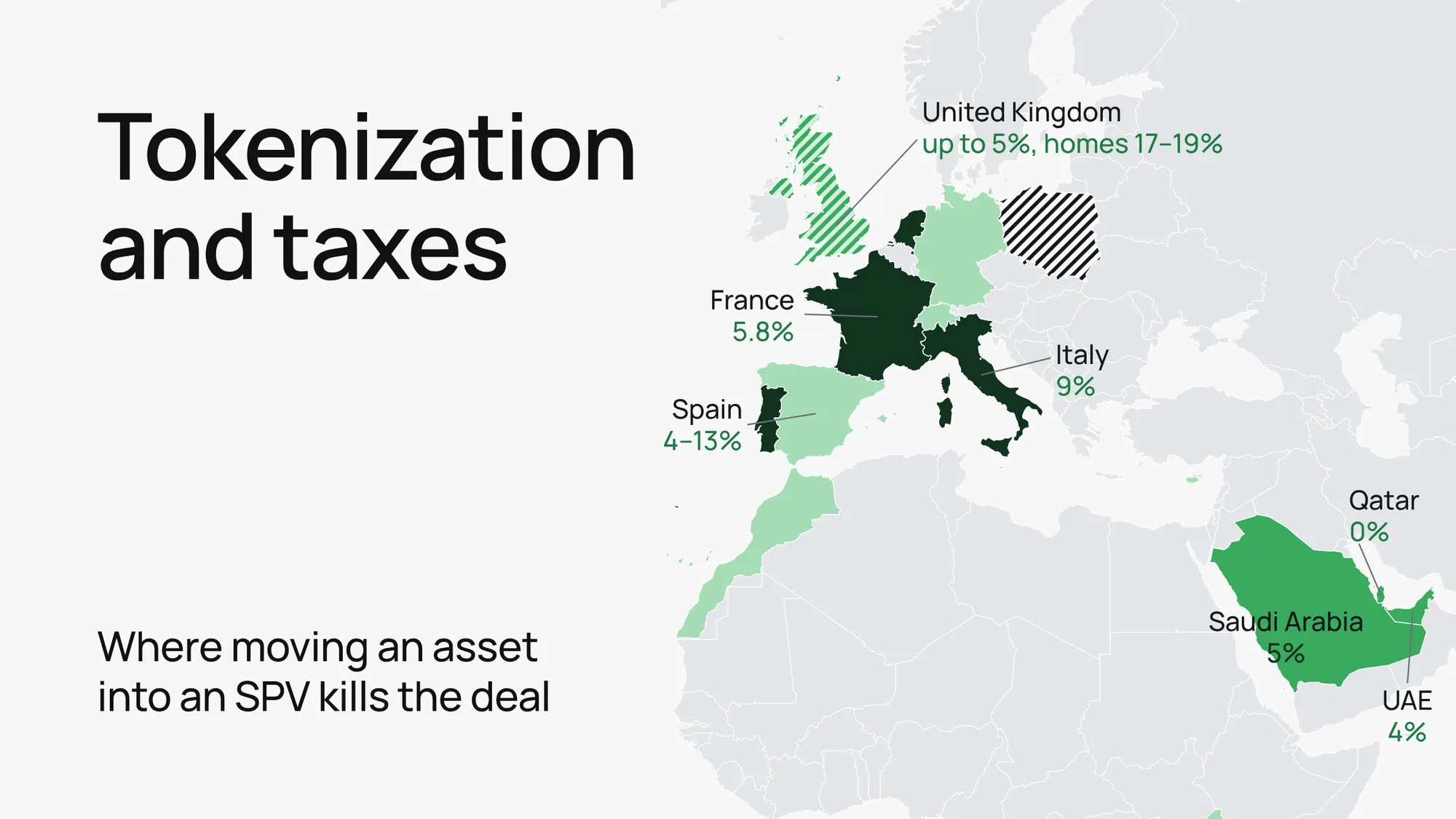
Almost every real estate tokenization runs through an SPV, and moving an asset into it can be taxed. In Chile it costs little more than notary fees. In Dubai it is a flat 4% fee. Here is how 30 countries compare, and what to check in yours.

Tokenization taxes start long before anyone buys a token. Almost every real estate tokenization rests on a special purpose vehicle, an SPV: a company that owns the asset and whose shares are issued as tokens. In cases where the property is held under private (individual) ownership, the owner has to move the asset into that company, and in many countries the state treats that move as a sale. Depending on where the asset sits, it can cost close to nothing or a large share of its value.
Tokenizer.Estate raises this question early, right after "is the asset good enough". A strong asset in the wrong jurisdiction, or in the wrong structure, can lose its economics before it raises a single dollar.
Key takeaways
The first tax in tokenization is the cost of moving the asset into the SPV. Check it before anything else.
Three things decide it: transfer tax on the property, tax on the gain when the asset is contributed, and tax on later trades of the SPV's shares.
Some countries let owners contribute property to a local company tax-neutrally. Contributing to a foreign SPV is often treated as a taxable sale.
Residential property held by companies is taxed heavily in several markets, including Singapore, the UK and parts of Canada.
In a few countries, every secondary trade of tokens can trigger transfer tax, which hurts liquidity more than the entry cost does.
Why the entry cost matters more than the token
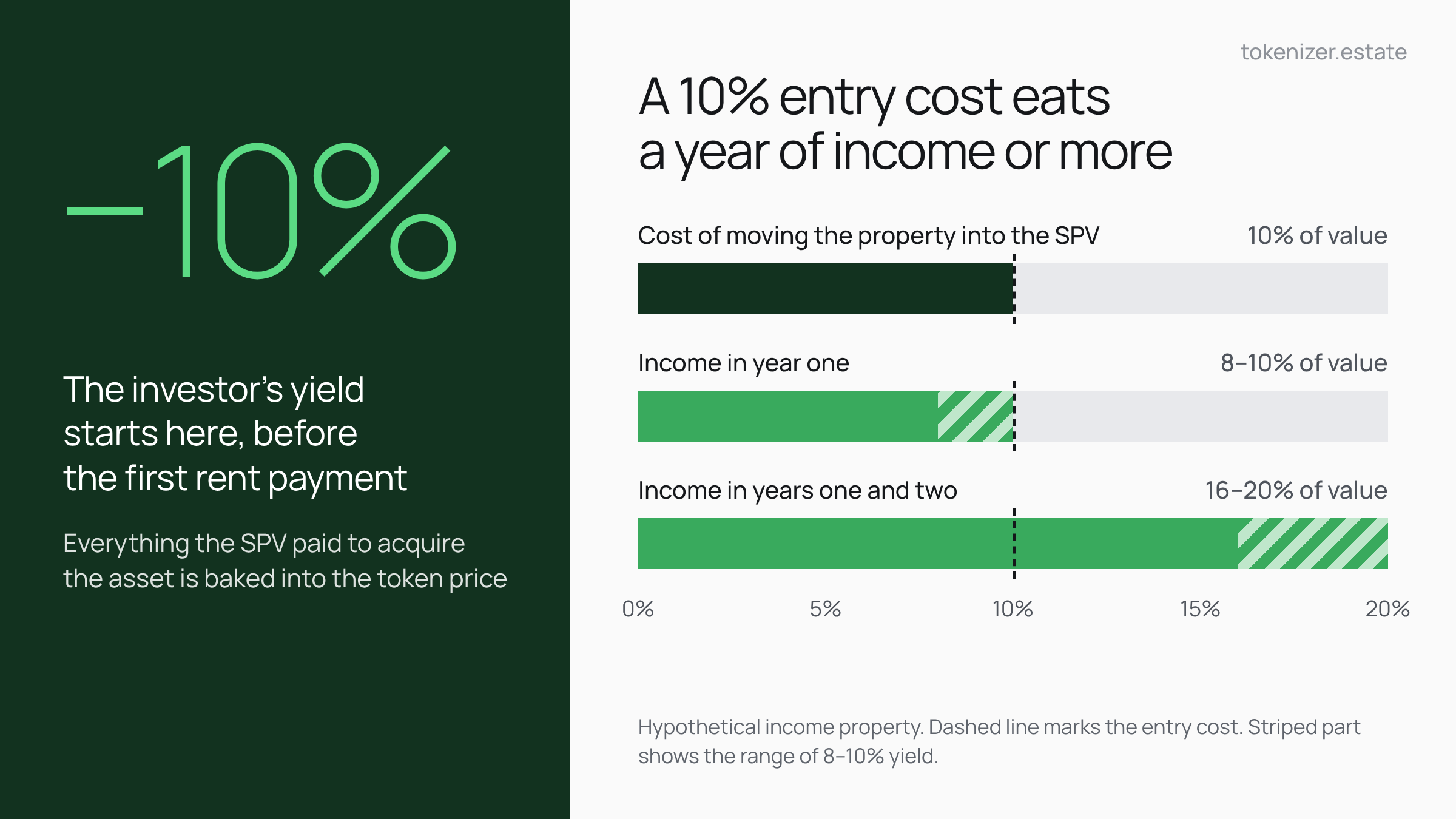
An investor who buys a token buys a share of the SPV. Everything the SPV paid to acquire the asset is already baked into the price. If moving a property into the company cost 10% of its value, the investor's yield starts 10% behind before the first rent payment. For an income asset that earns 8–10% a year, that is a year of returns or more gone on day one.
Legal wrappers are compared in detail in SPV, trust or fund. Here the question is narrower: what does the state charge for the move, and for what happens after it.
Three taxes to check before you tokenize
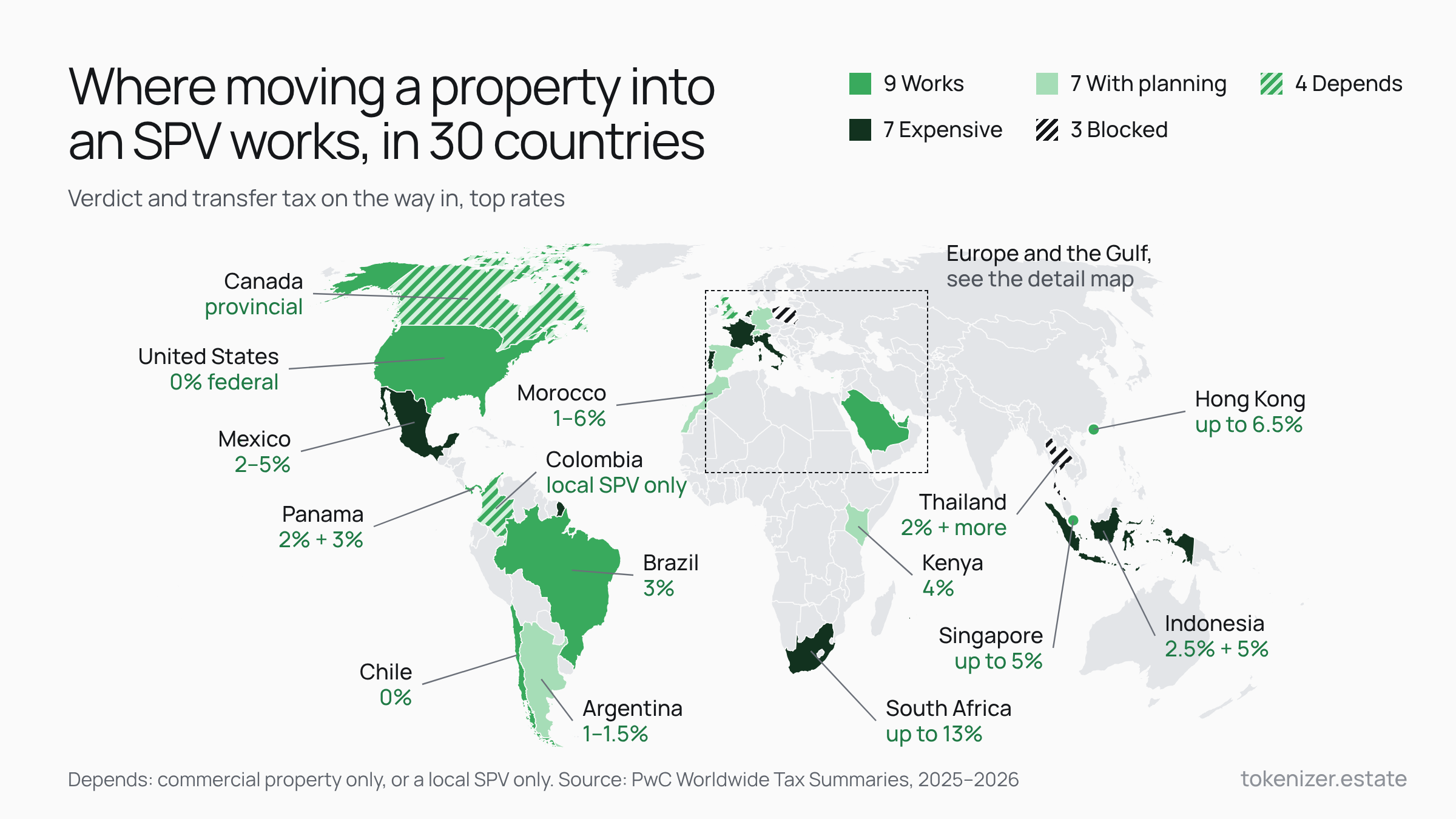
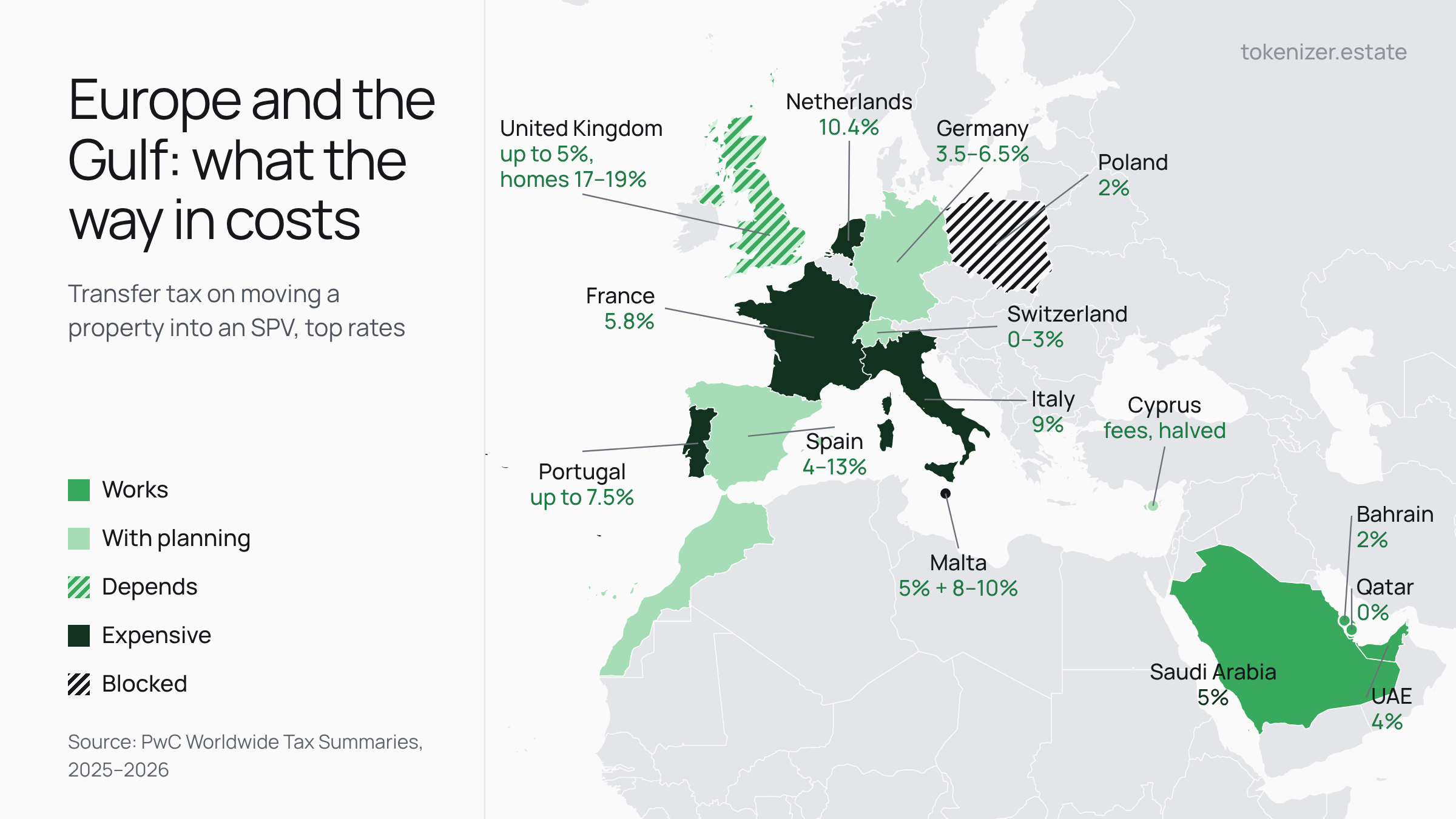
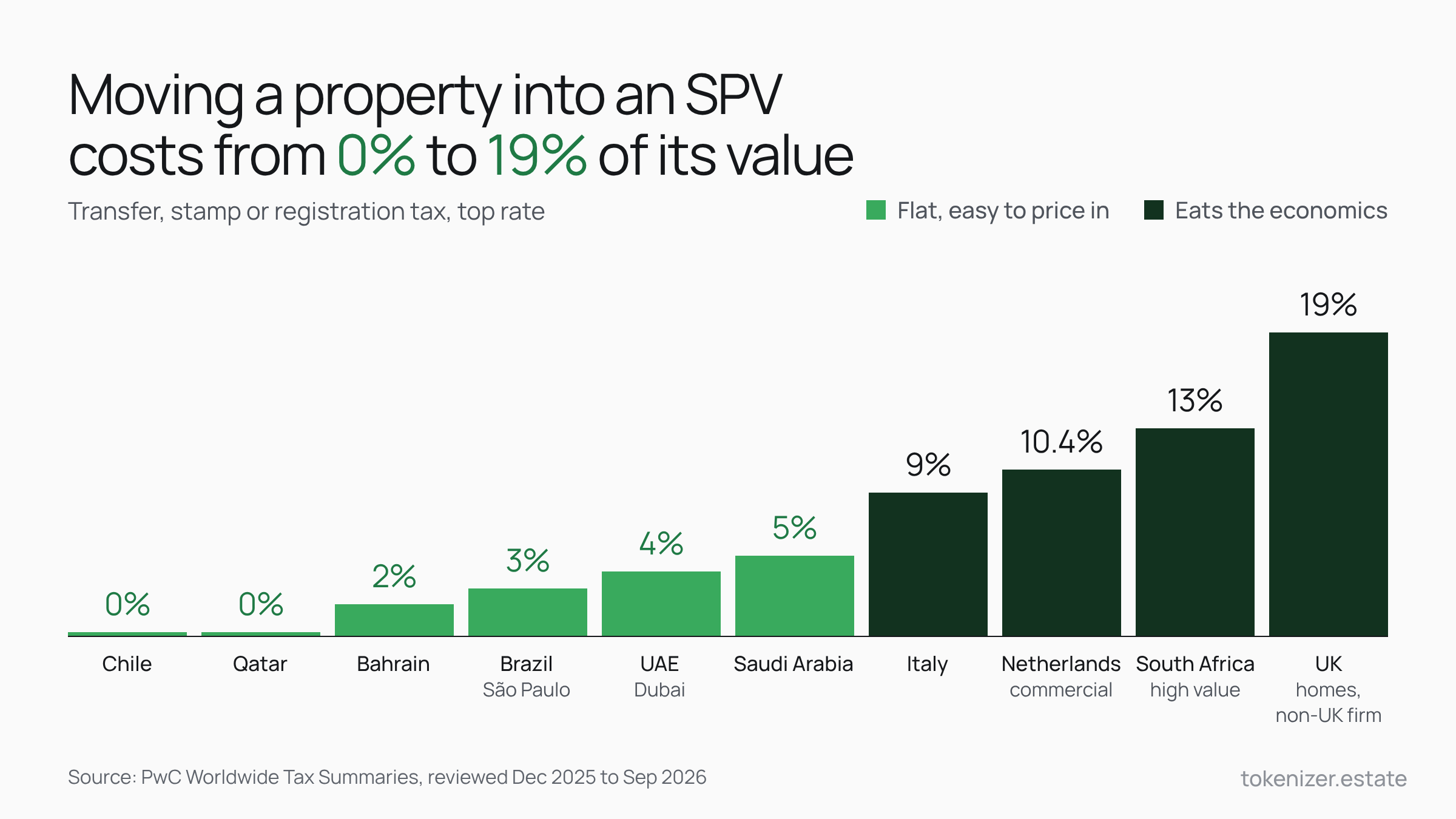
Transfer tax on the property. Most countries charge a transfer, stamp or registration tax when land changes owner, and a transfer to your own new company is usually still a transfer. Rates run from zero in Chile and Qatar to 10.4% in the Netherlands and up to 13% on expensive property in South Africa.
Tax on the contribution itself. Putting an asset into a company in exchange for its shares can count as selling it. Then the owner pays income or capital gains tax on the increase in value since purchase. Some countries have a neutral regime for contributions to local companies: Brazil, Chile and the US among them. Contributions to foreign companies rarely qualify.
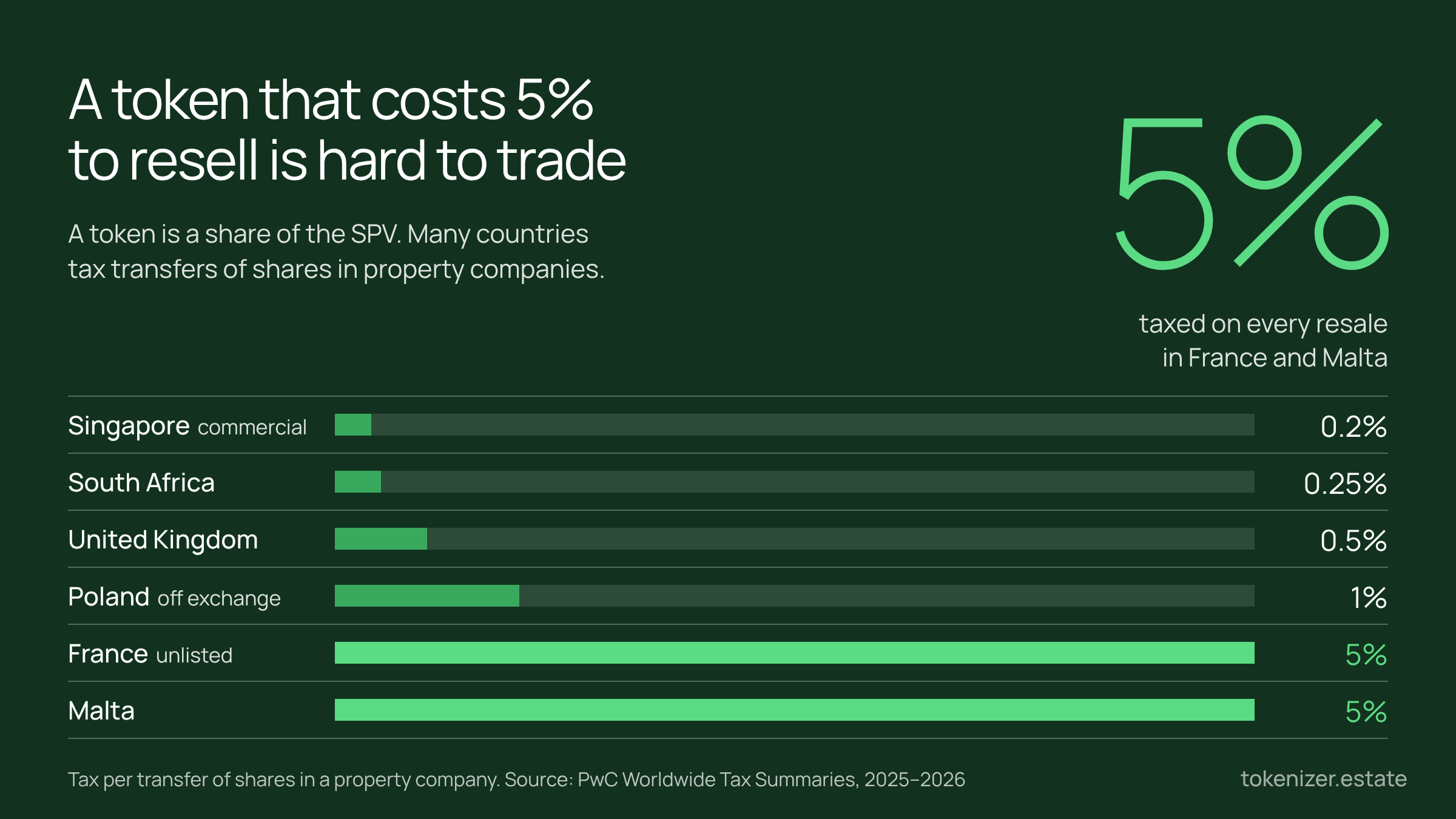
Tax on trades of the SPV's shares. Once the SPV exists, tokens change hands. Many countries tax the transfer of shares in a company that mainly holds property, either on every trade (France charges 5%) or once a buyer crosses a threshold (Germany looks at 90% of shares changing hands over ten years, the Netherlands at a one-third stake).
The third point is the easiest to miss. A token that costs 5% to resell is hard to trade.
For how investors are taxed on token income and gains, see the tax guide for the US, Germany, Singapore and the UAE.
Tokenization taxes in 30 countries
The tables below look at a property moving into a company and at later trades of that company's shares. Transfer and stamp tax rates come from PwC Worldwide Tax Summaries, country pages reviewed between December 2025 and September 2026. Verdicts are Tokenizer.Estate's own and assume an income-producing property and an ordinary SPV.
Gulf
Country | Moving property into an SPV | Trading SPV shares | Verdict |
|---|---|---|---|
UAE (Dubai) | 4% Dubai Land Department fee on market value | The fee can also apply to direct or indirect transfers of shares in a property-owning entity | Works, budget 4% |
Saudi Arabia | 5% real estate transaction tax | Also applies to transfers of real-estate-rich entities | Works, budget 5%, model trading |
Qatar | No transfer or stamp tax, registration fees only | No transfer tax | Works where foreign ownership is allowed |
Bahrain | 2% stamp duty, 1.7% if paid within two months | No specific charge | Works |
Europe
Country | Moving property into an SPV | Trading SPV shares | Verdict |
|---|---|---|---|
United Kingdom (England) | Up to 5% on commercial property. Companies buying residential pay up to 17%, 19% for non-UK companies | 0.5% stamp duty or SDRT on share transfers | Commercial works. Residential expensive |
Germany | Real estate transfer tax 3.5–6.5% by state | Taxed if 90% or more of shares pass to new holders within 10 years | Works with planning |
France | Registration duties of about 5.8%, up to 6.3% | 5% on every transfer of shares in an unlisted property company | Expensive to trade |
Spain | Transfer tax of 4–13% by region. Qualifying restructurings can be exempt | Generally exempt, with anti-avoidance rules for property companies | Works with planning |
Portugal | Property transfer tax (IMT) up to 6.5–7.5%, plus stamp duty | Can apply when a holder takes a large stake in a property company | Expensive |
Italy | Registration tax, usually 9% when no VAT applies | Generally no transfer tax on shares | Expensive |
Netherlands | 10.4% general rate, 8% for rental homes | Taxed when a buyer reaches a one-third stake in a property entity | Expensive entry, smooth trading |
Switzerland | Cantonal, from none to around 3% | Many cantons treat a controlling stake as a property transfer | Works with planning |
Poland | 2% transfer tax, plus 0.5% tax on the capital increase | 1% on sales of shares outside exchanges | Blocked legally for now: no MiCA regulator yet |
Cyprus | Land transfer fees, halved when no VAT applies. Reorganisations can be exempt. Stamp duty abolished from 2026 | No stamp duty | Works with planning |
Malta | 5% stamp duty for the buyer plus a final tax of 8–10% of value for the seller | 5% on shares in property companies | Mostly blocked |
Americas
Country | Moving property into an SPV | Trading SPV shares | Verdict |
|---|---|---|---|
United States | No federal transfer tax. State and local transfer taxes vary. Contributions to an LLC are generally tax-free | Some states tax transfers of a controlling interest | Works |
Canada | Provincial land transfer tax on a sliding scale. Foreign entities buying residential pay an extra 25% in Ontario and 20% in British Columbia | No transfer tax on shares | Commercial works. Residential with a foreign SPV blocked |
Colombia | Neutral into a local company. Into a foreign SPV it is a taxable sale (15% or up to 35% of the gain) | Taxed as a sale of shares | Local SPV works. Foreign SPV expensive |
Mexico | State transfer tax of 2–5%. A contribution to a company is generally treated as a sale for income tax | No stamp tax | Expensive |
Brazil | Municipal transfer tax (ITBI), 3% in São Paulo. The usual exemption for contributions to company capital does not apply to companies whose main business is real estate | No transfer tax on shares | Works, budget about 3% |
Argentina | Provincial stamp tax of about 1–1.5%, higher special rates in some cases | Stamp tax may apply to the contract | Works with planning |
Chile | No transfer tax, notary and registry fees only | No transfer tax | Works |
Panama | 2% transfer tax plus a 3% advance income tax on the gross value | Check with counsel | Works, budget about 5% |
Asia and Africa
Country | Moving property into an SPV | Trading SPV shares | Verdict |
|---|---|---|---|
Singapore | Stamp duty up to 5% on commercial property. Entities buying residential pay up to 65% extra | 0.2% on shares. Up to 71% extra duty on shares of residential property companies | Commercial works. Residential blocked |
Hong Kong | Stamp duty up to 4.25% on non-residential, 6.5% on residential | 0.2% on Hong Kong shares | Works, budget for it |
Indonesia | 2.5% final tax for the seller plus up to 5% duty for the buyer. Limits on foreign land ownership | Check with counsel | Expensive |
Thailand | 2% transfer fee, 3.3% business tax on quick resales, 0.5% stamp duty. Foreigners cannot own land | Foreign-controlled SPVs cannot hold land | Mostly blocked |
Morocco | Registration duties of 1–6% depending on the deal | Registration duties apply to share transfers | Works with planning |
South Africa | Progressive transfer duty, up to 13% on high-value property | 0.25% securities transfer tax | Expensive at the top end |
Kenya | 4% stamp duty in towns, 2% in rural areas. 15% capital gains tax on the gain | 15% capital gains tax | Works best through a REIT, which gets stamp duty relief from 2026 |
What the countries that work have in common
Three patterns show up across the tables.
A neutral way in. The US and Chile let an owner contribute property to a company without paying tax on the gain. Where this exists, the structure decision is usually about the SPV's home country, not about whether to tokenize at all.
A modest, flat transfer cost. Dubai's 4%, Brazil's 3% or Bahrain's 2% are real money but predictable. An owner can price them in, and a 10% income asset can absorb them in a few months.
Share trades that stay cheap. The UK's 0.5% or Singapore's 0.2% on share transfers still allow a working secondary market. France's 5% on every transfer, or Malta's 5%, do not.
Low tax is not enough on its own. Poland charges only 2% on the property transfer and 1% on share sales, but it still has no MiCA regulator and no way to apply for a licence. Until that changes, a tokenization run from Poland has no legal footing, whatever the tax maths says.
The countries that fail tend to stack these costs: a high transfer tax, a taxable contribution and a charge on every later trade. Residential property is hit hardest, because several governments deliberately tax companies that buy homes to cool their housing markets.
A country outside the easy cases is not off the map. Morocco's registration duties of 1–6% are workable and far from the worst case on this list. Malta, Thailand for land, and residential property in Singapore are much harder.
How to check your own country
If your country is not in the tables, these are the questions to put to a local tax adviser before any work on tokens:
What transfer, stamp or registration tax applies when property moves into a company, and on what value?
Is contributing property to a company in exchange for shares treated as a sale? Is there a neutral regime, and does it work for a foreign company?
Does the tax change if the SPV is local or foreign?
Is there a tax on transfers of shares in a company that mainly holds property? Is it charged on every trade or only above a threshold?
Are there extra charges for companies or foreign buyers acquiring residential property?
Can foreigners, or foreign-controlled companies, own the asset at all?
If the answers add up to more than one or two years of the asset's income, the deal needs a different structure or a different asset.
On Tokenizer.Estate
Tokenizer.Estate provides the white-label software layer for real estate tokenization: token issuance, investor KYC, a register of holders, and automated distributions under your own brand, with the legal and tax structuring left to your own counsel. If you want a second look at whether your asset and jurisdiction fit, book a free consultation.
FAQ
Do I pay tax when I move my property into an SPV for tokenization?
Usually yes, at least a transfer or registration tax. Whether you also pay tax on the gain depends on the country and on whether the SPV is local or foreign. Some countries, such as Chile and the US, allow a tax-neutral contribution to a local company.
Which countries are cheapest for real estate tokenization?
On entry cost alone, Chile and Qatar charge no transfer tax, and the US allows tax-free contributions to an LLC. Bahrain, Brazil and Dubai charge a modest flat fee of 2–4%. The right answer also depends on investor rules, foreign ownership limits and where your investors are.
Why is a foreign SPV more expensive than a local one?
Many tax systems give neutral treatment only to contributions to domestic companies. Moving property into a foreign company is often treated as a sale, so the owner pays tax on the gain at the moment of transfer.
Are token trades taxed?
They can be. A token usually represents a share of the SPV, and several countries tax transfers of shares in property companies. France charges 5% on each transfer, Poland 1%, the UK 0.5%. Germany and the Netherlands charge only once ownership changes cross a threshold.
Can tokenization avoid real estate transfer tax?
No, and it should not be planned that way. Most countries have rules that look through the company to the property. Structure for clarity and compliance, not for avoidance.
Disclaimer: This article is for information only and is not legal, tax or investment advice. Tax rates and rules change often and depend on the details of each deal. Speak to qualified tax counsel in the asset's jurisdiction before structuring any offering.
Share this post
Build your own tokenization business with Tokenizer.Estate
Tokenizer.Estate provides a full end-to-end solution — from legal setup to blockchain infrastructure — to help you launch your project with confidence
Book a Free Consultation