Real Estate Security Token Offering: How an STO Is Structured, Filed, and Closed
A procedural walkthrough of the full real estate STO cycle, from regime selection to post-issuance reporting, with durations, costs, and benchmark deals.

Issuers planning a real estate STO all ask the same operational question: what actually happens, in order, between the decision to tokenize and wiring the first distribution to a token holder.
This article walks that sequence in six phases. It is written for the person who will execute the project inside a fund, developer, or asset manager. It is informational, not legal advice, and every structure below requires named counsel in the relevant jurisdiction.
STO vs Private Placement: Drawing the Boundary
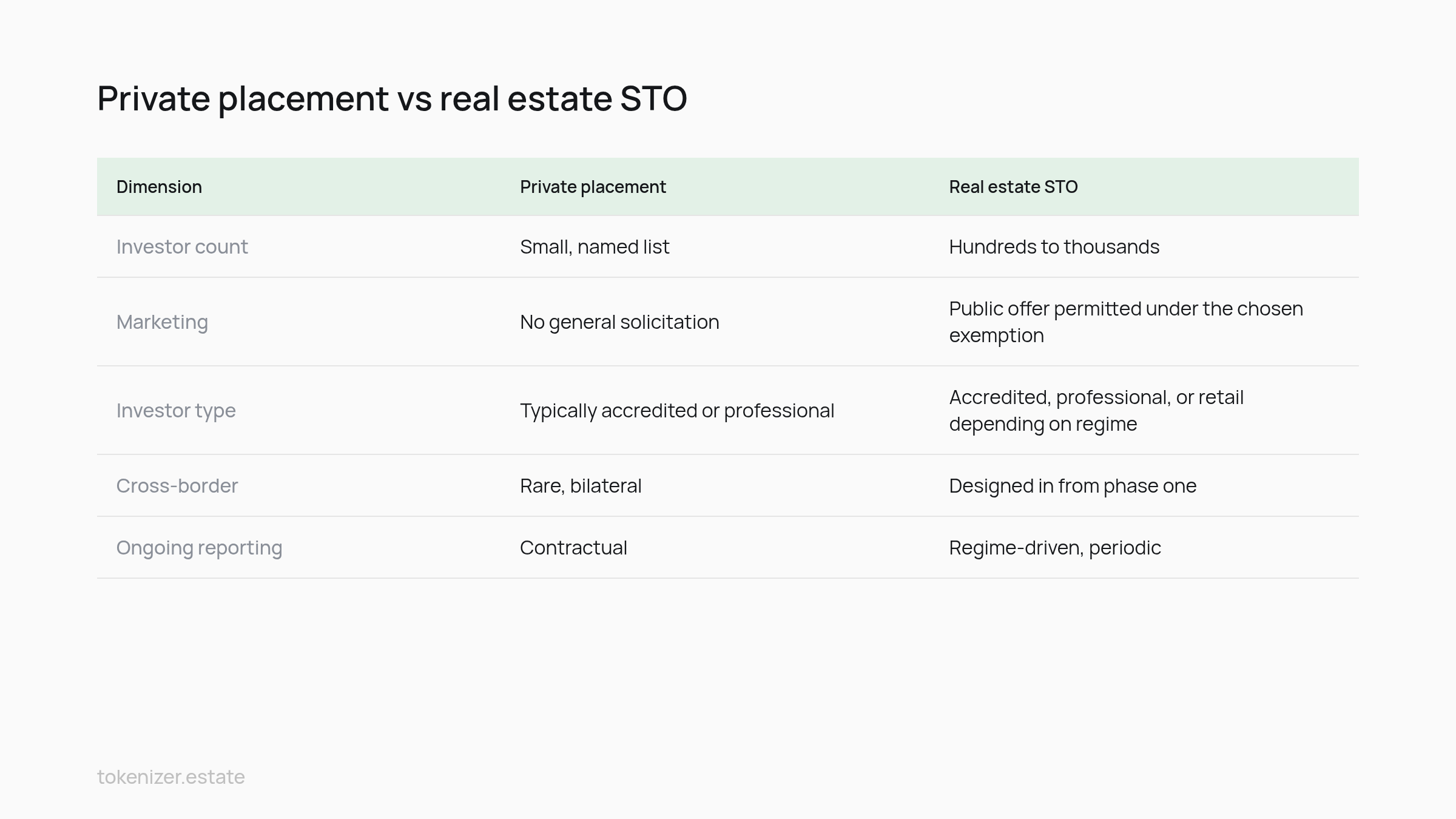
Not every tokenization is a security token offering. A closed placement among twenty known investors and a broadly marketed regulated issuance are different projects with different timelines, budgets, and reporting obligations. That classification determines every phase after it.
Four criteria draw the line. Number of investors sits first: below the exemption threshold in your regime, you can run a private placement with almost no marketing infrastructure. General solicitation comes second: the moment you publish the offer to an open audience, most jurisdictions push you into a registered or exemption-with-verification track. Investor type is third, accredited only, professional only, or retail-inclusive, and cross-border reach is fourth, because the moment you accept a subscriber in a second country, that country's securities regime applies to the token in their hands.
A tokenized offering is a legal structure first and a technology deployment second. As the Pension Real Estate Association describes it, tokenization represents an interest in an asset as a token on a blockchain, with transfers happening directly between participants on-chain. The interest being represented, whether direct property ownership, equity in a holding entity, or a debt claim, is the securities-law question, and it exists whether the ledger is public or private.
The economic case for the STO route over a plain private placement rests on distribution scale and unit size. The structure converts property ownership into fractional digital securities issued by a Special Purpose Vehicle (SPV), which lets the issuer set a minimum ticket low enough to reach investors a private placement would never accept, and automate the per-investor administration that makes small tickets uneconomic on paper.
Phase 1: Structuring and Regime Selection for a Real Estate STO
Phase one decides everything downstream. The regime chosen here fixes the investor pool and the marketing rules, along with the resale conditions and the reporting calendar for the life of the token. Typical duration is six to twelve weeks, executed by securities counsel with input from tax counsel and the tokenization platform.
United States: Reg D, Reg A+, Reg S
The US does not have a bespoke tokenization statute, so a real estate STO runs through an exemption: Reg D 506(b), Reg D 506(c), Reg A+, or Reg S, each combined with a Rule 144 lockup and an Alternative Trading System (ATS) constraint on resale. Reg D 506(c) allows general solicitation but requires verified accredited investors. Reg S sits alongside it for offshore subscribers, provided no directed selling efforts reach US persons.
The interest represented also drives the paperwork. PREA notes that legal documents can be prepared so real estate tokens represent either an ownership interest in the underlying property or equity in an entity that owns real property, with a debt interest as a third option. Each carries a different disclosure package and tax profile.
European Union: MiCA versus MiFID II
The EU boundary is often misread. The Markets in Crypto-Assets Regulation, or MiCA, became fully applicable on December 30, 2024, and governs crypto-assets that are not already financial instruments. It is frequently cited in tokenization coverage, but for a real estate STO the more important point is what it excludes: security tokens fall outside it.
Article 2(4) of Regulation (EU) 2023/1114 explicitly excludes crypto-assets that qualify as financial instruments under MiFID II, alongside deposits and structured deposits, plus other instruments already covered by existing financial regulation. A real estate STO that tokenizes shares in a property-holding SPV is a financial instrument. The regime is MiFID II plus the Prospectus Regulation, with the small-offer exemption (typically up to eight million euros) available in most member states.
UAE: VARA and ADGM
Two Emirati routes matter. The Virtual Assets Regulatory Authority (VARA) governs Dubai issuers outside the financial free zones, while Abu Dhabi Global Market (ADGM) runs a common-law framework with its own Financial Services Regulatory Authority. Structure decisions on the Gofaizen & Sherle comparative summary emphasize that ADGM suits institutional issuers targeting cross-border professional investors, while VARA handles Dubai-native retail-facing offers.
Japan: FIEA and the deepest STO pipeline
Japan runs real estate STOs under the Financial Instruments and Exchange Act, and by volume of closed deals it leads every other market. Kenedix completed the country's first real estate security token offering in August 2021, and roughly seventy real estate STOs had been executed by late 2024, with secondary trading running on the ODX START venue backed by SBI, Sumitomo Mitsui, Nomura, and Daiwa. The lesson for issuers is in the sequencing: Japan built the secondary venue alongside the issuance framework rather than promising it later.
Phase 2 and 3: Valuation, Offering Documents, and Token Standard
Phase two produces the numbers, phase three commits them to code. Both run in parallel once regime selection closes, and both must be signed off before any investor sees a subscription page. Combined duration is eight to sixteen weeks.

Valuation and offering documentation
An independent appraisal from a RICS-qualified or locally licensed valuer establishes the property value. That number feeds the offering memorandum, the SPV share capital, and the token supply. Counsel then drafts the private placement memorandum or prospectus, the subscription agreement, the SPV operating agreement, and the risk disclosures. Auditors review historical operating statements if the property is income-producing. The output is a bound offering document that must reconcile, line by line, with what the smart contract will enforce.
ERC-3643, ERC-1400, or custom
The token standard is a compliance decision expressed in Solidity. It is not a technical preference. The standard determines whether the transfer restrictions written into the offering documents can actually be enforced when a token holder tries to sell.
ERC-3643, also called T-REX (Token for Regulated EXchanges), is the working answer for most real estate STOs. The EIP-3643 specification defines it as an institutional-grade security token standard providing a library of interfaces for compliant transfer of security tokens through an automated on-chain validator. The specification notes the need for a standard supporting compliant issuance and management of permissioned tokens across a range of asset classes, including real estate. In QuillAudits' explanation, ERC-3643 extends the ERC-20 framework to support permissioned and compliance-driven security tokens, so that unlike unrestricted fungible tokens, transfers pass through an identity registry and a compliance module before settling.
Standard | Compliance enforcement | Identity layer | Best fit |
|---|---|---|---|
ERC-3643 (T-REX) | On-chain, mandatory pre-transfer validation | ONCHAINID or equivalent | Regulated real estate STO with retail and cross-border investors |
ERC-1400 | Partitioned transfers, off-chain hooks | External registry | Institutional-only placements with fewer transfer events |
Custom contract | Whatever the developer codes | Bespoke | Rarely justified; audit and legal review costs offset the flexibility |
For a deeper walk-through of what these contracts actually execute at issuance, transfer, and distribution, see compliance configuration.
Sign-off comes from securities counsel confirming the on-chain rules match the offering documents, and from the auditor confirming the token supply matches the SPV cap table. The mistake that breaks investor onboarding: deploying the contract before counsel has reviewed the compliance module parameters, then discovering the contract cannot restrict transfers to accredited investors under Reg D 506(c). Redeployment resets the audit clock.
Phase 4: Investor Onboarding, KYC, and On-Chain Whitelisting

Phase four is where compliance meets the investor's browser. Onboarding runs the KYC and AML checks required by the chosen regime, verifies accreditation or professional status where the exemption demands it, and then writes the approved wallet address to the on-chain identity registry. Only whitelisted addresses can receive tokens; the compliance module rejects any transfer to an address that has not passed verification.
Duration for a single investor is between four minutes and three business days depending on the KYC provider and the jurisdiction, with longer timelines when accredited-investor verification requires document review. The platform executes the workflow, the transfer agent or the issuer's compliance officer approves each file, and the identity registry contract records the whitelist decision. The Signzy overview of STO compliance summarizes the sequence, which moves from identity verification through sanctions and PEP screening, then accreditation confirmation, and finally continuous transaction monitoring after tokens issue.
Throughput matters when the offer is public. The Dubai Land Department's Prypco Mint pilot is the reference point: the first property on the platform drew 224 investors and sold out inside its opening window. It shows that when KYC, wallet provisioning, and subscription payment are wired together, a single asset can absorb hundreds of retail investors almost immediately. It also shows the bottleneck: a manual review queue of 224 files does not clear that fast without automated document extraction and pre-approved risk tiers.
Transfer restrictions live in the contract, not the terms and conditions. ERC-3643's compliance module enforces jurisdiction caps and lockup periods at the point of transfer, alongside accredited-only holding rules that gate who can sit on the cap table.
A resale attempt from a US investor to a non-verified wallet reverts on-chain. For the operational detail behind KYC provider selection, sanctions screening, and ongoing monitoring, see infrastructure decisions. The mistake that breaks closing: opening the subscription page before the whitelist contract is wired to the KYC provider's approval webhook. Investors pay, tokens cannot mint, refunds start, and the offer window closes without a full raise.
Phase 5: Closing the Security Token Offering

Closing converts subscription commitments into settled positions. The escrow releases, the SPV records the new shareholders, the transfer agent updates the cap table, the custody arrangement takes effect, and the smart contract mints tokens to whitelisted wallets. Duration between subscription cutoff and full settlement runs from one to four weeks.
The St. Regis Aspen closing is the canonical benchmark. Elevated Returns issued 18 million tokens at $1 each, representing an 18.9 percent stake in the resort, distributed through Templum Markets to accredited investors under Reg D 506(c), with a 10,000 token minimum per subscriber.
The pricing rewards a second look. An 18.9 percent stake placed at $18 million implies roughly $95 million for the whole asset, while contemporaneous press cited a market valuation near $224 million. The gap is the lesson: a token offering prices what investors will pay for a minority, illiquid position, not what an appraiser assigns the building. That single reconciliation, matching the token supply and the stake against the SPV shareholder register on the day of closing, is what Phase 5 lives or dies on.
Cap table reconciliation is where closings fail. The transfer agent's ledger, the SPV's shareholder register, and the smart contract's token balances must show the same investors holding the same units on the same day. Any discrepancy creates a mismatch: a whitelisted wallet that did not fund, a subscription that cleared after the mint transaction, or a duplicate KYC record that blocks the first distribution. The closing checklist is short and unforgiving: escrow release, cap table sign-off, custody activation, mint execution, in that order.
Custody structure is fixed at closing and hard to change later. The choice is between qualified custody at a regulated custodian holding tokens on behalf of investors, and self-custody where investors hold their own private keys. The mistake that breaks post-issuance reporting: minting tokens before the transfer agent's system has ingested the final subscriber list. Distributions calculated against the smart contract balance will not match distributions calculated against the transfer agent record, and the first tax reporting cycle will surface every mismatch.
Phase 6: Post-Issuance Distributions, Reporting, and Corporate Actions
Post-issuance is not a phase with an end date. It is the operating state of the offering for the life of the property. Distributions to token holders run on the schedule set in the offering documents, typically quarterly for income properties. Periodic reporting follows the chosen regime: Form D annual updates under Reg D, prospectus supplements for Reg A+, and the equivalent filings under MiCA-adjacent MiFID II obligations. Corporate actions such as buybacks, secondary transfers on an ATS or MTF venue, refinancing events, or an eventual property sale each require a governance vote recorded against the token holder registry.
The market context sizes the opportunity for businesses raising capital through this route. Savills puts the global real estate base at roughly $379 trillion, and it remains one of the least accessible asset classes to outside capital. Forecasts for how much of it tokenizes vary by an order of magnitude depending on what each house counts, which is why we compare the methodologies separately in the tokenization forecast analysis. Any single number here should be read as directional, not measured. For the operational mechanics of running these ongoing obligations, see post-issuance operations.
Post-issuance reporting is executed by the fund administrator working alongside the transfer agent and audit counsel. The recurring workstreams are distribution processing, tax document generation, secondary transfer approvals, and investor communications. The failure mode is under-budgeting these workstreams at phase one, then discovering in year two that the offering's economics do not survive the compliance overhead.
A real estate security token offering is a sequenced legal and operational project where the regime chosen in phase one dictates every constraint downstream. Skipping a phase does not save time; it moves the failure to the next one. The valuation done before regime lock produces documents that do not fit the exemption. The contract deployed before compliance review cannot enforce the transfer restrictions counsel drafted. The mint executed before cap table reconciliation breaks the first distribution.
Issuers planning a real estate STO and evaluating how to configure jurisdiction against token standard and compliance module setup can review the white-label infrastructure options at Tokenizer.Estate.
Share this post
Build your own tokenization business with Tokenizer.Estate
Tokenizer.Estate provides a full end-to-end solution — from legal setup to blockchain infrastructure — to help you launch your project with confidence
Book a Free Demo