Real estate tokenization platforms 2026: for issuers and for investors
There are 160+ tokenization platforms. Most look the same on their websites. But they serve different deals, different clients, and different markets. This guide compares five infrastructure platforms that matter in 2026 — and explains how to pick the one that fits your asset.

There are over 160 real estate tokenization platforms, and they answer two completely different questions. One is "where do I issue tokens against my own building?" That is the issuer's question, asked by developers, funds, and asset owners. The other is "where do I buy a fractional share of a property?" That is the investor's question, asked by people putting in anywhere from $50 upward.
The platforms that serve each group barely overlap, and picking from the wrong list wastes weeks. This guide splits them cleanly. First the two structural types, then infrastructure platforms for issuers, then marketplaces for investors, with a decision framework for each.
Two types of platforms, and why the difference matters
Before any brand names, understand the fundamental split.
Infrastructure platforms provide the technology, legal framework, and compliance tools for asset owners to tokenize their own properties. You bring the building. The platform gives you the smart contracts, the KYC/AML pipeline, investor onboarding, and sometimes secondary-market access. This is the model that matters for developers, fund managers, family offices, and operators of commercial assets.
Marketplace platforms tokenize their own properties, or ones they source, and sell tokens to investors. The platform finds the building, structures the deal, creates the token, and runs the marketplace. The investor just buys a token and receives income. It is a vertically integrated model: one company does everything, and you cannot bring your own building to it.
The rest of this guide follows that split: infrastructure platforms first, for issuers, then marketplaces, for investors.
Platforms for issuers (B2B): infrastructure
These are the platforms a developer, fund, or asset owner uses to tokenize a property they already own and raise capital against it.
Tokenizer.Estate
A full-cycle, white-label platform built for owners of real assets: commercial buildings, hotels, logistics parks, industrial facilities, marinas, and similar properties.
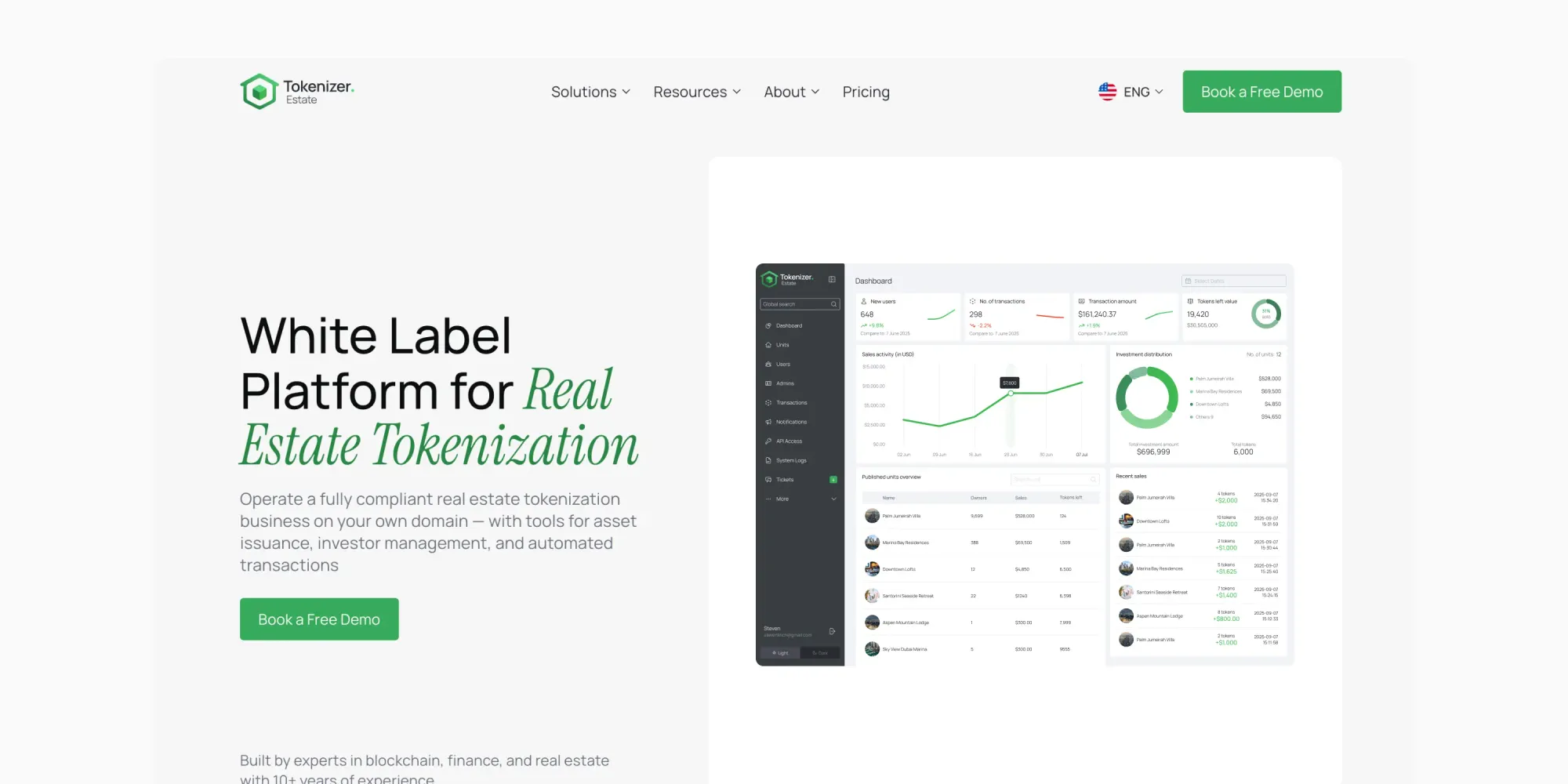
What it does. It covers the whole pipeline under the issuer's own brand: legal structuring support (SPV, offering documents), permissioned smart-contract deployment, an integrated KYC/AML onboarding flow, a branded investor portal, automated distributions, and a back-office dashboard. The legal structuring and regulatory approvals sit with the issuer's own counsel in each jurisdiction; the platform supplies the software rails the compliance rules run on, not the legal advice itself.
Who it is for. Asset owners and developers who want to tokenize their own property and keep control of the deal, the brand, and the investor relationships, rather than sell into someone else's marketplace.
What stands out. One partner covers the full journey, so the issuer does not assemble a separate legal team, tech team, and compliance provider. It supports multiple jurisdictions and asset types, from commercial buildings and hotels to logistics parks and industrial facilities.
Securitize
One of the largest tokenization platforms by assets under management, and the most heavily regulated in the space.
What it does. It is registered as a broker-dealer, transfer agent, and fund administrator, and operates a regulated Alternative Trading System, powering tokenized funds for some of the world's biggest asset managers. That combination of licenses is the most complete regulatory coverage in the industry.
Who it is for. Large institutional issuers: asset-management firms, sovereign funds, and major developers. Minimums on most offerings run high, into the thousands or millions, so it is Wall Street infrastructure adapted for blockchain rather than a tool for a single-building owner.
What stands out. The institutional client roster gives it unmatched credibility with traditional finance. The trade-off is a process built for large firms, not for a developer with one asset who wants to launch next month.
Tokeny
A European compliance-first platform behind one of the most widely used token standards for regulated assets.
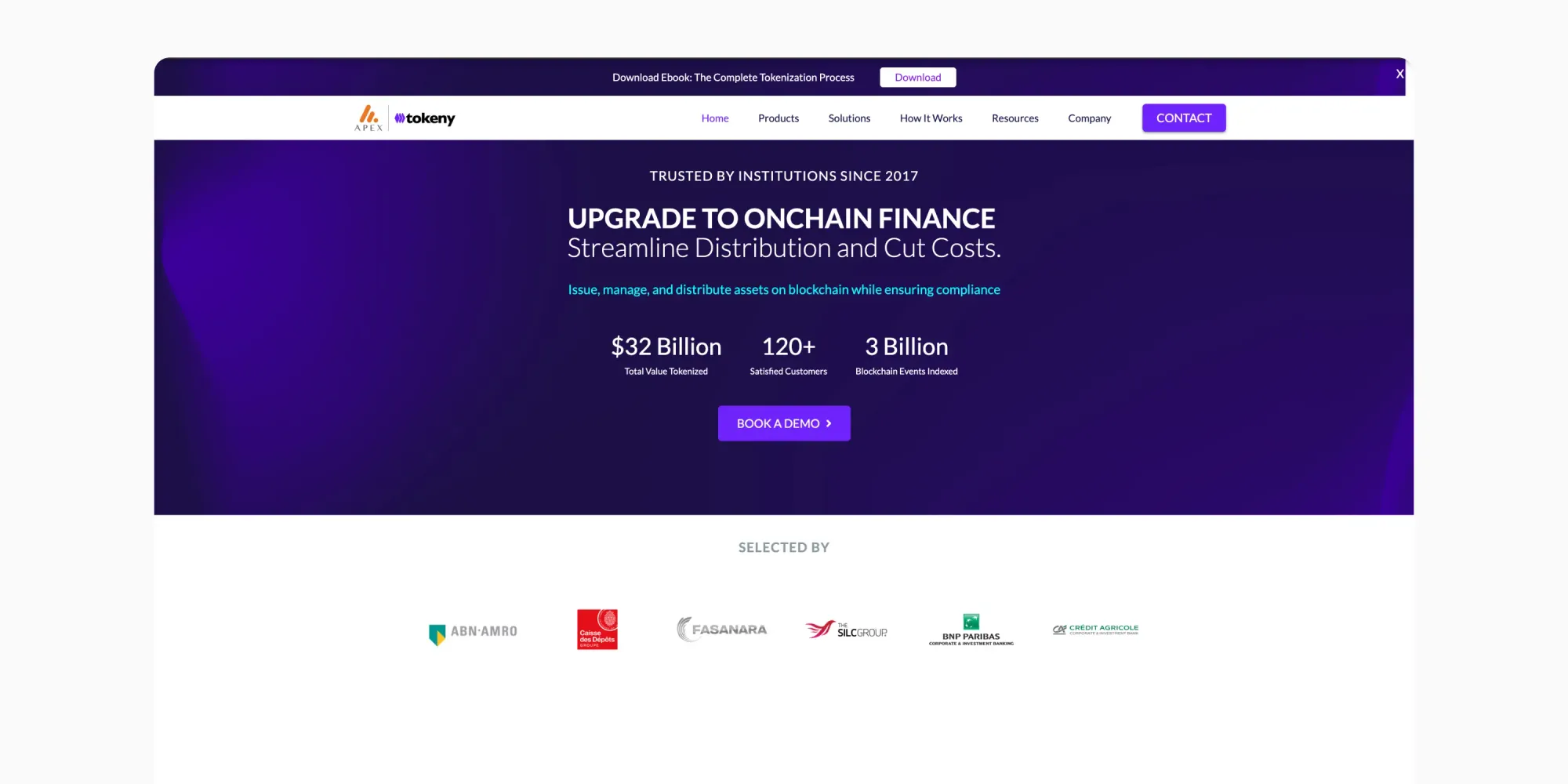
What it does. Its permissioned-token approach embeds compliance rules, whitelisting and transfer restrictions, directly into the token smart contract, so every transfer is checked against an identity registry and compliance module before it executes. Compliance is automatic, not manual, and the platform is asset-agnostic and multi-chain.
Who it is for. Banks, asset managers, and institutional issuers in Europe and globally who need MiFID II, MiCA, and multi-jurisdictional compliance built into the token itself.
What stands out. For issuers in heavily regulated European markets, its token standard is the one regulators recognize. The trade-off is that it is infrastructure for financial institutions, not a direct service for a developer who owns one building.
Brickken
A multi-asset SaaS platform out of Spain for real-world asset tokenization.
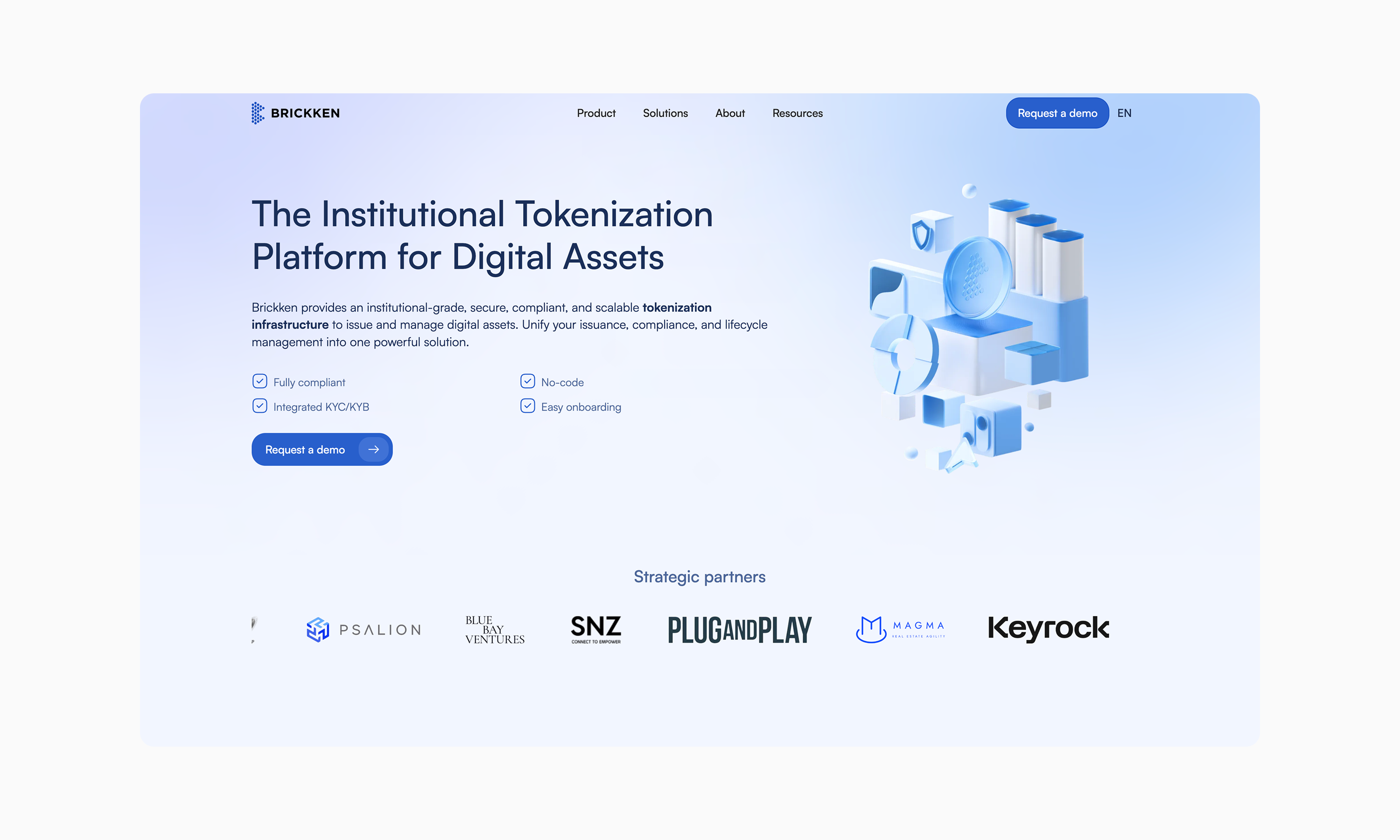
What it does. It supports several asset types, equity, debt, revenue-sharing, and real estate, across multiple blockchains, with no-code issuance, an API, sandbox testing, and white-label investor portals. KYC/AML and document signing are built in, and it accepts payment in fiat or crypto.
Who it is for. Enterprises and issuers that want modular, one-stop infrastructure for regulated security tokens, with workflow automation and a partner marketplace.
What stands out. The breadth of features and asset types, plus low-cost blockchain options, make it a flexible choice for firms entering tokenization across more than just real estate.
DigiShares
A white-label platform that asset owners deploy under their own brand, strong in European and Middle Eastern markets.
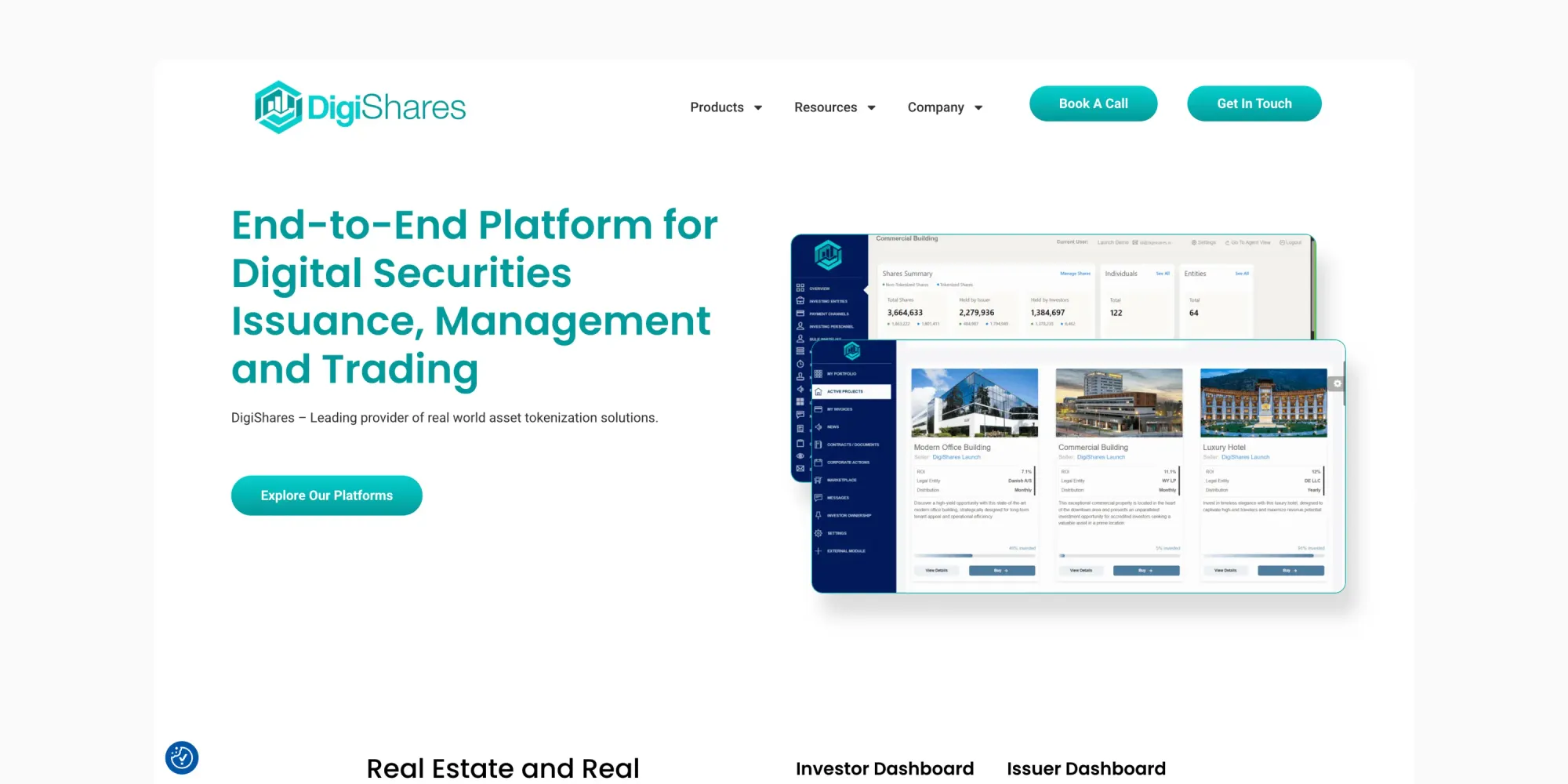
What it does. It covers token issuance, cap-table management, automated distributions, investor onboarding, and an internal marketplace for secondary trading, and integrates with a wide range of wallets, KYC providers, custodians, and exchanges. The white-label model gives the issuer a branded portal, their logo, their domain, on DigiShares infrastructure underneath.
Who it is for. Real estate developers, fund managers, and issuance platforms that want their own branded solution without building the technology from scratch.
What stands out. The white-label approach and breadth of integrations let a bank or property firm plug in and launch quickly. The trade-off is that you build on someone else's stack: the branding is yours, the infrastructure decisions are theirs.
RedSwan
A US platform focused specifically on institutional-grade commercial real estate.
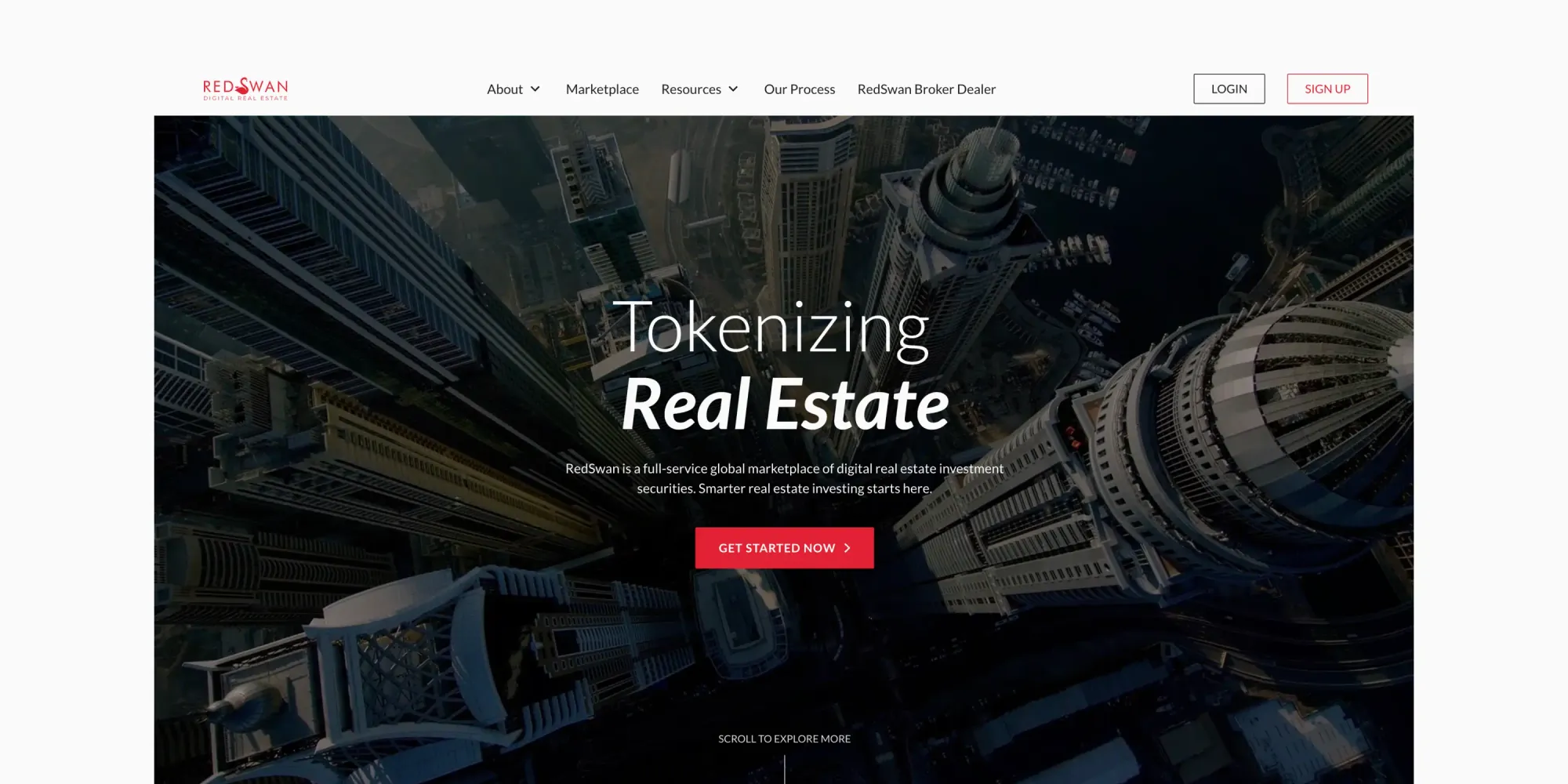
What it does. It tokenizes commercial properties, Class A apartments, offices, hotels, and logistics portfolios, and distributes them to accredited and international investors, with its own secondary marketplace. It also structures diversified funds giving exposure to multiple asset types through a single allocation.
Who it is for. Commercial real estate owners and operators who want to tokenize institutional-grade assets and tap a ready investor base.
What stands out. Deep commercial-real-estate specialization and a large portfolio. The trade-off is that it works more as a curated CRE marketplace built around its own deal sourcing than as open infrastructure you plug any asset into.
Blocksquare
An EU platform that takes a legally rigorous, registry-linked approach.
What it does. It integrates with land registries through notarized agreements, so on-chain tokens carry a direct, enforceable claim on the underlying property rather than a purely digital IOU. Its tooling targets companies and governments issuing property-backed tokens while preserving investor legal recourse.
Who it is for. Issuers who want the strongest possible legal tie between the token and the deed, and who operate in jurisdictions where that notarized link matters.
What stands out. The registry integration gives token holders real legal recourse, not just a claim on an entity. It has been used for real fractional-ownership offerings tied to notarized deeds.
How to choose an issuer platform
What is your asset? A single commercial building, a diversified fund, a development-stage project, or a portfolio. Single-property deals have different requirements than multi-asset funds, and some platforms specialize in one.
Where are your investors? Domestic accredited, international, European, or multi-jurisdictional. The compliance framework has to match the investor base, and getting it wrong is a legal problem, not a technical one.
What do you want to control? The spectrum runs from a fully managed "here is my building, handle everything" service to a white-label platform with your own brand on it.
What is your budget and timeline? A full custom white-label deployment costs more upfront and takes longer; a turnkey service on an existing platform is faster but gives less control over branding and investor experience.
Platforms for investors (B2C): marketplaces
These are the platforms an individual uses to buy a fractional share of a property and earn a slice of the rental income. They are a different set of companies entirely.
Lofty
Similar in spirit to RealT, focused on US single-family rentals with low minimums and daily income distribution, plus an internal marketplace where investors can resell tokens relatively quickly. Property financials are shared transparently and holders can participate in some governance decisions. It suits investors who want a fully digital, low-friction way into rental property.
HoneyBricks
Aimed at commercial real estate, mainly multifamily apartment buildings, structured as security-token offerings backed by an ownership stake in the property entity. Currently oriented to accredited investors, with higher minimums than the single-family platforms but access to institutional-grade assets and secondary trading after a lock-up. It suits investors who want commercial exposure rather than individual rental homes.
Binaryx
A marketplace focused on luxury vacation and resort properties in international destinations, where the platform handles property management and short-term rental operation on behalf of investors. Minimums are low and income is distributed to investor wallets. It suits someone who wants fractional exposure to premium international holiday real estate without managing it.
Estate Protocol
A UAE-based marketplace fractionalizing high-quality real estate, starting in Dubai, with low minimums and income paid in stablecoins, operating within the region's regulatory framework and its government push toward property tokenization. It suits investors who want a slice of the Dubai market without the usual barriers.
How to choose an investor platform
The questions are different from the issuer's.
What kind of property? Single-family rentals, commercial buildings, or luxury vacation homes each sit on different platforms with different risk and income profiles.
What is your investor status? Some platforms are open to everyone; others are restricted to accredited investors, which changes what you can access.
How important is exit? Check whether the platform has a real secondary market and how active it is. Low minimums mean little if you cannot sell when you need to.
Is the operator sound? The category's largest early platform entered liquidation in 2026 after a property-tax dispute, with distributions suspended and token holders facing a distressed recovery. A token is only as reliable as the operator behind it, so weigh the operator's track record, reserves, and governance, not just the yield on the marketing page.
Where is the platform regulated? The regulatory home of the platform determines your legal protection. Prefer platforms operating inside a clear framework over ones in a grey zone.
The bottom line
The two lists rarely overlap because they solve different problems. If you own a building and want to raise capital while keeping control, you need an infrastructure platform from the first list. If you want to invest a few hundred or a few thousand dollars into someone else's property and earn income, you need a marketplace from the second.
Getting this right at the start saves weeks. An issuer who approaches a retail marketplace cannot list their own asset there; an investor who lands on an infrastructure platform finds tooling built for issuers, not a place to buy $50 of a rental home. Match the platform to which side of the deal you are on, then use the four questions for your side to narrow the choice.
For deeper technical context on how smart contracts, compliance standards, and secondary markets connect across these platforms, the market map covers the full four-layer ecosystem.
This article is for informational purposes only and does not constitute an endorsement of any platform or investment, legal, or financial advice. Platform features change; always conduct your own due diligence and consult qualified professionals before selecting a tokenization partner or investing.
Share this post
Build your own tokenization business with Tokenizer.Estate
Tokenizer.Estate provides a full end-to-end solution — from legal setup to blockchain infrastructure — to help you launch your project with confidence
Book a Free Consultation