How to tokenize land in 2026: a guide for developers and landowners
Land pays no rent, so a land token is only as good as the plan behind it. Here is how to tokenize land properly: structure, valuation, disclosure, exits, and the numbers.

Years before anyone used the phrase "land tokenization", a British company called Asset Land was already running the model on paper. It split development sites into small plots, sold them to investors for between £7,500 and £24,000 each, and told buyers the land would rise in value once it got planning permission or was rezoned. In April 2016 the UK Supreme Court confirmed that the whole arrangement was an unauthorized collective investment scheme, even though every investor held legal title to their own plot.
The court looked past the title deeds. Investors had no real control over their investment, and Asset Land was the central operator of the scheme. In substance, it was running a fund.
Keep that case in mind, because it answers most of the questions people ask about how to tokenize land. The blockchain part is new. The legal and economic questions are not. If you split land into pieces and sell them to people who rely on you to make the land worth more, you are running an investment product, and the token is just the record of who owns what.
This guide is for landowners, land developers, and sponsors who want to raise capital for land with tokens and do it properly. It covers which land is worth tokenizing, the two structures that exist today, how to value and disclose a parcel that pays no rent, how investors get their money back, and a worked example with numbers.
Why land tokenization is different from tokenizing a building
Most tokenization guides assume a building with tenants. Rent comes in, it is paid out to token holders, and the token behaves like a small bond with some upside. Land breaks that model in four ways.
There is no rent. Raw land and development plots usually produce nothing until something happens to them. Your investors will get no quarterly distribution to point at while they wait. Every dollar of return comes from a future event: a rezoning, a sale, a joint venture, a finished project.
The return is a business plan, not an asset. A leased warehouse is worth roughly what its income says it is worth. A field on the edge of a growing town is worth one number today and a very different number once the local authority approves 200 homes on it. The person who gets that approval creates the value. Investors in a land token are mostly buying your ability to deliver that approval.
Carrying costs run from day one. Property tax, insurance, security, maintenance, consultants, and interest on any debt all have to be paid out of the capital you raised, because nothing else is coming in. Tokenization does not make those obligations go away. One US platform that sold tokens in Detroit rental houses to overseas investors raised about $140 million and then owed millions in unpaid taxes and blight fines to the city, which filed what it called its largest nuisance abatement lawsuit. In July 2026, one of its co-founders told investors the company was entering voluntary liquidation. Details of the asset sales remained unclear. Those were houses with tenants. Land with no income has even less room for a weak carrying budget.
Timing is uncertain. Planning processes slip. A two-year entitlement plan can take four. Every extra month costs money, and your investors' annualized return drops with it.
Because of all this, a land token offering lives or dies on the quality of the plan, the budget, and the disclosure. The technology is the easy part.
Which land is worth tokenizing
Not every parcel belongs in a token offering. Here is a practical split.
Land type | Fit for tokenization | Why |
|---|---|---|
Entitlement plays (buy unzoned land, win approvals, sell to a builder) | Strong | Clear business plan, defined timeline, a known kind of buyer at exit. The sponsor's work creates the uplift, which investors can evaluate. |
Land assembled for a specific development | Strong | Capital has a purpose and a schedule. Often the first stage before a construction raise. |
Ground-leased land | Strong | It produces rent, so it behaves more like an income asset. Long leases suit periodic distributions. |
Land under contract to a homebuilder (lot takedowns) | Good | Exit is partly contracted. Proceeds arrive in tranches, and each one can be paid out to token holders as it comes in. |
Agricultural land with crop income | Good, but a different asset | Returns come from leases and crops as much as appreciation. We cover it in our guide to farmland tokenization. |
Speculative raw land with no plan ("hold and hope") | Weak | No catalyst, no income, no timeline. This is the land-banking pattern regulators have spent years shutting down. |
Land with unclear title, informal tenure, or foreign ownership limits | Avoid until fixed | A token cannot cure a title problem. If you cannot insure the title, you should not sell fractions of it. |
A simple test: can you explain, in one paragraph, what will happen to this land, who will pay for it at the end, and roughly when? If yes, you have an offering. If the honest answer is "land usually goes up", you have a land-banking pitch, and the FCA estimates land-banking schemes have cost UK investors as much as £200 million. Don't put that on a blockchain.
How to tokenize land: the two structures
There are two ways to connect a token to a piece of land. One is available almost everywhere. The other exists in very few places, and you will probably not be able to use it yet.
The SPV model: the token is a share in the company that owns the land
This is how nearly every land token offering works in 2026. You set up a special purpose vehicle, usually an LLC or limited company, for one parcel or one project. The SPV buys the land and holds title in the normal way, recorded in the normal land registry. The tokens represent equity in the SPV, or debt issued by it.
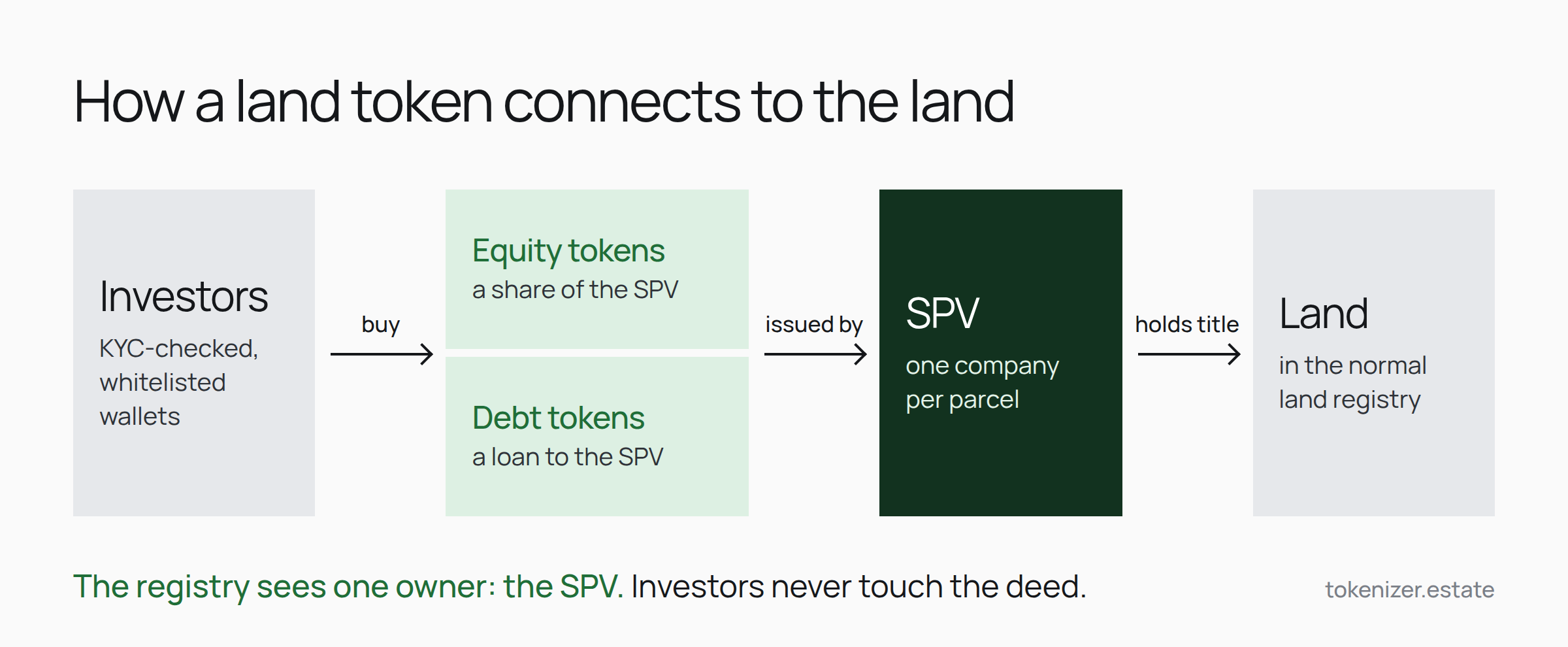
Investors therefore never touch the deed. Equity token holders own a share of the entity that owns the land, and debt token holders are lenders to it. Their rights come from the SPV's operating agreement and the offering documents. When the land is sold, the SPV receives the money and distributes it to token holders. We explain what a property token legally represents in our guide to digital property ownership, and how to choose between an SPV, a trust, and a fund wrapper in this comparison of legal structures.
The SPV model has two practical advantages for land. It can work in many jurisdictions, provided local law allows the SPV to own the land. The registry only sees one owner. And it keeps each parcel's risk separate, so a failed rezoning on one site does not touch investors in another.
Registry-native title tokens: where the government runs the ledger
The second model connects tokens directly to the official title record. Very few places have done this, and the projects differ more than the headlines suggest.
Dubai. In March 2025 the Dubai Land Department launched the pilot of its Real Estate Tokenisation Project and described itself as the first real estate registration entity in the Middle East to implement tokenisation on property title deeds, working with VARA and Dubai Future Foundation. In May 2025 the first project went live through a VARA-licensed platform, offering tokenized shares in ready-to-own properties from AED 2,000, open at launch only to UAE ID holders and settled only in dirhams. In February 2026 the DLD announced a second phase that activated resale transactions for about 7.8 million real estate tokens from 20 February. The DLD projects tokenized property could reach AED 60 billion, about 7% of Dubai's transactions, by 2033.
It is one of the most advanced registry-native systems so far. But note what it covers: completed, ready properties on one government-approved platform. It is not a route for a developer to tokenize a plot and run an entitlement plan.
Georgia. Georgia's National Agency of Public Registry built a system with Bitfury that uploads a hash, or digital receipt, of each land transaction to the Bitcoin blockchain, as a back-end layer to the existing registry. It makes the record harder to tamper with. It does not split land into tradable fractions. People often cite Georgia as a land tokenization example, but it is really a registry integrity project.
Maharashtra, India. In September 2026, Chief Minister Devendra Fadnavis said the state had prepared a draft Maharashtra Digitisation and Exchange of Land Token Asset (DELTA) Act and set up a committee to review it. It is not law yet. Business Today notes that the announcement does not yet say how tokens would correspond to legal ownership, how they would trade, or how investors would be protected.
Our view: registry-native tokens are where land ownership is heading in the long run, and they will make title transfer cheaper and cleaner. But a registry token only records who owns the land. It does not run a rezoning, hold a carrying budget, or negotiate with a homebuilder. For a development or entitlement play, you need an entity that does those things, which means an SPV, even in a jurisdiction with tokenized title deeds.
What not to copy
In May 2025 the President of the Central African Republic announced that more than 1,700 hectares near Bossongo would be offered as land concessions bought with the $CAR meme coin on Solana. Decrypt noted that the decree cited the mining code and that the token was down 92.7% from its peak at the time. Whatever happens to that project, it shows the gap between putting land "on-chain" and giving investors enforceable rights. If a buyer cannot say which legal document gives them their claim, they don't have one.
Valuing land when there is no income
For a building, you start with net operating income and a cap rate. For land, there is no income to capitalize, so valuers rely on two other methods.
Comparable sales. What have similar parcels, with similar zoning and access, sold for recently? This works for land in active markets and is weak for unusual sites or slow markets.
Residual valuation. Estimate what the finished development would be worth, subtract construction costs, fees, finance, and a developer's profit, and what is left is what the land is worth. The UK government's own land value estimates, for example, are built from a residual valuation model and assume a serviced site with planning permission, and the same guidance warns that those figures do not represent market value.
That warning matters for your offering. The residual method is very sensitive. A small change in assumed sale prices or build costs produces a large change in the land value, because land is the number left over at the end. If your offering valuation assumes the land already has approvals it does not have, you are overstating it.
Three rules for a land token valuation:
Value the land as it is today, with its current zoning. Show the entitled value separately as the target, not as the starting point.
Get an independent appraisal at issuance and again at each major milestone, such as approval of the rezoning. Land values jump at milestones, not smoothly over time.
Publish a sensitivity table: what the land is worth at 10% lower sale prices, 10% higher build costs, and a 12-month delay.
We go deeper into appraisal timing and stale NAV in how tokenized property is valued. For land, the lag problem is worse, because nothing happens for months and then everything happens at once.
What land investors need to see
Good disclosure is what separates a land offering from a land-banking scheme. At a minimum, your offering documents should cover:
Title and survey. Title insurance or the local equivalent, a boundary survey, easements, and access rights.
Current zoning and the entitlement plan. What you are applying for, which approvals are needed, from whom, the expected timeline, and what has already been filed.
Physical due diligence. Environmental reports, flood risk, ground conditions, and the distance to water, sewer, power, and roads. Off-site infrastructure is often the cost that kills a land deal.
The carrying budget. Taxes, insurance, consultants, and interest for the planned period, plus a contingency, and what happens if it runs out. Can the sponsor call more capital? Will investors be diluted?
The exit plan and who the buyer is. Named builders with interest, an option agreement, or at least evidence of recent sales of entitled land nearby.
The downside. What the land is worth if the rezoning is refused, and what investors get back in that case.
Sponsor economics. Fees, co-investment, and promote, so investors can see when you get paid relative to them.
Then keep reporting after the raise. With no rent arriving, milestone updates are the only signal investors get that the plan is on track.
Exit paths: how land token holders get paid
Land returns arrive through an exit, so define the exit before you launch. There are five common routes.
Sale of entitled land to a developer or homebuilder. The classic entitlement play. The SPV sells, receives cash, and distributes it to token holders. The smart contract can then redeem the tokens and close the offering.
Phased lot takedowns. A builder buys lots in batches over two or three years. Each takedown becomes a distribution event: the contract takes a snapshot of token holders, and each one is paid in proportion to their tokens.
Joint venture with a developer. The SPV contributes the land as equity in a development JV instead of selling it. Token holders keep exposure to the finished project, with more upside and a longer hold. The offering documents must allow this, or you will need investor consent.
Build-out by the sponsor. The sponsor develops the site itself. The land token becomes the first stage of the capital stack, and a separate construction raise follows. We cover that second stage in how to fund construction with tokens.
Ground lease. The SPV keeps the land and leases it long-term to a developer or operator. A non-income asset becomes an income asset, and token holders start receiving regular distributions.
Secondary trading is not an exit plan. Some investors will want to sell early, and a permissioned secondary market or a buyback window helps. But nobody should invest in a land token expecting a liquid market in a pre-entitlement parcel. Say so plainly in the documents.
Land tokenization is usually a securities offering
In most jurisdictions, selling fractional interests in land that someone else manages for profit is a securities or collective investment offering. The token format changes nothing.
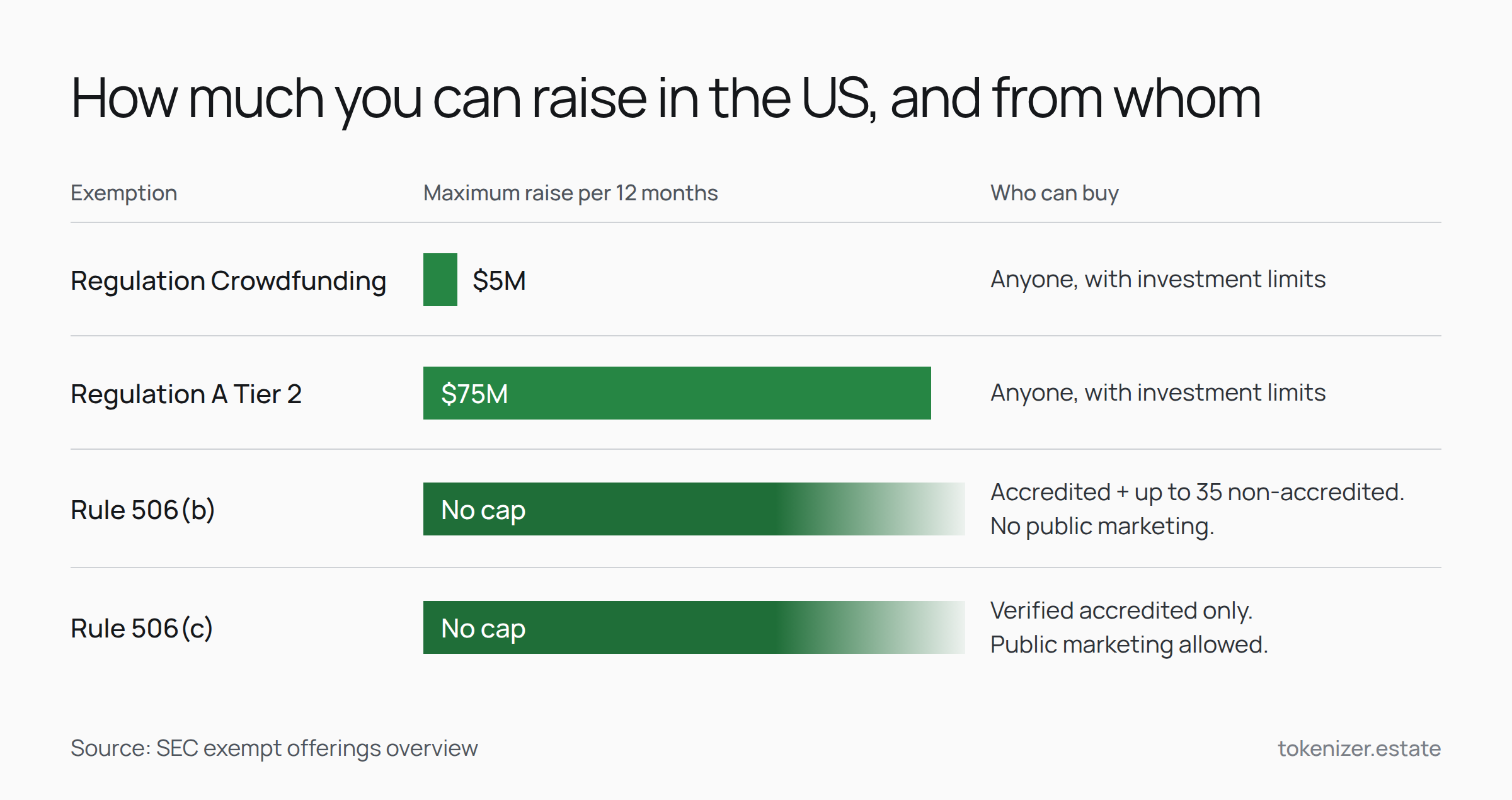
In the US, SEC staff said in a joint statement on 28 January 2026 that the format of a security "does not affect application of the federal securities laws." Most land offerings use one of the standard exemptions. According to the SEC's exempt offerings overview, Rule 506(c) allows general solicitation but only to verified accredited investors, Rule 506(b) allows up to 35 non-accredited investors in a 90-day period without general solicitation, Regulation A Tier 2 allows offerings of up to $75 million, and Regulation Crowdfunding up to $5 million, each over a 12-month period.
In the UK, the Asset Land case is the clearest warning. The FCA has said it does not regulate the sale of land, but it does regulate collective investment schemes, and an operator must be authorized to promote or run one. Giving each investor title to a plot did not help Asset Land. Putting each plot in an NFT will not help either.
In the UAE, Dubai's tokenization project runs with VARA and the DLD inside a defined framework. Elsewhere, assume you need local securities counsel before you write a single line of marketing.
Practically, this means your platform must restrict who can hold the token. Only whitelisted investors who meet the exemption's rules can buy, and transfers to anyone else must fail. That is a technical requirement as much as a legal one.
A worked example: tokenizing an entitlement play
The numbers below are hypothetical, to show the mechanics.
Say a land developer has a 40-acre parcel under contract at $6.0 million on the edge of a growing town. It is zoned agricultural. The plan is to rezone it for 220 single-family lots over about two and a half years, then sell the entitled lots to a homebuilder.
Capital needed | Amount |
|---|---|
Land purchase | $6.0M |
Closing costs | $0.2M |
Entitlement (engineering, studies, legal, application fees) | $0.9M |
Carrying costs (taxes, insurance, maintenance) for 30 months | $0.5M |
Offering and legal costs | $0.3M |
Contingency | $0.4M |
Total equity | $8.3M |
The sponsor puts in $0.8 million and raises $7.5 million through tokens issued by the SPV. No debt, because land loans are expensive and lenders are cautious with unentitled land. The sponsor's $0.8 million and the investors' $7.5 million are repaid first, in proportion to what each put in, followed by an 8% simple annual preferred return. Remaining profit is split 70% to all equity and 30% to the sponsor as a promote.
Now three outcomes, assuming the contingency is spent in each case and selling costs are 3% of the sale price:
Scenario | Sale | Token investors receive | Multiple | Annualized return |
|---|---|---|---|---|
Base: rezoning approved, 220 lots sold at $55,000 per lot after 30 months | $12.1M | about $10.1M | 1.35x | about 12.7% |
Delay: same approval and price, but after 42 months (extra carry covered by contingency) | $12.1M | about $10.3M | 1.37x | about 9.5% |
Denial: rezoning refused, land sold as-is after 30 months | $5.5M | about $4.8M | 0.64x | a loss of about 36% in total (about 16% a year) |
Two things stand out. First, the delay case pays investors slightly more cash, because the preferred return keeps accruing and the sponsor's promote shrinks. The structure protects investors from a slow process, but their annualized return still falls by about three points. Second, the downside is serious. If the rezoning fails, investors lose about a third of their money, because the entitlement budget and carrying costs are gone and the land was bought at a price that assumed some chance of approval.
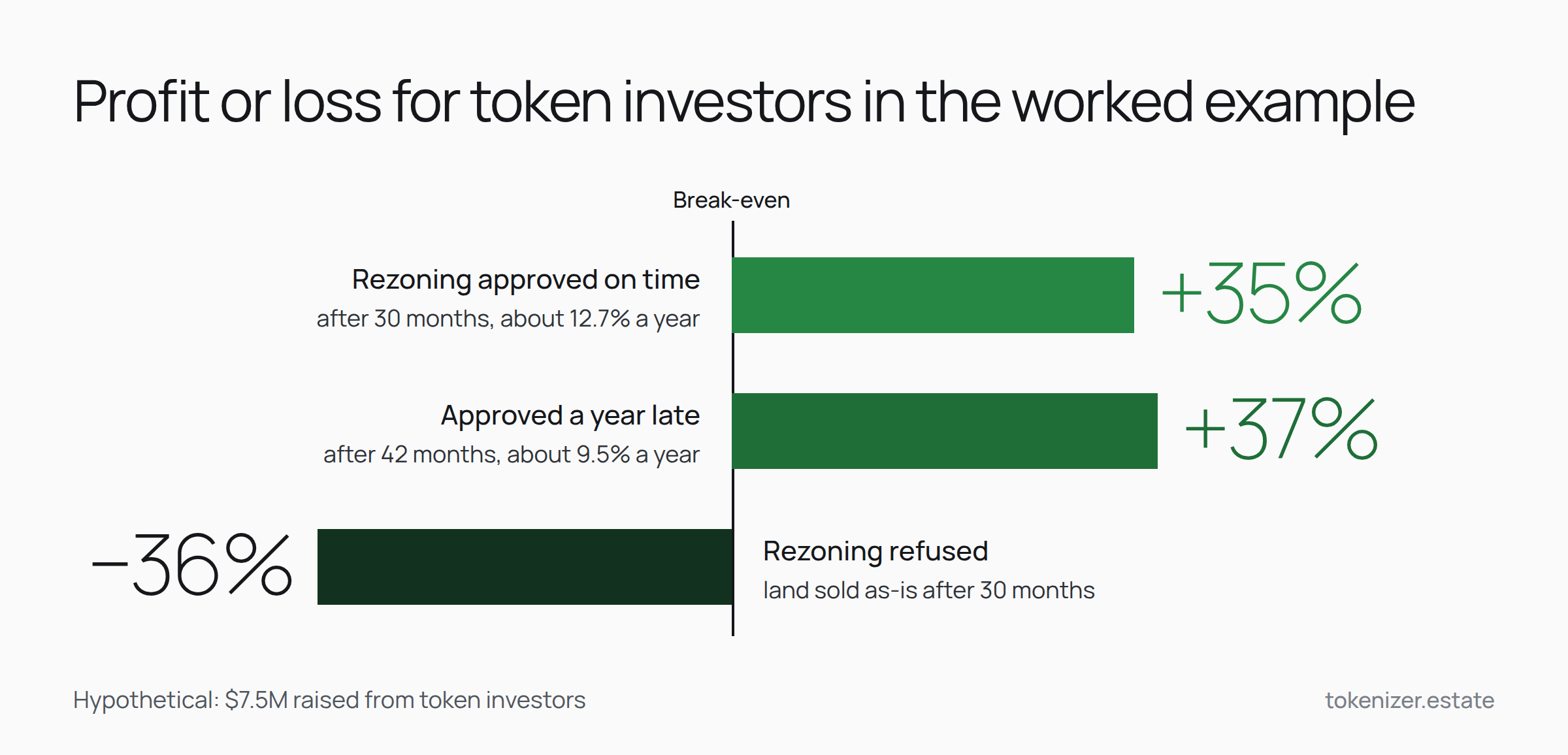
This is the risk you should show investors on page one. A land token offering that only presents the base case is a sales brochure, and in some jurisdictions it is a regulatory problem.
Running a land offering on your own platform
If you are a landowner or land developer with one parcel, a marketplace listing might be enough. If you have a pipeline of sites, or you plan to follow the land raise with a construction raise, you need your own infrastructure under your own brand. This is where Tokenizer.Estate fits.
Land deals have deadlines. An option or purchase contract gives you a fixed window to close. We launch your own branded platform in 2 to 4 weeks. That can be the difference between raising inside your option period and asking the seller for an extension.
Only eligible investors can hold the token. KYC and AML run automatically through Sumsub, and tokens are permissioned ERC-20 on EVM-compatible chains. Transfer rules are written into the token, so only investors who pass your checks can buy or receive it. For a 506(c) offering, accredited status also has to be verified.
Land pays out in events, not monthly rent. The smart contract generator handles token sale stages, holder snapshots for distributions, and token redemption without hiring Solidity developers, and the contracts are audited by Hacken. For a lot takedown, the contract takes a snapshot of holders and each investor is paid in proportion to their tokens. The final sale becomes a redemption that closes the position.
Investors need milestone visibility. The investor dashboard runs under your logo, colors, and domain. Investors buy tokens, track their holdings, and use redemption or buyback options. Your back office handles investor requests, portfolio and transaction monitoring, and audit logs, with role-based access for your team. You keep control of your private keys and funds.
Each parcel needs its own offering page. The landing page builder has more than 30 ready blocks and is SEO optimized, so each new site gets a proper page instead of a PDF.
One platform for a pipeline. Each new parcel becomes a new offering on the same branded platform, with its own page, token and investor list, so your fourth land offering runs on the same setup as your first. Legal structuring is handled by your own counsel or our legal partners. See pricing for the current plans.
If you have a parcel and a plan, book a free consultation and we will walk through how the offering would look on your own platform.
FAQ
Can you tokenize land you already own outright?
Yes. You transfer the land into an SPV, or form the SPV first and have it take title, and the SPV issues tokens. The transfer may trigger transfer tax or capital gains depending on the jurisdiction, so get tax advice before you move title.
Is a land token a security?
In most cases, yes. If investors put in money and rely on a sponsor's work to make the land more valuable, regulators will treat it as a security or a collective investment scheme. The US and UK examples show the same thing: what matters is the rights attached to the token and who manages the investment, not the token format.
Can the token itself be the title deed?
Only where the land registry recognizes it. Dubai is piloting tokenization on title deeds for ready properties. Almost everywhere else, the registry records the SPV as owner and the token represents a share in the SPV or a loan to it.
How do land token holders get paid if land has no rent?
Through an exit: a sale of the land, phased lot sales to a builder, a joint venture, or a ground lease that turns the land into an income asset. Define which one before you raise.
What happens to investors if the rezoning fails?
The SPV usually sells the land as-is or holds it for another attempt, depending on what the documents allow. Investors take a loss in most cases. Your offering should show that scenario in numbers.
How is land tokenization different from farmland tokenization?
Farmland produces income from crops and leases, so it behaves more like a yield asset. General land tokenization is mostly about appreciation from entitlement or development. See our guide to farmland tokenization for that model.
This article is for information only and is not legal, tax, or investment advice. Land offerings are regulated differently in each jurisdiction. Speak to qualified counsel before you raise capital.
Share this post
Build your own tokenization business with Tokenizer.Estate
Tokenizer.Estate provides a full end-to-end solution — from legal setup to blockchain infrastructure — to help you launch your project with confidence
Book a Free Consultation