Real estate syndication: how it works, who gets paid, and how to start one
A syndication pools money from passive investors into one property, run by a sponsor for fees and a promote. This guide is for the sponsor: the legal structure, offering rules in four markets, how the waterfall pays out, and the servicing work that starts after the raise.


A real estate syndication is a deal where one operator (the sponsor) pools money from many passive investors to buy or develop a property none of them would finance alone, then runs it for a fee and a share of the profit. That is the textbook version.
"Syndication" is mostly a US word. The same structure goes by other names elsewhere: a club deal in the UK, Europe and the Gulf, a co-investment when a fund or family office brings partners into one asset, a property syndicate in the UK, a single-asset or deal-by-deal raise in private equity language, and in much of Latin America a real estate trust (fideicomiso) that pools investors into one development. The mechanics in this guide apply to all of them. A joint venture is a close cousin, but there both partners usually take part in decisions, while in a syndication the investors stay passive.
Most syndication guides are written for the passive investor deciding whether to write a check. This one is written for the person on the other side of the table: the sponsor who structures the deal, raises the equity, and then has to service those investors for five to seven years. That sponsor can be a developer funding a project, an operator buying stabilised assets, a fund manager or a family office bringing co-investors into a deal. The mechanics are the same.
We will go through the roles, the legal wrapper, the securities rules, the economics, how first-time sponsors find their first investors, and where the operational load actually sits. Then we will show what changes when you run the same syndication on your own branded tokenization platform.
The economics and the operating load are the same in every market. The securities and tax rules are not, so the legal sections cover the US, the UK, the EU and the UAE side by side.
Key takeaways
A real estate syndication pools money from passive investors into one property, run by a sponsor for fees and a share of the profit. Outside the US the same structure is often called a club deal, co-investment or property syndicate.
In almost every market the investor's interest is a regulated investment. The exemption you choose (Reg D in the US, private-placement and professional-investor routes in the UK, EU and UAE) decides who you can raise from and whether you can market publicly.
Sponsors earn fees for work and a promote for performance. Investors are paid first through the preferred return, and the waterfall decides who gets what at sale.
The hidden cost of syndication is servicing investors for five to seven years: the cap table, distributions, annual tax statements and constant questions.
Tokenization keeps the legal structure but moves the register, onboarding and payout preparation into software, which makes smaller tickets and more investors economical.
How a real estate syndication works: the two sides of the deal
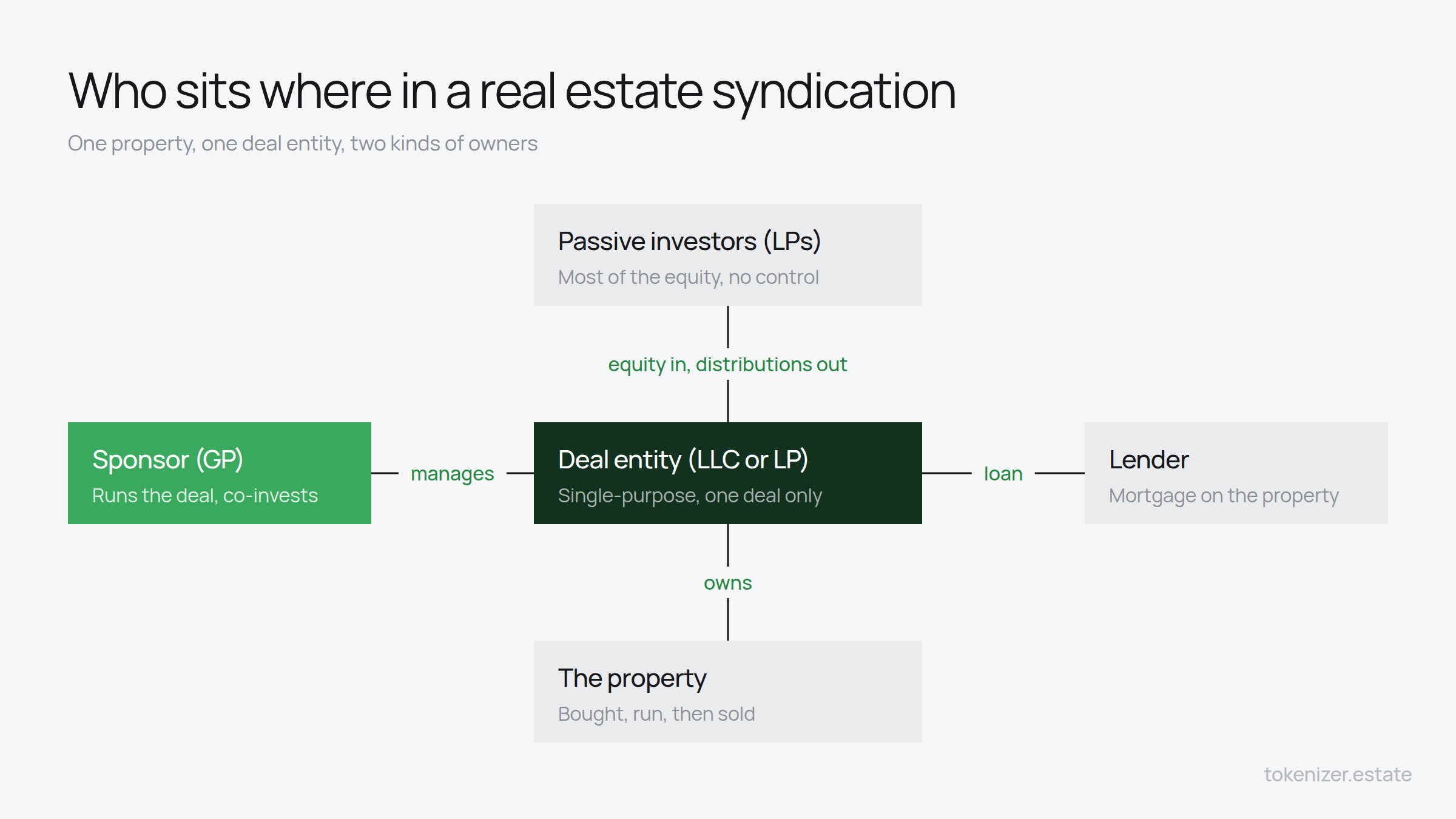
Every syndication has the same basic shape. One party brings the deal and the work. The other party brings most of the money.
The sponsor (GP)
The sponsor, also called the syndicator or general partner, finds the property, negotiates the purchase, underwrites it, arranges the loan, raises the equity, and then manages the asset until it is sold or refinanced. The sponsor signs the loan guarantees when the lender asks for them, hires and supervises the property manager, and makes the decisions. In most deals the sponsor also puts in some of its own money, usually a small share of the equity, so that it has cash at risk next to the investors.
The sponsor is usually not one person. It is a management entity (often an LLC) that serves as the manager of the deal entity. Larger sponsors split the role: one partner finds and runs deals, another raises capital, a third handles finance and reporting.
The passive investors (LPs)
The investors, called limited partners or members depending on the entity type, provide the bulk of the equity. They do not run anything. Their liability is generally limited to what they put in, and in exchange they give up control. They cannot fire the property manager or decide when to sell. What they get is a defined share of cash flow and sale proceeds, set out in the deal documents.
That trade, money for passivity, is the whole product. Investors are buying the sponsor's judgment and effort. This is why every serious LP asks the same first question: what has this sponsor actually sold, and what did investors get back compared with the projections?
The legal structure of a syndication
A syndication is two things at once: a property company and a securities offering. You need both pieces right.
The entity
The deal sits in a single-purpose entity, almost always a limited liability company or a limited partnership, that owns one property (or a small set of related ones). The sponsor's management company is the manager or general partner of that entity. The investors buy membership interests or LP units in it.
How the entity is taxed depends on the market. In the US it is usually a partnership for tax, so income, losses and depreciation pass through to investors, who each get a Schedule K-1 every year. In other markets the vehicle may be taxed itself, or investors may be taxed only on what they receive. Either way, every investor needs an annual statement of their share, and producing those statements becomes one of the biggest operating headaches later.
The documents
Operating agreement (or LP agreement). The rulebook. It sets the manager's powers, what decisions need investor votes, how capital calls work, the fee schedule, the distribution waterfall, transfer restrictions, and what happens if the sponsor is removed.
Private placement memorandum (PPM). The disclosure document. Business plan, risk factors, sponsor background, conflicts of interest, use of proceeds, and the terms of the securities.
Subscription agreement. What each investor signs to buy in. It includes the investor's representations, including whether they qualify for the offering (accredited, professional or qualified, depending on the market).
The securities rules: who you can raise from, market by market
Why a syndication is a regulated offering
An interest in a syndication is, in almost every major market, a regulated investment. Investors put in money, expect a profit, and rely on the sponsor's efforts to get it. In the US that makes it a security. In the UK it is usually a collective investment scheme. In the EU it can be both a transferable security and an alternative investment fund. The labels differ, but the consequence is the same: you either follow a full public-offering regime, which nobody does for a single property, or you use an exemption that limits who you can raise from and how you can market the deal.
That choice is the first real strategic decision in a syndication.
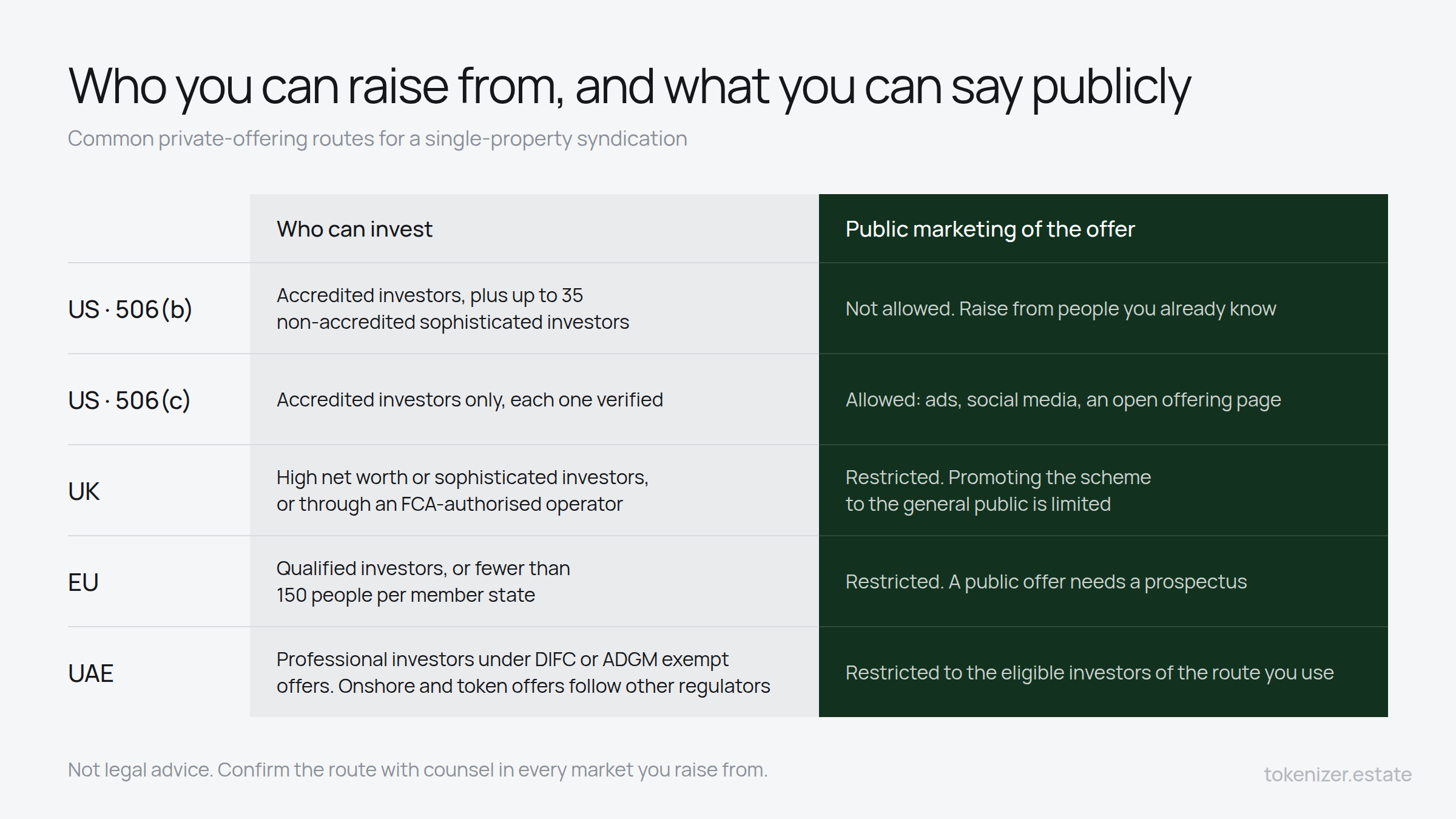
United States: Reg D 506(b) vs 506(c)
Almost every US syndication uses Regulation D, Rule 506.
506(b) suits sponsors raising from people they already know. You cannot post the deal on LinkedIn, run ads or put an open offering page on your website. 506(c) lets you market openly, but every investor must be accredited and you must verify it. Since a March 2025 SEC staff letter, a high minimum investment combined with written representations can be part of that verification.
Accredited, for individuals, means net worth over $1 million excluding the primary residence, or income over $200,000 ($300,000 with a spouse or partner) in each of the past two years.
United Kingdom
Pooling investors' money into a property they do not control day to day is usually a collective investment scheme, and the FCA regulates collective investment schemes even when the underlying asset is land. Operating one needs FCA authorisation, and promoting it to the general public is restricted, so most UK syndications are offered only to investors who qualify as high net worth or sophisticated, or are run through an authorised operator. The UK Supreme Court applied the collective investment scheme rules even to schemes where investors held title to their own plots of land.
European Union
A vehicle that raises money from several investors to invest under a set strategy is often an alternative investment fund, so its manager needs authorisation or, for smaller managers in many member states, a lighter registration. Offering the units also falls under the prospectus rules, with exemptions for offers made only to qualified investors or to fewer than 150 people per member state. The EU framework for property token issuers covers what changes when the units are tokens.
United Arab Emirates
The answer depends on where the vehicle sits. The DIFC and ADGM free zones have their own financial regulators with exempt-offer regimes for professional investors, onshore offers fall under the federal securities regulator, and tokenized offerings in Dubai add VARA. Our UAE jurisdiction guide walks through the options.
The decision in every market
The trade-off is the same everywhere. Raise privately from people you already know, with less paperwork and no public marketing, or use a route that lets you market more widely to a verified, eligible pool. If your network can fill the raise, the private route is simpler. If it cannot, choose the wider route from day one, because switching mid-raise is hard once you have already talked to people quietly. If your investors sit in several countries, each investor's home rules matter too, so confirm the route with counsel in every market you raise from.
Real estate syndication economics: who gets paid, and when
Syndication pay comes in two buckets: fees for work and a promote for performance. Fees are paid regardless of outcome. Good LPs read the fee section first, because fees are what the sponsor earns even when the deal goes sideways.
The fees
Ranges vary by market, asset type, deal size, and sponsor experience. As one benchmark from US deals, Committed Capital (January 2025) gives these:
Acquisition fee: 1% to 3% of the purchase price, paid at closing, for sourcing and underwriting the deal.
Asset management fee: 1% to 2% of invested equity per year, for overseeing the property and handling investor relations. Some sponsors charge it on gross revenue instead.
Disposition fee: 1% to 2% of the sale price.
Refinancing fee: 1% to 2% of the new loan amount.
Development or construction management fees, loan guarantee fees, and in-house property management fees show up in some deals. Every one of them should be in the operating agreement, in numbers, not in vague language.
The preferred return and the promote
The preferred return ("pref") is the return investors receive before the sponsor shares in profits, commonly expressed as an annual percentage on contributed capital. It is a priority, not a guarantee. If cash flow falls short, a cumulative pref accrues and must be caught up later before the sponsor gets its share.
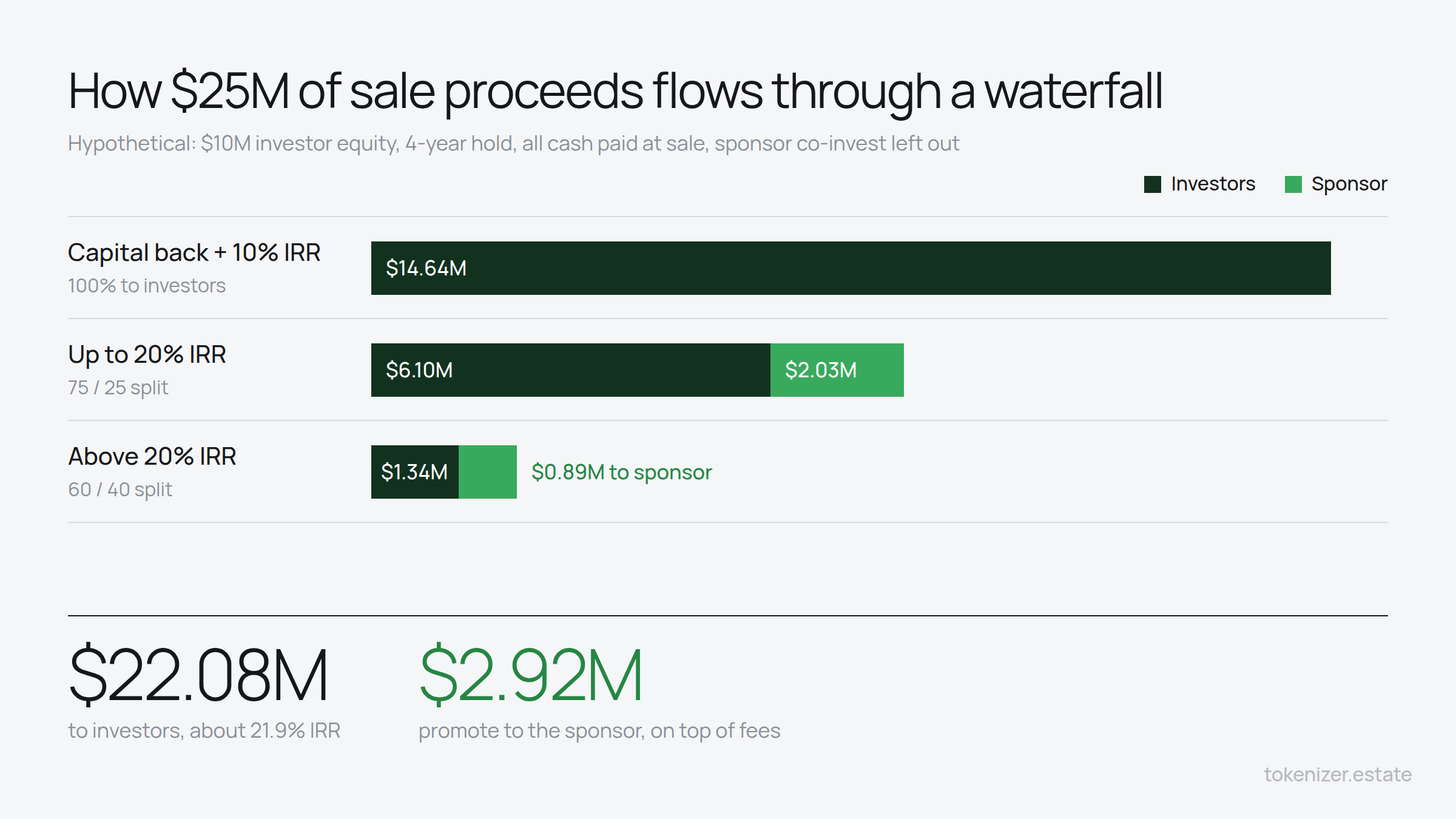
The promote is the sponsor's disproportionate share of profits once a deal clears a set return threshold. It is the real estate version of carried interest. A simple deal has one split above the pref (say 70/30 or 80/20). A more complex deal has tiers. A typical example pays all investors pro rata until they get their capital back plus a 10% IRR, then splits 75/25 until investors reach a 20% IRR, then 60/40 above that.
The order in which money flows through these tiers is the waterfall. This is why investors push for lower fees and a higher co-invest, and why sponsors with a track record can ask for a bigger promote: their pay is tilted toward performance, which investors like.
How to start a real estate syndication: finding your first LPs
Our existing guide on how to raise capital for real estate compares syndication with joint ventures, funds, crowdfunding, and tokenization. Here we assume you have chosen syndication and need the first check. The order of steps matters.
Get a deal under contract you can actually defend. Investors back deals and people, not strategies. A real address and a conservative underwriting model beat a deck about "value-add multifamily in the Sun Belt."
Hire securities counsel before you talk to anyone about investing. The exemption you choose controls what you are allowed to say and where, both in your home market and in the countries your investors live in. Counsel also drafts the operating agreement, offering memorandum and subscription documents, and makes any required filings.
Build relationships before the offering, not during it. Private-placement rules in most markets favour people you already know. In the US, for a 506(b) raise, the SEC staff treats a pre-existing, substantive relationship as one way to show you are not generally soliciting. "Pre-existing" means formed before the offering starts; "substantive" means you know enough about the person's finances and sophistication to judge them. Self-certification alone by checking a box is not sufficient (C&DIs 256.26–256.31). Practically: start a mailing list, publish market commentary, host dinners and webinars long before you have a live deal. The SEC staff notes that information not involving an offer of securities can be shared widely (C&DI 256.24).
Put your own money in, and say how much. Your co-invest is the cheapest credibility you can buy.
Borrow a track record if you do not have one. Many first-time sponsors co-GP with an experienced operator who signs the loan and lends credibility, in exchange for a share of fees and promote.
Choose a route that allows wider marketing if your network cannot fill the raise. In the US that is 506(c). Elsewhere it may mean offering to verified professional or qualified investors, or working through an authorised operator. Either way, your onboarding has to check eligibility cleanly.
Talk to counsel before paying anyone to introduce investors. Paying transaction-based compensation to people who bring in investors raises broker-dealer questions you want answered before you sign anything.
One more note. In most markets the rules change once the number of investors passes certain thresholds, so check those limits with counsel before you plan for hundreds of small tickets.
The part nobody puts in the pitch deck: running the syndication
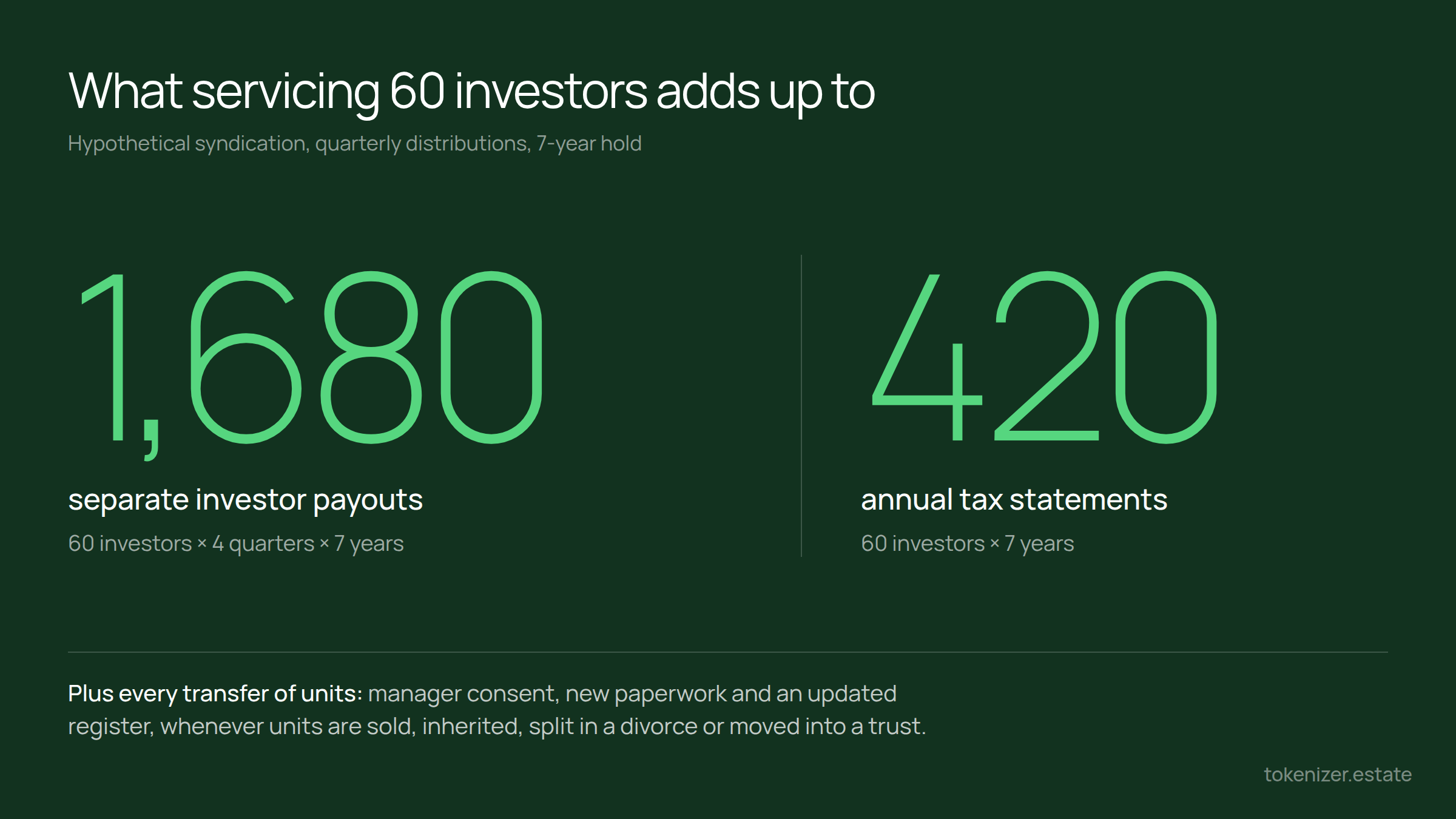
Closing the raise is the start. You will now service those investors for the whole hold period, and in a traditional setup almost all of it is manual.
The cap table
Each investor's capital account has to be tracked: contributions, distributions, accrued pref, and ownership percentage. It changes every time someone transfers an interest. Investors die, divorce, move units to a trust, or roll them into a self-directed IRA. Each change needs the manager's consent under the operating agreement, new paperwork, and an updated register. In many syndications that register is a spreadsheet.
Distributions
Every quarter someone calculates what each investor is owed under the waterfall, checks it against accrued pref, collects updated bank details, and sends dozens of ACH transfers or wires. One wrong account number turns into a week of email. When a refinance or sale happens, the waterfall calculation gets harder and the stakes get higher.
Annual tax reporting
Every investor needs a yearly statement of their share of income, and the deadlines are strict. In the US, a partnership files Form 1065 and issues a K-1 to every investor. For calendar-year partnerships the return is due by March 15, and late filing is penalised per partner for every month it is late. Other markets have their own forms and deadlines, but the input is the same everywhere: clean capital account data is what makes the accountant fast.
Running a real estate syndication on your own tokenization platform
Tokenization does not replace syndication. You still have an SPV, an operating agreement, an offering exemption, a pref, and a promote. What changes is the plumbing: the investor register, onboarding, payout preparation and transfers move from spreadsheets and email to software and smart contracts. Our tokenization vs syndication comparison covers that trade-off head to head. Here is how it maps onto the specific pains above, using Tokenizer.Estate as the example.
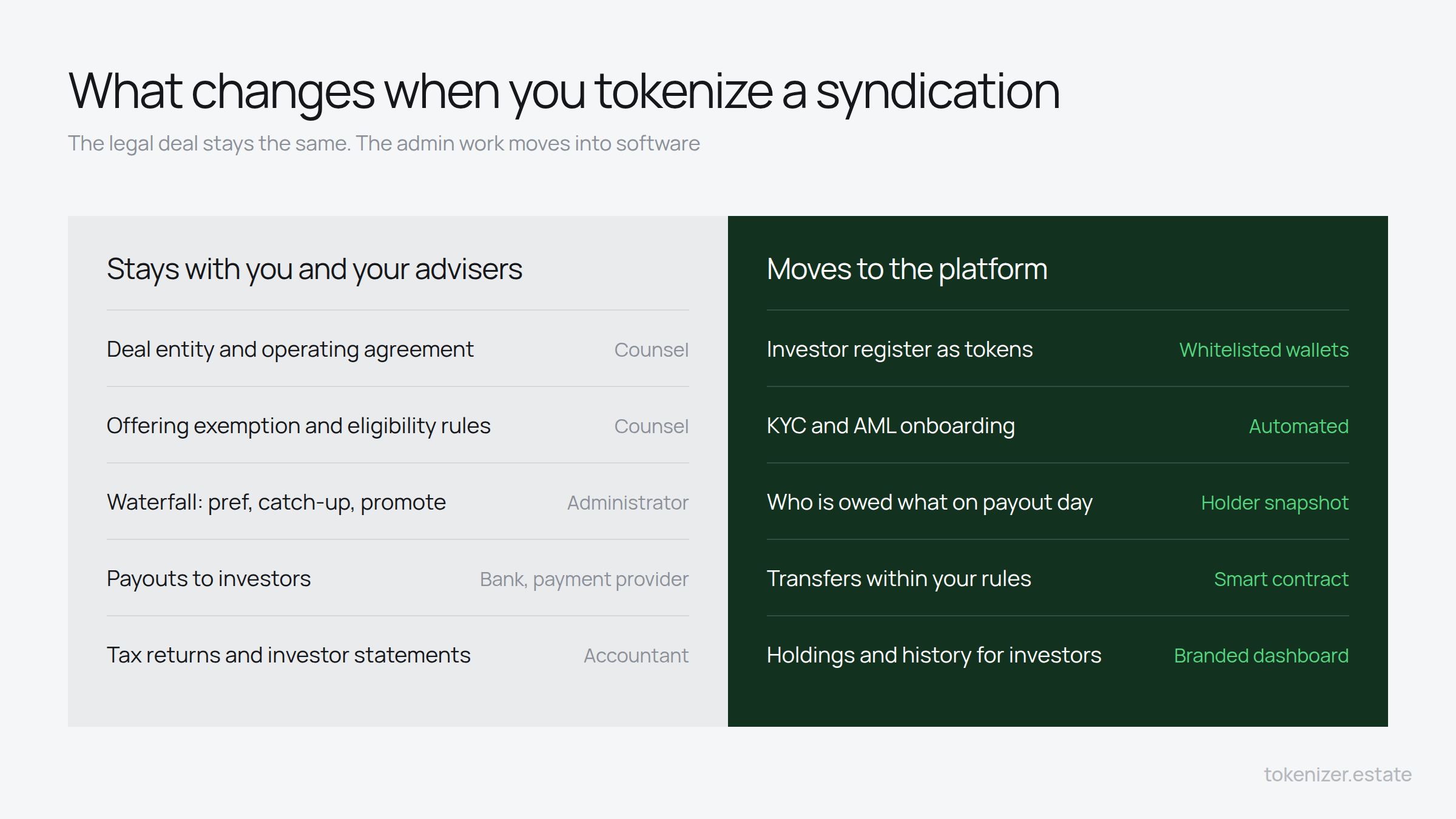
The cap table becomes the token register. Each LP interest is represented by permissioned ERC-20 tokens on an EVM-compatible blockchain. Permissioned means only whitelisted wallets of KYC-cleared investors can hold or receive them, so the transfer restrictions in your operating agreement are enforced by the token, not by a manager checking emails. The register is always current, and it is the data your accountant needs for the annual tax statements.
Onboarding stops being a PDF chase. KYC and AML checks run automatically through Sumsub. Investors subscribe and pay through a dashboard, with both traditional payment providers and crypto payments supported. Your eligibility checks (accredited, professional or qualified, depending on the market) still have to meet the local standard, but they plug into a digital flow instead of an inbox.
Distributions start from a snapshot. The smart contract generator handles token sale stages, holder snapshots for distributions, and token redemption without you hiring Solidity developers. The contracts are audited by Hacken. On each distribution date the contract records who holds how many tokens. You or your administrator still calculate the waterfall under the operating agreement (pref, catch-up, promote) and fund each tier, and payouts go by bank transfer or payment provider. What changes is the prep work: instead of rebuilding a spreadsheet and checking every holder's balance by hand, you start from a list that is already correct, whether you have 60 holders or 600.
Investors serve themselves. Each investor sees their holdings and history in a dashboard carrying your logo, colours, and domain, not ours. Where your documents allow it, they can use redemption or buyback options instead of emailing you to ask how to exit. That is a real answer to "can I sell my units?", subject to the restrictions your counsel sets.
Your team sees everything in one place. The back office covers portfolio and transaction monitoring, investor request handling, analytics, role-based access, and audit logs. Private keys are stored on separate secure infrastructure.
Marketing fits the exemption you chose. The landing page builder has 30+ ready blocks, SEO optimisation, and light and dark modes. If your route allows public marketing (506(c) in the US, for example), you can publish the offering page openly. If it does not, keep offering details behind login for investors you already know, and use the public pages for content and education only.
A wider investor base becomes economical. When servicing an investor costs very little, you can set lower minimums and accept more, smaller checks from eligible investors at home and abroad, instead of chasing a handful of $100,000 tickets. The securities rules do not change. The economics of who you can afford to serve do.
A branded platform launches in 2–4 weeks, and each new syndication runs on the same platform as the last one. Legal structuring stays with your own counsel.
If you syndicate deals today, the funds use case and the property developers use case show how the platform maps to each structure. Or book a free consultation and walk through how your next deal would run on it.
One honest limit: tokenization does not remove tax reporting. Your vehicle still files its returns and issues investor statements. What it removes is the reconciliation work that makes tax season painful. Secondary liquidity also depends on regulated venues and real buyers, not on the token itself. We cover that in our guide to fractional real estate.
Real estate syndication FAQ
What is a real estate syndication in simple terms?
A group purchase of property run by a professional. A sponsor finds and manages the deal; passive investors provide most of the equity through an LLC or LP and share in the cash flow and sale proceeds according to the operating agreement.
How do real estate syndicators make money?
Through fees (acquisition, asset management, disposition, sometimes refinancing and construction management) and through the promote, a share of profits above the investors' preferred return. Most also earn a return on their own co-investment.
Do investors need special status to invest in a syndication?
Usually, yes. Most syndications use private-offering exemptions limited to accredited, professional or qualified investors, depending on the market. In the US, a 506(c) deal is limited to verified accredited investors, while a 506(b) deal can also admit up to 35 non-accredited but sophisticated investors in any 90-day period.
How much money do you need to start a real estate syndication?
There is no legal minimum. You need enough to cover legal costs for the offering documents, deposits and due diligence on the property, and a meaningful co-investment. Lenders will also look at the sponsor's net worth and liquidity when the loan requires a guarantee.
Can a syndication advertise on social media?
Only if the exemption you use allows it. In the US that means Rule 506(c), where every investor must be verified as accredited. In the UK and the EU, promoting an investment scheme to the general public is restricted, so public posts are usually limited to general content rather than the offer itself.
How is tokenization different from a syndication?
A tokenized deal is usually still a syndication legally: an SPV, an offering exemption, a waterfall. The ownership record lives on a blockchain instead of in a spreadsheet, which lowers servicing costs and allows smaller tickets. Our guide to real estate security token offerings covers how that offering is structured and filed.
This article is for information only and is not legal, tax, or investment advice. Securities rules, tax deadlines, and penalty amounts change; confirm the current requirements with qualified counsel and a tax adviser before structuring an offering.
Share this post
Build your own tokenization business with Tokenizer.Estate
Tokenizer.Estate provides a full end-to-end solution — from legal setup to blockchain infrastructure — to help you launch your project with confidence
Book a Free Consultation