Which assets are suitable for tokenization, and how to check yours
Before any token is issued, we ask every owner the same question. The answer matters more than the structure, the jurisdiction or the technology, and it explains why some assets find investors fast while others wait for years. Here is that question, and how to check your own asset.

The assets suitable for tokenization are the ones that would attract investors even without a token: an asset that already earns a strong income, or one people want to own for its name. Tokenization is a way to split ownership of that asset into shares and run the investor side on software. It does not create demand. If nobody would buy a stake in the asset on paper, nobody will buy it on a blockchain either.
We say this to every owner who comes to us, and we have said it for years. It is also the reason we turn down a large part of the projects we are offered.
Key takeaways
Tokenization structures a deal. It does not find buyers for it.
Two kinds of assets work: boring ones that earn 10% or more a year in US dollars, and iconic ones people want to say they own.
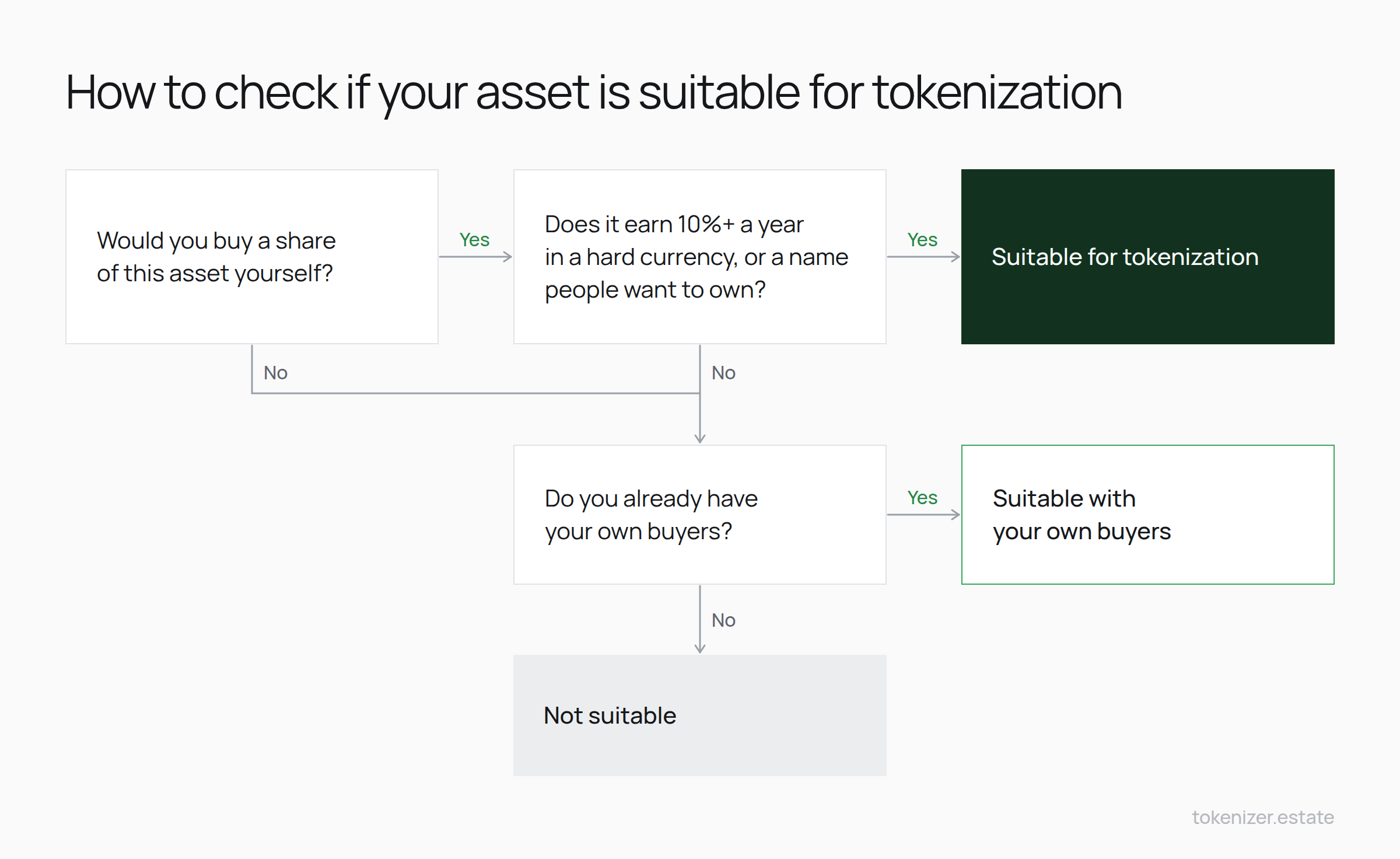
The first test is one question to the owner: would you buy a share of this yourself?
The exception is an owner who already has buyers and only needs the structure.
For a good asset, tokenized equity works as an alternative to a bank: capital for expansion in exchange for a share of the income.
Why tokenization does not sell an asset
This is not the most comfortable thing for a tokenization company to say, but it is true: most tokenization projects never raise much, and many never launch at all. We see these cases all the time, in our own market research and in the projects that come to us after trying elsewhere. They tend to fail for the same reasons, and that is exactly what tells us how to make a project work. The pattern behind those failures is older than tokenization.
A large share of the industry came out of crypto, and it carried over the logic of the 2017–2018 ICO boom: announce a token and money will follow. For a short while it did. A Boston College study of 2,390 ICOs completed before May 2018 found that only 44.2% of the projects were still active four months after their token sale. Most had a white paper, no product and no income.
The same logic, applied to real-world assets, produced client lists full of beauty salons, small workshops, mining claims and service firms. Assets that had trouble finding investors before tokenization had the same trouble after it.
Regulators frame it the same way. In July 2025 SEC Commissioner Hester Peirce called tokenization "enchanting, but not magical", and in January 2026 SEC staff confirmed that tokenizing a security does not change its legal status or the rules around it. The asset and the deal are what investors buy. The token is how the deal is recorded.
If you want the longer history, we compare the two models in tokenization vs ICO.
The one question: would you buy a share yourself?
Before we talk about structure, jurisdiction or technology, we ask the owner one thing: if this were someone else's asset, would you buy a part of it?
The question sounds simple, but it filters out most weak projects in a minute. An owner knows the real income, the real risks and the real condition of the asset better than any investor ever will. If they hesitate, an outside investor will hesitate more, and no token design changes that.
If the answer is no, we say we cannot help, and we say it directly. We have tried launching projects with weak assets. They did not raise.
If the answer is yes, the next questions are practical: what the asset is, what it earns, and how real it is. That means a presentation, financial statements, title or ownership documents, and the operating history. The asset passes or fails on those papers, before any token exists.
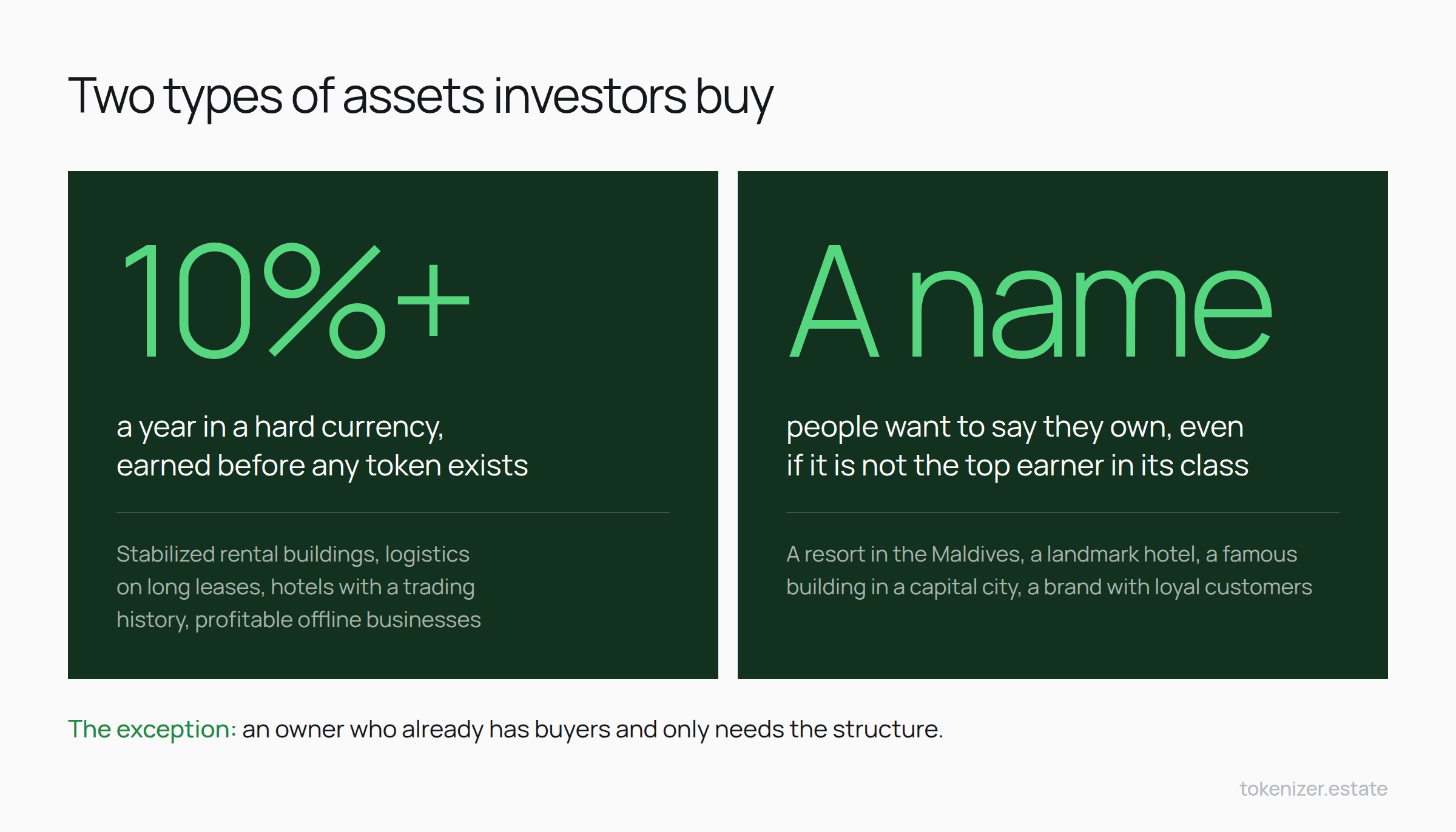
Suitable asset type 1: boring assets that earn real money
The first kind of asset suitable for tokenization is unexciting on purpose. A stabilized rental building, a logistics warehouse on long leases, an operating hotel with years of trading history, a profitable offline business with audited accounts. Nobody talks about these at dinner, but they pay.
Our working threshold is an asset that already earns 10% or more a year in US dollars, or the equivalent in another hard currency such as pounds or euros, before any token is issued. That is a qualification bar for the asset, not a return anyone is promised. The reason for the bar is what investors can get elsewhere without effort:
Benchmark (October 2026) | Approx. yield |
|---|---|
US 10-year Treasury | about 5.1–5.3% |
Tokenized US Treasury funds, average 7-day yield (late September) | about 3.5% |
UK Bank Rate | 3.75% |
Sources: US Treasury and Bank of England rates as of mid-October 2026; tokenized fund yield per rwa.xyz, late September 2026. Figures vary by methodology and date.
An investor can hold government paper for around 5% with almost no risk. A private asset with less liquidity, more work and more risk has to clear that by a wide margin to get attention. Around 10% in dollars, it starts to interest not only smaller investors but larger ones too, including family offices and funds looking for steady income outside public markets.
Currency matters as much as the number. A double-digit yield in a currency that loses value every year can end up below a Treasury bill for a dollar-based investor. That is why we look at income in hard-currency terms, not in the local headline rate.
The same logic holds outside the US. A UK income asset that pays a high single-digit or double-digit net yield in pounds stands well above any bank deposit in the country, and that gap is what makes the raise work.
Suitable asset type 2: assets people want to own for the name
The second kind of asset may not be the most profitable in its class, but it is recognizable and people want a piece of it. A resort on an island everyone has seen in photos, a landmark hotel, a famous building in a capital city, a brand with loyal customers.
For these assets, the reason to invest is partly emotional, and that is fine. A person in a small town anywhere in the world may never buy a villa in the Maldives. Owning a share in a Maldives resort, and being able to tell friends about it, is a different proposition. The investor is not a customer of the hotel, but a partner in it.
Large developers see the same thing. In February 2026, Dar Global, a listed developer, announced a tokenized offering linked to a branded resort it is building in the Maldives: about 100 beach and overwater villas, scheduled to open in 2030. The first offering is not a share in the villas. It gives eligible accredited investors income from the development loan at a fixed rate. The resort is years from opening, and the deal still draws attention because of what and where it is.
An image asset still needs a sound structure and honest numbers. The name gets investors to look. The documents decide whether they stay. We cover how hotel deals are structured in tokenized hotels.
The exception: you already have buyers
There is one case where we work with an asset that would not pass on its own: the owner already has a sales channel. A developer with a database of past buyers, a fund manager with investors who back every deal, a business with a community of loyal customers who want a stake.
Here the owner is not asking tokenization to find investors. The investors exist. What the owner needs is a clean structure, compliant onboarding, a register of holders and a way to run distributions without spreadsheets. That is a software and structuring job, and it is a legitimate one.
The question we ask changes from "would you buy a share?" to "who exactly will buy, and how do you reach them?". If there is a concrete answer, we can work. If the answer is "tokenization will bring them", we are back to the ICO logic.
Assets that are not suitable for tokenization
The assets that fail tend to look alike. These are the ones we decline, or accept only when the owner has their own buyers:
Small, unremarkable assets. A single average apartment or a small workshop. Legal and compliance costs stay roughly flat whatever the deal size, so they eat the economics, and there is nothing to make an investor choose this deal over a hundred others.
Businesses without stable income. An idea, a start-up, a business that may become profitable later. This is the ICO model with a different label.
Online businesses and services sold as "real-world assets". They can be good businesses, but the token adds nothing that equity crowdfunding or a venture round would not.
Assets the owner would not buy. If the person who knows the asset best does not want it, the market will not either.
Assets with unclear ownership. No clean title, disputed rights, or an asset the issuer does not fully control. This is where the most expensive failures in the industry came from.
The opposite case shows how much the asset matters. When Dubai Land Department ran the first listing of its tokenization pilot, the property, a two-bedroom apartment in Business Bay, was offered at AED 2.4 million against a DLD valuation of AED 2.89 million. It drew 224 investors and was funded within a day, as The National reported. Investors responded to a well-priced asset in a market they trusted. The token was how they bought it.
Tokenization as an alternative to a bank
For a good asset, the honest way to describe tokenization is this: it lets the owner bring in additional capital, usually for expansion, in exchange for a share of the asset and its income. In that sense it competes with a bank loan more than with a crypto launch.
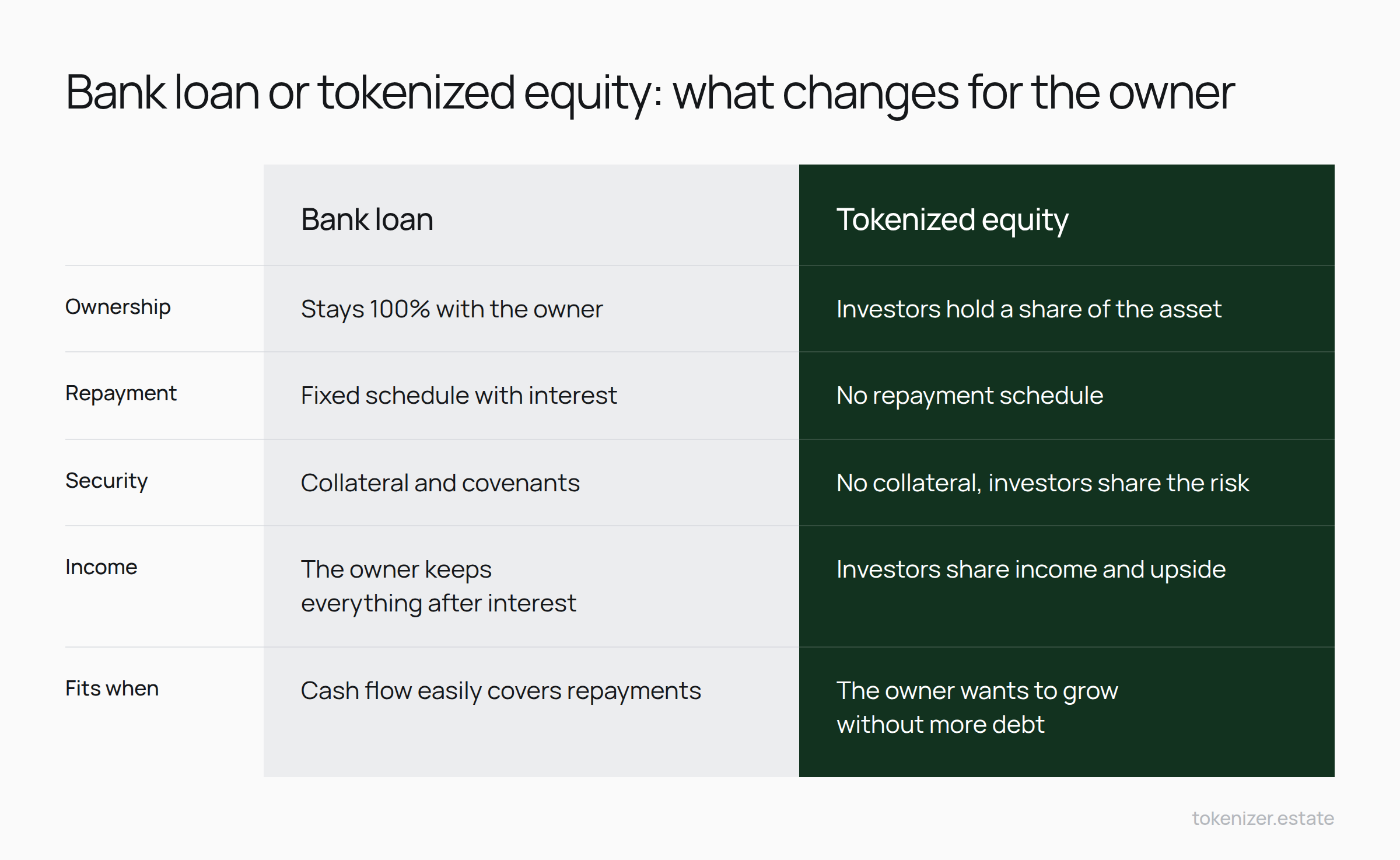
The trade-off is clear. A loan keeps full ownership with the owner but comes with fixed repayments, collateral and covenants. Equity raised through tokenization has no repayment schedule, but investors share the income and the upside. Bank credit is available in 2026 for the right borrower: the Federal Reserve's July survey of loan officers showed easier standards for commercial real estate loans. Tokenized equity makes sense next to that, not instead of it, when an owner wants to grow without adding debt, or when the bank's terms do not fit the plan.
What we actually do is closer to fractionalization than to crypto: a real asset or business is placed in a legal structure, usually an SPV, and its shares are issued and administered as tokens. We compare the main legal wrappers in SPV, trust or fund.
When an asset passes, the conversation moves to structure: the legal wrapper, the investor terms and how distributions will run. For more on cost, timelines and execution models for property, see property tokenization: costs, fit and who should do it.
On Tokenizer.Estate
Tokenizer.Estate provides the white-label software layer for real estate tokenization: token issuance, investor onboarding, and automated distributions under your own brand, with the legal structuring left to your own counsel. If you have an asset and want an honest view on whether it fits, book a free consultation.
FAQ
Which assets are suitable for tokenization?
Assets that would attract investors without a token: income assets earning roughly 10% or more a year in US dollars or another hard currency, and recognizable assets people want to own for the name. Assets with weak income or unclear ownership are not suitable, unless the owner already has buyers.
Can tokenization help me find investors?
Not by itself. Tokenization structures ownership and automates the investor side. Investors come because of the asset and the deal terms. A token makes a good deal easier to run, not a weak deal easier to sell.
Is tokenization an alternative to a bank loan?
For a good asset, yes. It raises equity for a share of the asset and its income, with no fixed repayment schedule. Many owners use it next to bank debt rather than instead of it.
Can any business be tokenized?
Technically, almost any. Commercially, only those with stable income or a strong name. Online services and early-stage start-ups rarely gain anything from a token that equity crowdfunding or a venture round would not give them.
What if my asset is average but I have my own buyers?
Then tokenization can still make sense as structure: compliant onboarding, a register of holders and automated distributions for investors you bring yourself.
Disclaimer: This article is for information only and is not legal, tax or investment advice. Yield and market figures come from the sources named and vary by methodology and date. Speak to qualified counsel before structuring any offering.
Share this post
Build your own tokenization business with Tokenizer.Estate
Tokenizer.Estate provides a full end-to-end solution — from legal setup to blockchain infrastructure — to help you launch your project with confidence
Book a Free Consultation